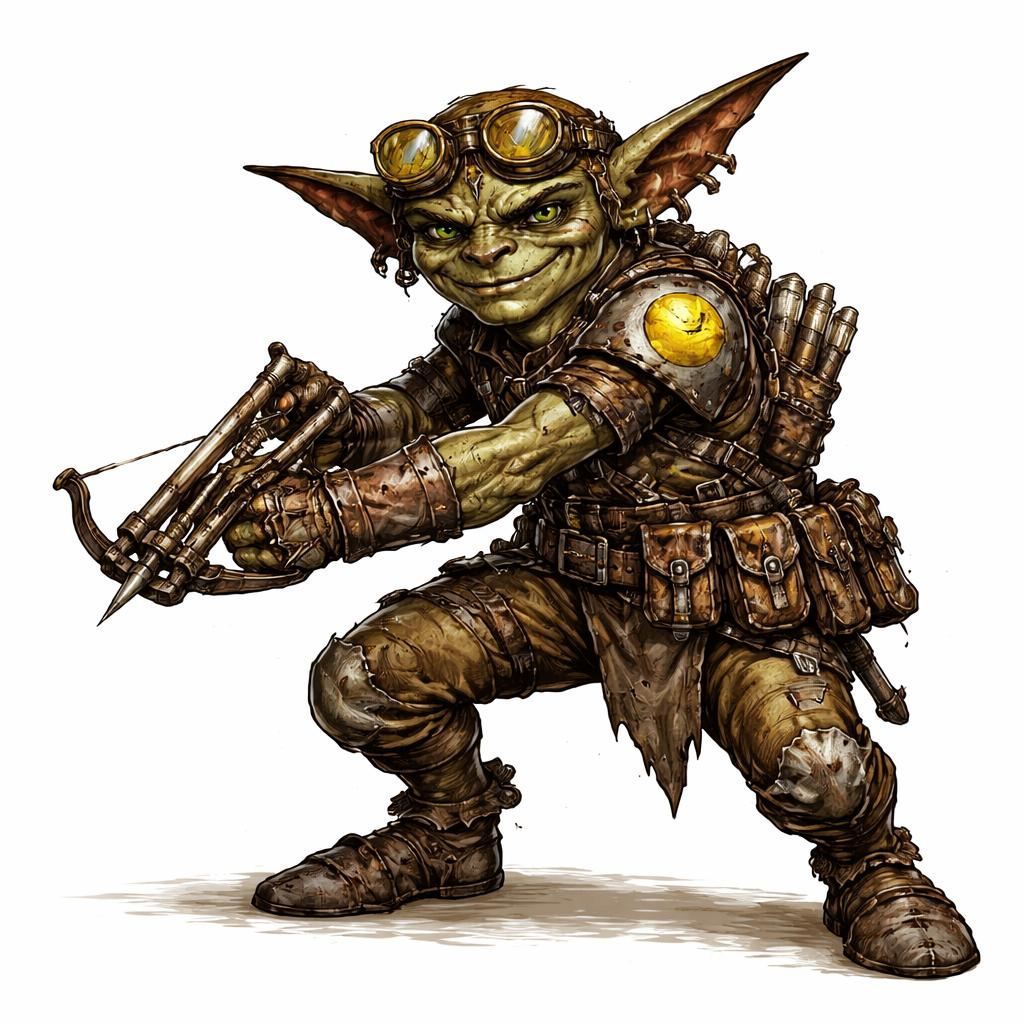

Wheelwatch Goblin Archer
Small Humanoid (Goblinoid), Chaotic Evil
Armor Class: 12
Hit Points: 9 (2d6 + 2)
Speed: 30ft
Challenge Rating: 1/4 (50 XP)
| STR | DEX | CON | INT | WIS | CHA |
|---|---|---|---|---|---|
| 8 | 14 | 12 | 10 | 8 | 8 |
Saving Throws: none
Skills: Stealth +4
Damage Vulnerabilities: none
Damage Resistances: none
Damage Immunities: none
Condition Immunities: none
Senses: darkvision 60ft, passive Perception 9
Languages: Common, Goblin
Actions & Abilities
Shortbow: Ranged Weapon Attack: +4 to hit, range 40/160 ft, one target. Hit: 1d6+2 piercing damage.
Dagger: Melee Weapon Attack: +2 to hit, reach 5 ft, one target. Hit: 1d4+1 piercing damage.
Nimble Escape: The goblin can take the Disengage or Hide action.
Appearance
Against a stark white background, a goblin archer stands a compact 3 to 3.5 feet tall, wiry and ready. The silhouette is lean and slightly crouched, as if forever poised to pivot and strike from the wheel’s frame. One foot braced on a spoke, the other tucked for a swift shift, they read the space like a clock: deliberate, precise, inevitable. A forearm-mounted shortbow rides along the arm when not in use, while a thigh-quiver holds spare bolts within easy reach. A belt and pouches reveal a tinkerer’s toolkit—tiny clockworks and riveted gadgets peeking from leather—and the whole figure seems built to fight and fix in the same breath.
Color and surface catch the lamp’s glow: skin olive to muted green, dulled by damp, mill grime, with greased streaks that mark arms and face from constant tinkering. Leather armor in greens and browns is patched and reinforced with rivets, its surface bearing years of repair. Brass and iron accents gleam softly, catching light with every measured shift. A pale yellow emblem—reminiscent of a lemon’s relief—rests on a worn badge or patch, a quiet nod to a hidden latch and a broader heraldry of loyalty to the Goblin Defense Force. In lamplight, grease and mill oil cling to fabrics and metal, giving a slick, reflective sheen that accentuates the gadgets at the belt and the small tools tucked at the waist.
Face and expression are a study in sly calculation. The goblin’s sharp, goblin-lean features include a flat nose and a wily mouth that plays at a constant, knowing grin. Eyes blaze amber-green, bright and alert, often narrowed behind brass-rimmed goggles perched over the brow. Long, pointed ears bear scratches and oil smudges, framing a face that looks perpetually three steps ahead. When they smirk, a few yellowing teeth show—a hint of menace tempered by cleverness.
Limbs tell the tale of deft control. Arms are long and slender, fingers nimble as tweezers and bolts, ready to coax a tiny clockwork into life or nudge a bolt into place. The forearm-mounted shortbow is a signature touch, a weapon that doubles as a poseable extension of the limb, while the thigh-quiver keeps a spare arc of projectiles within easy reach. Legs are wiry and quick, built for sprinting, sharp pivots, and sudden bursts of movement across the wheel’s supports. The wheel itself is not mere scenery but a living backdrop—their armor and oil-slick sheen echoing the chamber’s atmosphere, as if paired with a constant, mechanical rhythm.
Movement is deliberate and controlled, never chaotic. The goblin shifts with the cadence of a well-tuned mechanism: poised in a ready stance, glides from perch to cover, fires from the wheel’s frame by leaning into the shot, then vanishes behind spokes or casing, only to reappear for another volley at the cadence of the wheel. This is an engineer-defender’s art—discipline over brute force, timing over frenzy, the wheel both shield and ally.
Special features amplify the dynamic: a belt gallery of clockworks, wrenches, and riveted gadgets speaks to a tinkerer’s craft. Subtle gear-like motifs trace around the eyes and along the forearms—scar-like lines that read as tattoos, a personal sigil of their philosophy: the dam-clock cadence. Brass goggles, smudged with oil, frame a gaze that reads the armor like a map. There is no inherent bioluminescence; the creature casts light rather than living glow—brass and steel catching and bending lamplight into a warm, amber-dusted sheen. The lemon motif recurs as a quiet emblem of retreat and puzzle-work, a heraldry echoing through gear, patch, and badge.
In sum, the figure is a compact, disciplined engineer-defender: agile, precise, and unyielding. Olive-green skin, patched greens-and-browns armor, brass accents, and a lemon-yellow emblem fuse into a vivid, tactile presence. The wheel is both weapon and partner, the toolbox a portable arsenal, and the gaze—bright amber-green behind brass goggles—fixes the target with clockwork inevitability. Set against a white backdrop, this full-figure render communicates a creature whose every movement feels preplanned, whose gear tells a story of loyalty to a cause, and whose cadence, like the wheel itself, promises a measured, unstoppable strike.
Tactical Information
Here is a narrative-style breakdown of the Wheelwatch Goblin Archer’s behavior and interactions, aligned to its CR 1/4 design. It’s written to help a GM run day-to-day presence, combat, and roleplay moments in a way that feels cohesive with the creature’s theme.
Day-to-Day Life
The Wheelwatch Goblin Archer makes its home and duties at the damp mill chokepoint, where the great wheel’s patient rhythm becomes a metronome for its life. By day it is quiet and methodical, never rushing a patrol and never wasting a shot. It moves with the same economy it uses in maintenance—measured, practiced, and always glancing toward the wheel’s frame as if listening for a clockwork heartbeat beyond the noise of the mill.
Socially, this goblin is part of a small, disciplined cohort rather than a lone scavenger. It shares tasks with fellow wheelwatch goblins: checking crossbows, oiling joints in the wheel’s supports, and rehearsing timing with the wheel’s rotation. They speak in clipped goblin phrases, lacing their commands with clockwork metaphors and reminders to “watch the cadence” and “let the wheel tell you when to move.” Despite their grim occupation, they take pride in precision. They fix, tweak, and calibrate not only weapons but their own timing—believing the wheel’s cadence is as much a training ground as a battlefield.
In their downtime, you’ll find them hunched over a grease-streaked belt or tinkering with small clockworks and riveted pouches. Their idea of a reward is not treasure so much as a clean shot, a balk-free rotation, or a satisfied click when a bolt’s flight partners perfectly with the wheel’s turning. They eat simple rations and hoard the scavenged parts that can be repurposed into a minor gadget or a tighter aim. The lemon-carved shelf is not just decorative; it’s a shared talisman of their retreat route and a reminder to respect the latch behind it.
Combat Behavior
A Wheelwatch Goblin Archer enters combat with a calm, almost ceremonial posture. It chooses a perch on the wheel’s supports where its line of sight tracks along the spokes toward the chokepoint. It studies the field the way it studies a mechanism—where the line of sight is clean, where cover is half-hidden behind wheel ribs, and where the reflective pool might betray an intruder’s approach.
Opening volley and cadence
- When a target is in view and the wheel’s rhythm is audible, the goblin fires a measured volley of 2–3 shortbows shots in rapid succession, timed to the wheel’s rotation so that each bolt seems to arrive with the wheel’s own tempo. After those shots, it uses Nimble Escape to slip behind the wheel’s frame and gain half-cover, re-emerging for another volley as the wheel turns and line of sight shifts.
Tactics in motion
- The wheel’s frame and supports are both shield and perch. Each shot is chosen for timing and target—priority goes to the most exposed adversary or the one threatening the chokepoint’s integrity.
- If forced by pressure or if the party closes, the goblin remains patient and uses the environment to its advantage: it steps into the wheel’s frame where its silhouette is diffused by the spokes, uses the damp sheen to obscure its movement, and pops out where it can still threaten the same target before retreating again.
- The shallow pool on one wall becomes a hazard for any pursuing melee. A creature who moves too aggressively in pursuit might suffer a Dex check to stay on footing; a failed check can slow someone or cause a stumble, granting the goblin additional tactical advantage for a follow-up shot or a retreat.
Environmental and puzzle leverage
- The hidden latch behind the lemon-carved shelf isn’t a trap in the goblin’s default mindless routine; it’s a contingency that the goblins rely on if the fight goes long or if intruders press the rim of the coil too hard. The goblin understands that timing the wheel’s cadence creates a moment where the latch can be manipulated (by players or by the goblins, depending on the scene). If the players attempt to engage the latch without solving the cadence, the goblin’s alarms rise and it fights with heightened intensity—more guarded, more precise, less flashy.
- If a fight drags on and the latch is pressed by players, the goblin will instinctively defend the mechanism, using the wheel’s cadence as a shield against flanking attempts. If the players prove clever enough to synchronize with the dam-clock, the goblin may become unsettled, allowing a tense moment of quiet where timing could swing the encounter.
Reaction to being outnumbered or the fight going poorly
- The goblin’s instinct is to press the chokepoint rather than charging headlong. If overwhelmed, it uses Nimble Escape to vanish behind wheel framing and calls for a retreat to safer angles, returning when the line of sight improves or cover is available again.
- It will avoid direct melee unless cornered or a shield wall is built around it. It prefers ranged harassment and exploiting environmental hazards to keep adversaries off balance.
Roleplay/Narrative Interactions
Personality and communication
- The Wheelwatch Goblin Archer speaks in clipped, practical phrases and peppering its speech with clockwork imagery. It respects precision, order, and a clean, timed shot more than loud bravado. It is not cruel for cruelty’s sake, but it is merciless about the rhythm—the moment a plan loses its tempo, it grows tense and more aggressive in its firing until cadence is restored or retreat becomes necessary.
- It is wary of outsiders, especially those who don’t understand the wheel’s cadence or who threaten the latch’s secrecy. It will test strangers with guarded questions and may imply a small puzzle to earn safe passage or information about the mill’s defenses.
Threat responses and diplomacy
- If threatened, the goblin will not bluff. It speaks quickly, offers no grand promises, and demands that intruders respect the wheel and leave the perimeter intact. If a creature proves it can think in rhythm with the wheel (for example, solving a simple timing puzzle or demonstrating patience with timing), the goblin might soften its stance and propose a bargain rather than a battle.
- If offered a bribe of salvage, parts, or a small clockwork component, the goblin’s suspicion eases just enough to entertain a brief negotiation. It may reveal a little lore—news about other wheelpoints or maintenance routes—if it believes it stands to gain something tangible from the deal. It will not reveal military secrets, but it might share a hint about how to read the wheel’s cadence or where a harmless route to a control valve lies.
Cornered or captured behavior
- If cornered and the latch seems within reach, it will defend the latch with a stubborn, almost ritualistic tenacity. If capture is inevitable, it will still try to stall to maintain the wheel’s rhythm in its last moments, then surrender but with a promise to return—unless the party destroys the wheel or steals the mechanism, in which case it becomes a stubborn, vengeful specter of the mill’s defense.
Useful roleplay prompts and lines
- “Wheel watches. You move. We shoot.”
- “ cadence tells us where to shoot; you must listen as the wheel turns.”
- “If you time it right, the latch sings. If you force it, the room learns your name in floodwater.”
- “We do not waste metal on empty bravado. Show you respect the rhythm, or leave.”
GM tips for running this archetype
- Let the wheel’s cadence be audible in the scene. A ticking, creaking rhythm gives players a cue to time actions, and makes the goblin’s timing feel like a natural advantage rather than a gimmick.
- Use the lemon shelf and latch as a tactile puzzle rather than a purely abstract mechanic. A DC 12 Investigation or Perception check gives the party a sense of the mechanism; a DC 12 Wisdom (Investigation) or related check helps them learn to operate it in sync with the wheel’s cadence.
- The pool’s slick surface is more than flavor—it should be a potential hazard that can turn the tide in a chase or provide a reason to pause and rethink a plan.
- If the party handles the latch successfully, consider a momentary “alarm” effect that invites a brief additional threat (one Wheelwatch Goblin Archer or a small contingent), giving players a sense that their action has real consequences.
- Maintain the goblin’s core identity: disciplined, patient, and tactical. They aren’t (and shouldn’t be) combat powerhouses; they are a narrative engine for terrain-based, timing-driven encounters.
What this design adds to the table
- A memorable, terrain-driven encounter that emphasizes strategy and timing over brute force.
- A puzzle and exploration thread tightly integrated with flavor—the cadence of the dam, the lemon-carved shelf, and the hidden latch behind it.
- A CR 1/4 foe that feels coherent with the Goblin Defense Force’s ethos: engineers who weaponize infrastructure, turning a mill’s cycle into a controlled battlefield tempo.
- Rich opportunities for day-to-day storytelling as well as combat and negotiation moments, all anchored by a single, disciplined archer who uses the wheel as both shield and stage.
This set of behaviors should help you run the Wheelwatch Goblin Archer as a distinct, memorable encounter: a small, cunning defender who makes the most of a dramatic terrain, a clockwork rhythm, and a simple but potent set of tools.