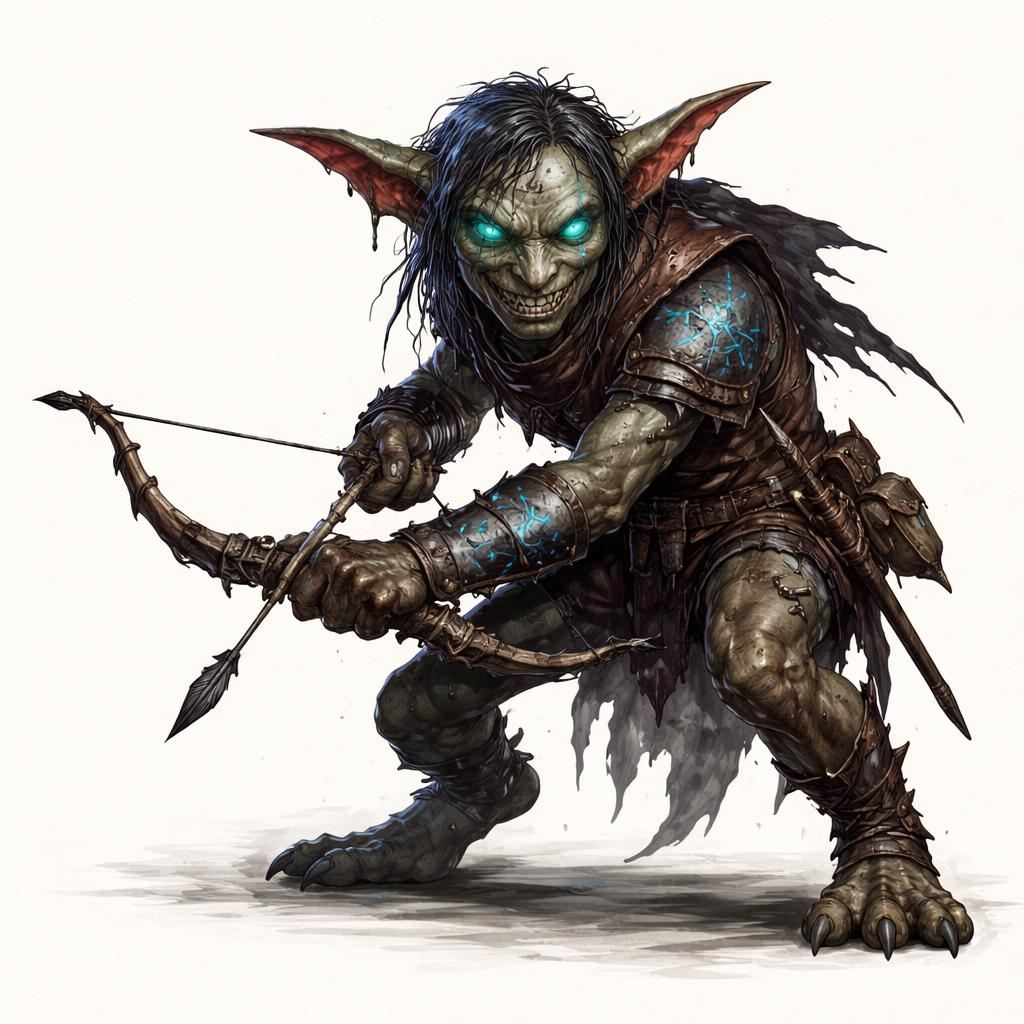

Weeping Gallery Skirmisher
Small Humanoid (Goblin), Chaotic Evil
Armor Class: 13 (Leather)
Hit Points: 9 (2d6+2)
Speed: 30 ft.
Challenge Rating: 1/4 (50xp)
| STR | DEX | CON | INT | WIS | CHA |
|---|---|---|---|---|---|
| 8 | 14 | 11 | 10 | 8 | 8 |
Saving Throws: None
Skills: Stealth +4
Damage Vulnerabilities: none
Damage Resistances: none
Damage Immunities: none
Condition Immunities: none
Senses: Darkvision 60 ft., passive Perception 9
Languages: Goblin
Spellcasting
“”
Actions & Abilities
Shortbow: Ranged Weapon Attack: +4 to hit, range 80/320 ft., one target. Hit: 1d6+2 piercing damage.
Dagger: Melee or Thrown: Melee attack, +4 to hit, reach 5 ft.; or Thrown attack, range 20/60 ft.; Hit: 1d4+2 piercing damage.
Nimble Escape (Bonus Action): Nimble Escape (Bonus Action). The goblin can take the Disengage or Hide action on its turn.
Appearance
Size and Shape:
The goblin stands about 3 to 3.5 feet tall, with a wiry, sinewy build—a compact torso and long, slender limbs that give it a lithe, primed-for-sneak silhouette. Its posture is almost always crouched and ready, shoulders narrow, moving with a measured tension that hints it can burst from cover in an instant.
Coloration:
Damp olive-gray skin carries darker grime from the corridor’s damp walls. Leather armor is weather-worn brown-black with a subtle, oily sheen. Runic etchings along bracers and patches glow pale blue when the pool’s cadence is active. Eyes glow a pale blue-green in dim light, and a few slick strands of coarse black hair cling to a damp scalp.
Texture and Surface:
Skin and clothing feel slick with moisture, like they’ve just stepped from water. Leather is rough but supple from oil, edges smooth from years scraping alcove walls. Hands bear quick calluses; the overall surface carries a tired, damp patina that blends with slick stone and shadow.
Facial Features:
A sharp goblin face with a short, blunt snout and a sly, calculating mouth. Teeth are small and yellowed from grime and use. Prominent, pointed ears tilt back from a high brow; eyes gleam with a quiet, calculating light, often set in a patient half-smile that sharpens to alertness.
Limbs and Appendages:
Arms and legs are slender but strong, built for rapid lunges and rapid recoil. Fingers are long and dexterous, ideal for nocking a shortbow and drawing a bolt in one fluid motion. Hands and wrists bear minor scar marks from alcove work; feet are small, sturdy, with tough soles for quiet footing.
Movement and Posture:
Generally crouched and ready, never fully upright unless advancing. It glides from alcove to alcove with practiced precision, leaning into shots and retreating with Nimble Escape. Its pace is a smooth, choreographed glide, as if dancing to the corridor’s tempo.
Special Features:
Runes along bracers and leather glow pale blue in time with the pool’s light, giving a faint magical aura. The body carries a perpetual, damp sheen that mirrors the corridor’s living nature, with subtle water-born camouflage lines that help blend with walls. Eyes flash brighter when attention is drawn to a target, adding a sharp, tactical edge to the creature’s presence.
Tactical Information
Weeping Gallery Skirmisher (Goblin Archer) – Narrative Tactical Portrait
Behavior in Day-to-Day Life
In the damp stillness of the Weeping Gallery, the Skirmisher lives as a patient, patient hunter. It does not stalk the party with reckless zeal; it reads the corridor the way a hunter reads wind and scent. Its life centers on the rhythm of drips, footfalls, and the glow-pulse of the heart pool. When not engaged in a volley, it is preoccupied with maintaining its alcove, sharpening a shortbow as cleanly as a pendulum, and brushing damp leather to keep it from slipping in the water-slick air.
These goblins are fiercely practical and surprisingly disciplined for goblins. They coordinate through ritualized timing—counting the cadence of drops, listening for a particular echo that signals a friend’s reload. They speak in quick, clipped goblin phrases, often in tandem with the pool’s glow: “Tick-tock, time for a shot.” They tend to group in small cohorts within the alcove network, trading quick glances and hand signals that mimic the gallery’s own clockwork ticks. They value speed, cover, and reliable reinforcements more than raw power, and they treat the corridor as a living ally rather than a mere battlefield: a place to defend, to funnel intruders, and to keep the rot in their favor.
Combat-ready or not, they remain suspicious of outsiders. A goblin will usually offer a brisk, reluctant choice: retreat to cover or answer the wall-etched cadence with a shot. They are not cowards, but they are patient: a foe who presses forward through the middle path will find the alcoves erupting in measured salvos, then quiet again as the goblins slip back to reload and watch. They show respect for the corridor’s rules—never stay where you stood during the last tick—and they adapt quickly if a party breaks the rhythm (noting which PCs favor one side or another, which are shielded by reach, which are slow to react).
Combat Behavior
The Skirmisher fights not as a bruiser but as a calibrated nuisance—harass from concealment, disrupt the party’s rhythm, and retreat before a counterstrike can be coordinated. In a typical encounter, the goblin archers are scattered along the sides, each perched in a shallow alcove at regular intervals so the central 6-foot path remains the only exposed line.
Opening actions are almost ceremonial: a whispered rustle, a quick breath, and then a shortbow emerges from the alcove to fire a precise, economical shot at the most threatening foe. The goal isn’t to crush a target in a single burst but to force choices—move forward, cede central ground, or stockpile actions to counter a push. After launching a volley, the archer reverts to its Nimble Escape: it uses its bonus action to disengage or Hide, slipping back into the alcove or into the pool’s damp edge to reload out of sight. Narrative cue: the pool’s glow pulses in time with the shot cadence, as if the corridor itself is counting the goblin’s strikes.
Alcove Ambush is not a flashy ability so much as a mechanical habit. The goblin prefers to shoot from cover, gaining narrative advantage when it ambushes from an alcove: a slight elevation or a corner that hides its silhouette, making it harder for enemies to respond before the next shot lands. If the party advances, the goblin will time its shots to the pool’s glow—every “tick” a moment to squeeze an arrow, every “tock” to vanish again before the first ally can close.
Environment plays a key role. The pool mid-way offers a reliable landmark that the goblins use to time their assaults. Touching or stepping into the pool dulls a stealthy approach and makes the goblins more confident in their position, while standing near the pool gives them a momentary misdirection that helps coordinate a re-aim or a reload. The water channels on either side slow movement and complicate attempts to close, nudging the party toward the one-way fork near the end.
If the encounter grows tense or the party outnumbers them, they lean on a simple, stubborn strategy: widen the funnel. They push a volley toward the most dangerous melee foe, then press toward a choke point near the fork, attempting to force the party into a single-file path where the archers can trade range for control. Reinforcements may arrive through a clockwork cue embedded in the walls—an ominous tick of a rune that signals another goblin to peel from a hidden alcove or from behind the door that guards the fork. The idea is not to kill quickly but to bleed resources, slow forward momentum, and convert the corridor’s layout into a trap.
Roleplay/Narrative Interactions
In non-combat moments, the Weeping Gallery Skirmisher remains terse, practical, and suspicious. They do not seek conflict for sport; they seek to preserve the corridor and their own advantage within it. If addressed, they speak in clipped Goblin with quick, emphatic gestures. They may respond to threats with little more than a wary glare and a pointed finger toward the runed walls, as if to say, “The cadence is law here.” If offered a bribe or safe passage, they consider it in terms of how it affects the corridor’s balance. A sufficient bribe—enough coin or a guarantee that intruders will be kept away from a key alcove—might prompt a grudging nod, a whispered agreement to “keep your feet in your lane,” and a temporary pause in hostilities while the party edges through.
They respect competence and timing. A PC that demonstrates a calm, measured approach, or that understands the corridor’s rhythm and avoids sudden, loud motions, might earn a rare moment of cautious regard. They might attempt to bargain for a safer route—perhaps a promise to refrain from triggering the pool’s glow in a way that reveals all alcoves to the party—or to exchange a fragment of runic lore for passage. However, diplomacy rarely wins outright; the goblins’ loyalty is to the corridor and its clockwork heartbeat, not to a single trespasser’s word.
When cornered or pressed, the Skirmisher’s instinct is to retreat to its alcove and disappear, letting the corridor “speak” through the tick-tock rhythms and the glow of the pool. They will not surrender their post easily, but they will bargain for time, content to let the fighting draw toward a bottleneck that favors their archery and ambush tactics. If a party manages to seize the pool or disrupt the cadence, they will respond with a firmer, more coordinated volley and a speedier rhythm of shots, using the disruption as a cue to push for the fork’s one-way trap.
Motivation, Intelligence, and Personality
The Skirmisher is driven by duty, discipline, and a pragmatic sense of survival. It is not particularly cunning on a grand scale, but it excels at exploiting a designed environment. Its intelligence is tactical rather than strategic: good at reading a corridor, timing a shot, and coordinating with a small group. It can be opportunistic—accepting bribes that improve its tactical position—but it is not easily deceived by grandiose promises, preferring concrete gains (safe passage, advantage for its next ambush, or control of the next alcove).
Overall, the Weeping Gallery Skirmisher is a low-CR, high-immersion encounter: a tiny archer who uses the corridor and its features as force multipliers, who speaks in clipped goblin, and who prefers to haunt the shadows rather than stand in the open. It invites players to think in terms of position, timing, and rhythm—to listen to the gallery’s heartbeat as much as to its enemies.