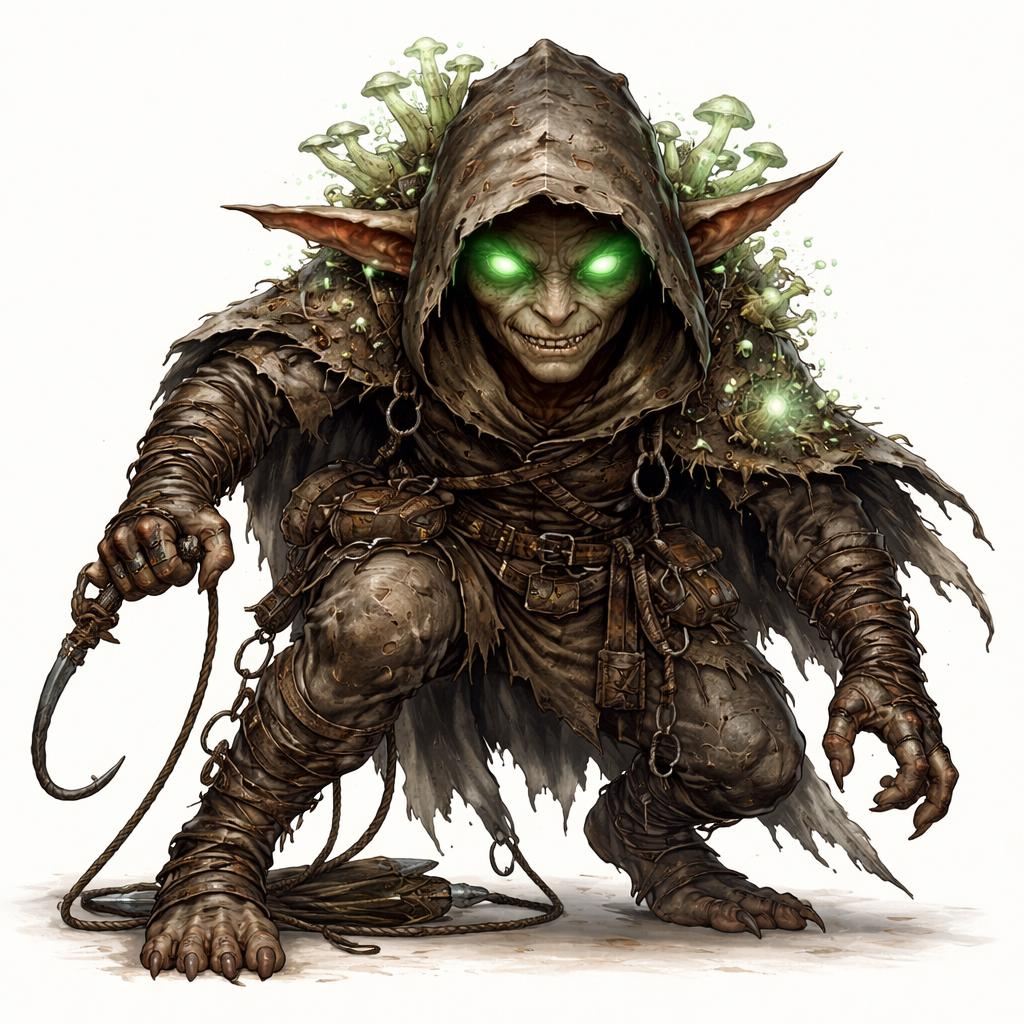

Gravgrasp Goblin
Small Humanoid (Goblinoid), Chaotic Evil
Armor Class: 12 (leather armor)
Hit Points: 9 (2d6+2)
Speed: 25 ft
Challenge Rating: 1/4 (50xp)
| STR | DEX | CON | INT | WIS | CHA |
|---|---|---|---|---|---|
| 10 | 14 | 12 | 8 | 10 | 8 |
Saving Throws: None
Skills: Acrobatics +4, Stealth +4
Damage Vulnerabilities: none
Damage Resistances: none
Damage Immunities: none
Condition Immunities: none
Senses: Darkvision 60 ft
Languages: Goblin
Actions & Abilities
Grasping Club: Melee Weapon Attack: +2 to hit, reach 5 ft., one target. Hit: 1d6 bludgeoning damage.
Gravitic Grasp (Grapple): Melee Weapon Attack: +2 to hit, reach 5 ft., one target. Hit: The target is grappled (Escape DC 11). While grappled, the Gravgrasp Goblin can use Gravitic Push as a bonus action on its turn to push the target 5 ft toward the nearest hazard.
Gravitic Push: Bonus Action: If the goblin has a target grappled or is adjacent to a hazard, it can push that target 5 ft toward the nearest hazard. If the target enters a hazard, apply the hazard’s effects per the DM’s ruling.
Dodge: The goblin takes the Dodge action. Until the start of its next turn, attackers have disadvantage on attack rolls against it, and it has advantage on Dex saving throws.
Hide: The goblin takes the Hide action to blend into dim light or terrain features, gaining advantage on its next Stealth check against a creature that hasn’t detected it.
Appearance
Against a pure white backdrop, a compact goblin stands 3–4 feet tall, a lean, sinewy silhouette with a permanently crouched, edge-hugging posture, fully visible and framed for dynamic motion. The skin reads pale and wan, a muted tone beneath scavenged leather. A faint green tint grips the hood and cloak where pale bioluminescent fungi cluster, casting a soft, greenish glow that brightens the face in dim light. The eyes glow green, slightly translucent, as if the chamber’s glow augments ordinary sight. The face is angular and wary, with sharp cheekbones and a mouth drawn into a sharp, mostly-serious line; narrow, irregular teeth flash when the goblin grins or snarls.
The surface textures tell the tale: ragged leather armor patched with scavenged cloth, weathered and rough, belts and pouches strapped tight over a lean frame. Fungal tufts cling to the hood, cloak, and sleeves, leaving a powdery, luminescent residue that dusts nearby surfaces. The hood and cloak host clusters of pale, glow-worm-like fungi that cast a dim, eerie light on the goblin’s features and gear, enhancing the sense of a creature at home in murky, gravity-warped terrain. A faint, earthy scent—damp stone and fungi—hangs with every move.
Limbs and appendages are long and dexterous: fingers are slender with short, practical nails, perfectly suited to gripping grapples and tweaking gravity-tether devices. The legs are wiry yet powerful, built for rapid bursts along narrow ledges. The gait is unmistakably goblin—quick, skittering steps with sudden bursts of speed—specialized for close-quarters combat and edge-to-edge navigation. The belt bears gravity-tether tools—spools, weights, and ropes—that clink softly as the goblin shifts stance and plots a path.
Movement is low and tactical: crouched close to the ground, it moves with surprising speed, tapping and grabbing its way along ledges, guiding others toward hazards while staying just out of reach. The armor is a collage of scavenged pieces reinforced in places with sinew or scrap metal, its surface punctuated by spores that waft with every motion, adding a faint, otherworldly shimmer to the ensemble. When the glow from the fungi lights the scene, it highlights the face and gear, revealing a creature perfectly adapted to murky, gravity-shifted terrain and the edge-of-sight approach.
Tactical Information
Gravgrasp Goblin: Tactical Breakdown in Narrative Form
Behavior in Day-to-Day Life
In its damp, gravity-warped world beneath the mill, the Gravgrasp Goblin tends to spend its days patrolling the immediate substructure with a small, tight-knit cohort or alone when guarding a particularly hazardous choke point. It is a creature of habit and improvisation, never far from a gravity-tether device or a cluster of bioluminescent fungi that marks its territory. Socially, it operates in pairs or tiny patrols—two to four goblins max—with a clear, if crude, pecking order: a lead goblin who points to the next ambush site, and others who execute the plan with quick, practiced motions.
Its motivations are straightforward: secure the goblin defense perimeter, herd intruders toward danger, and prove its own savvy by bending a treacherous battlefield to its advantage. It tolerates other goblins but is wary of anyone who threatens its control of the space or the gravity devices it guards. It spends time calibrating gravity-tether tools, testing the wave patterns of gravity shifts, and maintaining the terrain as both weapon and shield. When a intruder wanders within its domain, the Gravgrasp Goblin watches, listens for the sound of shifting gravity, then moves with surprising speed to close the distance and set the stage for a hazard-driven encounter.
In daily life, it avoids open, heavy combat and prefers to keep to the edges—narrow ledges, carved niches, and the periphery of the central chasm. It uses the chamber’s features as an extension of its own limbs: a ledge becomes a foothold, a niche becomes a perch for a better angle on its next grapple, and a gravity device becomes a lever that tilts a foe toward danger. Its temperament blends greed, mischief, and a hunter’s patience; the moment a suitable target presents itself, it surges forward to engage on its own controlled terms.
Combat Behavior
When combat erupts, the Gravgrasp Goblin treats the battlefield as a living trap. It does not seek to overpower opponents with raw strength, but to collide with them in a way that forces movement toward the chamber’s hazards. Its number is small, so it leans into terrain rather than brute force.
-
Opening tactics: It closes quickly to melee range, prioritizing a frontline foe. On its first successful strike, it uses Gravitic Grasp to grapple the target. The grapple is not just a hold—it is a tether to control where the enemy moves next, keeping them in or near gravity-warped zones rather than letting them bustle freely.
-
Primary tactic: With a grapple established, the goblin uses Gravitic Push to nudge the grappled foe toward the nearest hazard (the chasm edge or the rickety bridge). The environment does the heavy lifting; the goblin’s role is to steer the movement and ensure the victim persists on a perilous path rather than a safe retreat.
-
Environment as weapon: If possible, the goblin harasses foes into a position where a gravity wave, a shifting floor, or a creaking bridge tilt can become a hazard. It may back away to keep fights near the edge, then re-engage when an optimal push opportunity arises.
-
Targeting and priorities: It focuses on frontline foes who threaten to split the party, rather than distant spellcasters. It’s more concerned with influencing the fight’s geometry than dealing consistent damage.
-
Outnumbered or fights go poorly: If the goblin finds itself outnumbered, it doesn’t press a full-on brawl. It seeks to split the party by moving foes toward separate hazards, creating bottlenecks and forcing poor footing. If overwhelmed, it retreats toward a safer ledge or niche, using its terrain knowledge to stay in a position where gravity shifts can still assist a looming escape or a narrow reprieve. Should the opportunity arise, it signals or retreats to its allies for a regroup, hoping to restore control over the battlefield rather than trade blows one-for-one.
-
Strengths and weaknesses: Its strength lies in battlefield control and terrain exploitation. It excels in leveraging gravity cues and environmental hazards. Its defenses are modest (AC 12; HP 9), so it avoids prolonged exchanges in open space and relies on movement, cover, and the chasm’s edge. Its weakness is dependence on the terrain; if the party can pull it away from hazards or disrupt gravity waves, the goblin’s control wanes.
Roleplay/Narrative Interactions
Non-combat encounters reveal the Gravgrasp Goblin as a shrewd opportunist with a distinctly practical mindset: improvise, direct, and misdirect. It speaks in short goblin phrases, punctuated by gestures, head-tips toward gravity devices, and pointed pushes toward out-of-the-way surfaces where it can “demonstrate” the arena’s hazards.
-
Threat responses: It is wary of threats but not cowed by them. It responds to intimidation with a measured grin and a readiness to pivot to a show of control—the gravity devices ripple, and suddenly the floor creaks in a way that suggests “try me.” It will bluff about the safety of the race to the edge, using the reputation of its gravity-warped home to assert dominance.
-
Diplomacy and bribes: The Gravgrasp Goblin is more likely to test a potential ally with a challenge or riddle of sorts than to bargain on raw mercy. If offered a bribe, it may consider a trade, especially if the payoff benefits its domain’s security (loot, spare parts for gravity devices, or a map to a preferable route through the chamber). It would not surrender its leverage easily; a proposer might gain its temporary trust by demonstrating knowledge of the gravity engines or by offering a non-obvious shortcut through the perilous terrain.
-
Communication style: It does not rely on magical speech; communication is brisk, practical, and forceful. It uses goblin grunts, clipped phrases, and visual cues (a pointing finger toward a gravity device, a tilted floor illustration with its own body used as a demonstration).
-
Cornered or approached by adventurers: If trapped or backed into a niche, it becomes resourceful and tactile, coordinating with its tether tools, attempting to tilt the space to its advantage, and offering terms in exchange for safe passage or information. It prides itself on cleverness; if cornered, it tries to bluff or redirect attention to nearby hazards, leveraging the party’s fear of stepping onto a shifting bridge or near the edge.
-
Personality traits in play: Quick-thinking, wary of direct confrontation, and a lover of a well-orchestrated trap. It’s not cruel for cruelty’s sake; it’s a tactical opportunist, guided by the thrill of bending a dangerous space to its will. If treated with a measure of respect for its craft, it may offer a guarded alliance of convenience or information for future encounters.
Notes for Running
-
Environment-driven storytelling: Emphasize the gravity waves, shifting floors, and the fragile bridge as active players in the encounter. Describe the clank of gravity devices and the faint bioluminescence on its hood to reinforce its bond with the chamber.
-
Encounter pacing: Use the terrain as a counterbalance to the goblin’s modest stat block. Let players feel the risk of the central chasm and the bridge’s sway, with the Gravgrasp Goblin as the conductor of that risk.
-
Thematic tone: Keep the goblin’s behavior grounded in improvisation and battlefield control. Its triumph comes from the party’s misstep, not from overwhelming force.
If you’d like, I can tailor these three narrative sections to a specific party size and composition (e.g., a party of 4 with a 1/4 CR encounter), or adapt the narrative to a different system while preserving the gravity-driven combat flavor.