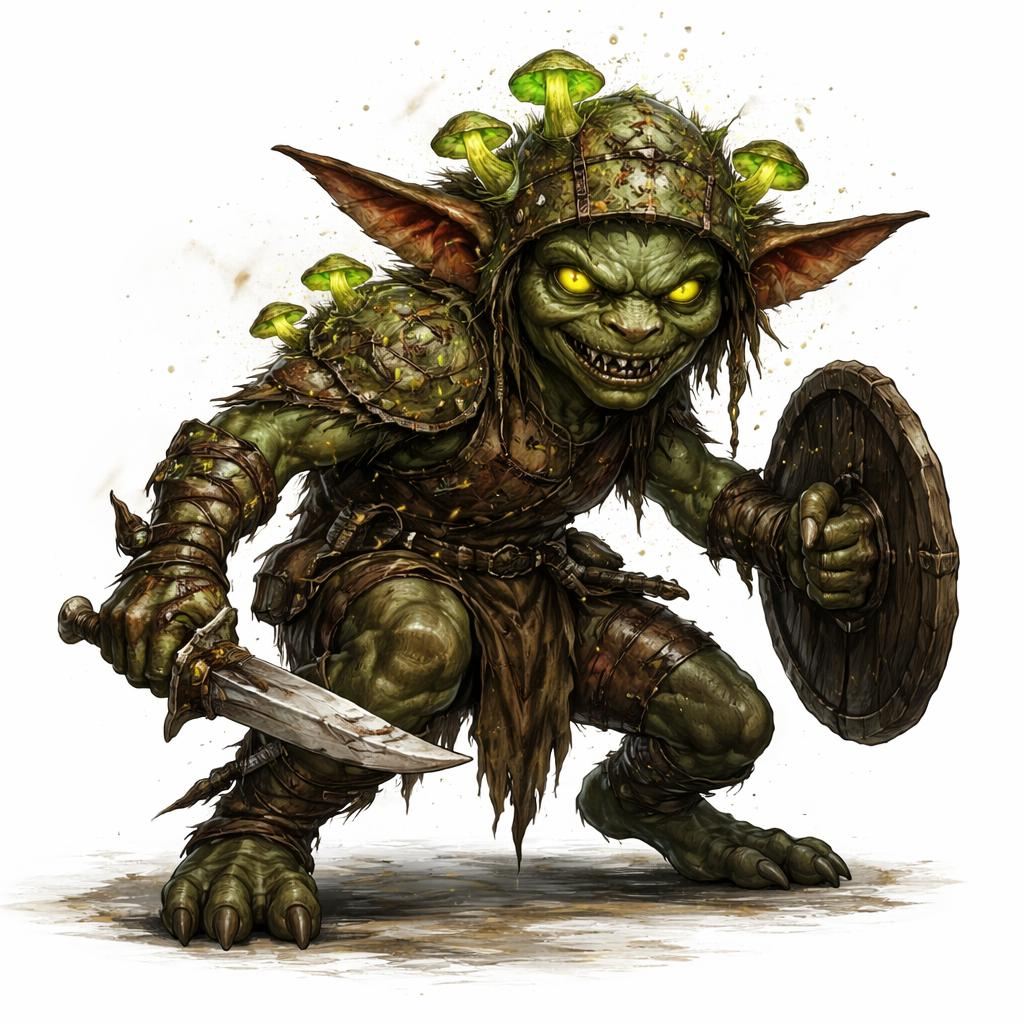

Glowshroom Goblin Defender
Small Humanoid (Goblin), Chaotic Evil
Armor Class: 12 (Leather Armor)
Hit Points: 9 (2d6+2)
Speed: 20ft
Challenge Rating: 1/4 (50xp)
| STR | DEX | CON | INT | WIS | CHA |
|---|---|---|---|---|---|
| 12 | 14 | 12 | 8 | 9 | 8 |
Saving Throws: none
Skills: Stealth +4
Damage Vulnerabilities: none
Damage Resistances: none
Damage Immunities: none
Condition Immunities: none
Senses: darkvision 60ft, passive Perception 9
Languages: Common, Goblin
Spellcasting
“”
Actions & Abilities
Short Sword: Melee Weapon Attack: +4 to hit, reach 5 ft., one target. Hit: 6 (1d6+2) piercing damage.
Shield Bash: Melee Weapon Attack: +3 to hit, reach 5 ft., one target. Hit: 2 (1d4+1) bludgeoning damage. If hit, the target must succeed on a DC 11 Strength saving throw or be knocked prone.
Hide: The goblin takes the Hide action, blending into the glow of the bioluminescent mushrooms. If undetected, it has advantage on its next attack against a creature that doesn’t see it.
Dodge: The goblin takes the Dodge action. Until the start of its next turn, any attack rolls against it have disadvantage, and the goblin has advantage on Dexterity saving throws.
Disengage: The goblin takes the Disengage action, avoiding opportunity attacks for the rest of its current turn.
Appearance
A compact goblin stands in a deliberate, low crouch, about 3.5 feet tall, its wiry frame coiled for quick bursts and precise, deliberate movement. The silhouette is compact yet alive with tension: weight on the balls of the feet, a slight lean forward as if always ready to pivot or slip along slick rock. A sturdy shield arm is held up for swift parries, while the other hand grips a light weapon, poised for a rapid, close-quarters strike. Against a pure white background, the creature reads as a living blur of intention—loose, economical steps keeping relentless pressure on a chokepoint.
Skin is olive-green and damp with a greenish sheen from tunnel humidity, rough and slick to the touch, with a touch of translucence where moisture settles. Patchwork leather armor covers the torso and limbs, worn and stitched with grubby moss; mossy green patches create a mottled camouflage that shifts with every movement. Here and there, bioluminescent mushrooms sprout on the shoulders and toward a crude helm, their caps smooth and damp, catching light and reflecting it in a faint, shifting glow. A halo of spores clings to clothing and skin, thinning and fluttering with each step.
The face is goblin sharp and expressive: a broad, goblinish countenance with a small, upturned nose, a wide mouth lined with irregular, glinting teeth, and large, pointed ears swept back. Eyes glow amber-green, bright and observant, catching every flicker of the fungus around them. A few damp tendrils of hair cling to the scalp, and a thin line of spore-streaked residue traces from the corners of the mouth, hinting at a lingering, earthy aura.
Limbs are long and lean—perfect for precise grappling and rapid, targeted strikes. Fingers are dexterous, with blunt nails suited for snatching small objects or snagging a shield strap in a tight moment. The shield arm is sturdy, built to parry and block, while the other hand wields a light weapon with quick, economical motions. Movement is skittering and serpentine: fast on its feet, able to keep balance on mossy ledges, yet always conserving energy for the next, decisive move. The overall posture exudes readiness and menace, a creature who thrives at the threshold—between shadow and glow, between defense and offense.
Special features elevate the dynamic presence: bioluminescent mushrooms punctuate the shoulders and helm, casting a cool green glow that shifts with mood and movement, turning the goblin into a ghostly, hive-like silhouette in dim light. The glow enhances the camouflage, while a subtle halo of spores flickers as they move, giving the impression of a living cloud that clings to the armor and skin. Together, these elements create a vivid, complete image: a compact, agile warrior who blends damp earth with living light, always ready to strike from a carefully chosen position.
highlights:
- Colors: olive-green skin with damp green sheen; mossy green leather patches; amber-green glow in eyes; bioluminescent mushroom caps.
- Textures: rough, slick, mucus-like skin; coarse leather with moss; smooth, damp mushroom caps.
- Notable appendages: large, swept-back ears; long, dexterous fingers; shield arm paired with light weapon hand.
- Special features: bioluminescent mushrooms on shoulders and helm; spores trailing and shifting glow; mood-linked halo of spores.
- Pose: low, crouched stance with shield raised and weapon ready, illustrating precision, speed, and control.
Tactical Information
Day-to-Day Life and Ecology
- The Glowshroom Goblin Defender lives in a damp, dimly lit river crossing. They haunt the narrow tunnel near the lone boat, gathering and patching their crude armor with mossy greens and patches of glowshroom caps. Their “home” is the mossy ledges, slick rock shelves, and the quiet water that licks at their feet.
- Socially, they form small, stubborn squads tied to the chokepoint. They watch for river traffic, intruders, and any sign of Riverwarden activity, communicating with rough signals rather than refined speech. Their leaders are chosen more for vigilance and coordination than for clever schemes; when a plan works, it’s because the environment does most of the heavy lifting.
- Their daily rhythm revolves around maintenance, patrol, and mushroom care: patching leather, tending glowshrooms that brighten their area, and reinforcing the boat’s position as a rally point. They trade in practical, low-cost actions—keeping a tight line at the chokepoint, pulling a foe toward the water, or shoring up their patchwork defenses with rope and hooks.
- Motivations are simple and tangible: defend the crossing, feed and nurture the glowshrooms, and ensure river traffic pays its “toll” in route security or supplies. They’re patient, not impulsive, and they excel when the environment is on their side.
Combat Behavior
- Opening approach: The glow is their ally and their cue. In combat, they cluster around the boat, forming a tight, if crude, frontline that funnels foes toward the narrow chokepoint and the bank. They prefer to strike quickly and retreat back into the glow or behind the boat’s hull, saving their strength for repeated pushes rather than one decisive blow.
- Tactics and terrain use: On slick limestone and moss, they move with practiced ease. They rely on movement that keeps foes off balance: quick jabs with short swords, a shield bash to disrupt a foe’s stance, and then a pull toward water or onto a mossy shelf where footing is precarious. If two or more are adjacent, they mirror and shield one another, forming a rough “wall” of bodies to discourage direct charges—this is narrative rather than a formal mechanic, but it feels like a small defensive shield wall in play.
- Special environmental angles:
- Light-affinity: Their glowshrooms cast a green glow that helps them see in gloom and cues adjustments in positioning. In dim light, they gain a stealthy edge, slipping into positions where intruders’ line of sight is broken by glow-filtered shadows.
- Slippery Ground Awareness: The tunnel’s wet surfaces mean a lot of footing checks. They are adept at moving with the slick ground, gaining an edge on staying upright while foes risk slips. If someone slips, the goblins seize the moment to press a quick hit or to drive the target toward water or a ledge.
- Coordinated Defense: When at least two goblins guard the chokepoint or boat, the scene feels subtly more dangerous for intruders—an invisible, narrative reinforcement that nudges players to think about splitting their assault or threatening the boat itself.
- When outnumbered or the fight stalls: They don’t press reckless breaks for glory. They retreat toward the boat or into shadowed niches behind the moss shelves, hoping for a chance to regroup and call for potential reinforcements from side passages. If Riverwarden allies are present, they shift into support roles—holding the line so the Riverwarden can execute bigger actions or rescue a threatened ally.
- Weaknesses and cautions: They are small and lightly armored; a determined, well-armed party can overwhelm a single goblin quickly. Their strength lies in terrain, persistence, and hit-and-run strikes rather than brute power. If the water becomes a dead end or if the glow is extinguished, their advantage evaporates and they must rely more on discipline and numbers.
Roleplay and Narrative Interactions
- Demeanor and communication: They’re practical, curt, and wary of outsiders. They grunt in Goblin, with occasional crude gestures or signaling—enough to convey intent, warnings, or requests for coin/food or tolls. They’re not prone to lengthy diplomacy, but they will negotiate when it serves their purpose: safe passage, tribute, or information about river traffic.
- Threat responses: Threats are met with stubbornness and a readiness to retreat behind the boat or into the glow. They’ll glare, snap, and threaten with crude tools, then rely on their environment to complicate an assault. If cornered, they’ll defend the chokepoint to the last possible moment rather than surrender honorably—unless a bribe or advantageous bargain changes the odds.
- Bribes and diplomacy: They’re susceptible to practical offers. A small cache of glowshrooms, salt pork, shiny trinkets, or a promise of safe passage through the river are more persuasive than empty threats. They may require a tangible gain (not mere talk) and may share local gossip or route knowledge in exchange for payment or terms that don’t endanger their position.
- Interaction style with Riverwarden or allied factions: They tend to be more cooperative under the Riverwarden’s oversight, treating the patrol as an external force that validates their defense posture. Their cooperation can be conditional, requiring the Riverwarden to respect the chokepoint’s sanctity and to honor any agreed tolls. Absent that authority, they revert to territorial defense: warning off outsiders, guarding the boat, and signaling towards potential reinforcements if pressed.
- Cornered or pursued behavior: If pressed hard, they’ll fight with renewed determination—striking from the glow and attempting to push foes into the river or off ledges. If capture seems likely, they may attempt to bargain for their release, mutter a stubborn refusal, or retreat to a side passage to lure pursuers into a trap or a more advantageous fight near water.
Notes for the Table
- The Glowshroom Goblin Defender is designed as a low-CR frontline obstacle: modest offense, strong terrain synergy, and a persistent defense that rewards tactical positioning over brute force.
- Use the glow and water as storytelling tools: illuminate or obscure lines of sight, cue reinforcements, and create moments of tension as players navigate slick ground and the boat’s fragile hold on the crossing.
- If you want a touch more bite, you can add a second Glowshroom Goblin Defender for a slightly tougher fight, or stage a brief “river swing” hazard that players must avoid while engaging the goblins.
Would you like me to tailor these behaviors to a specific game system (for example, a 5e-style stat block with explicit action options, or a more generic system compatible with your campaign’s rules)?