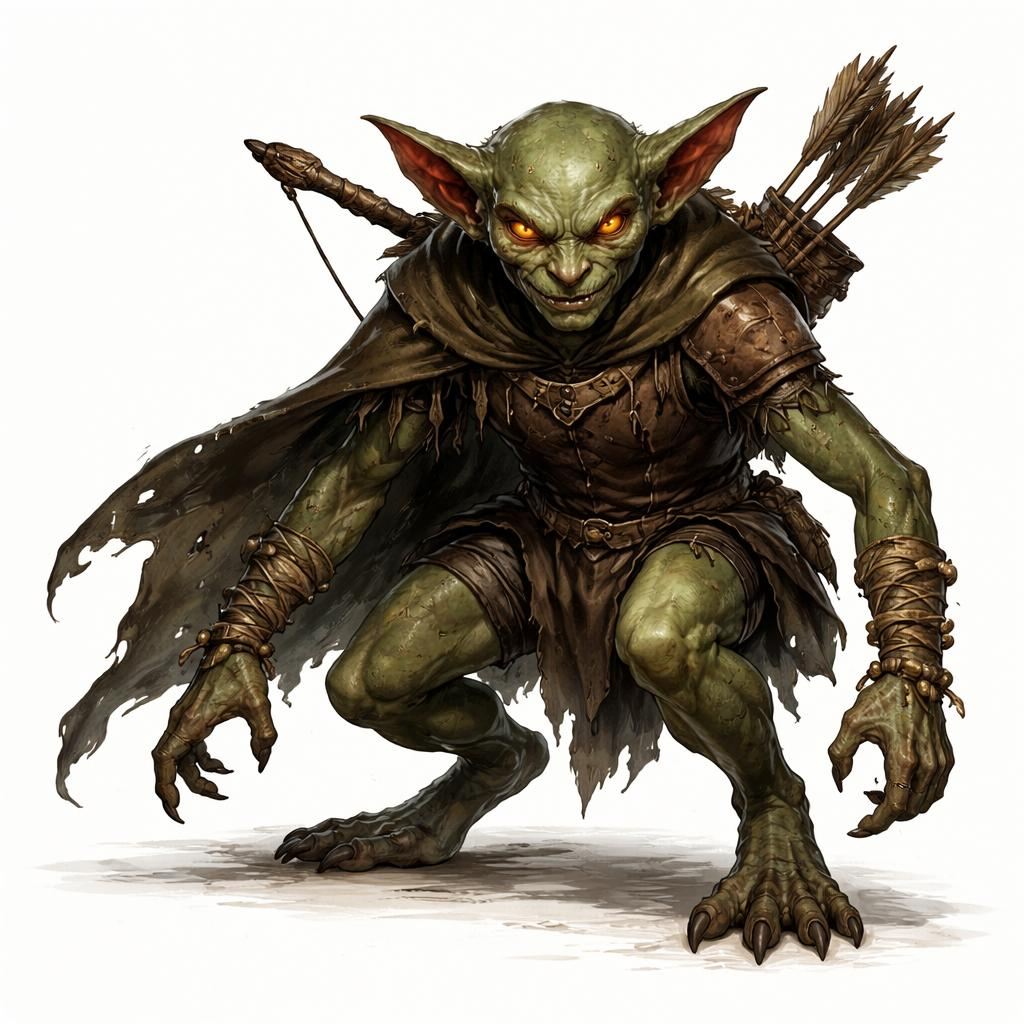

Whisperwheel Archer
Small Humanoid (Goblinoid), Chaotic Evil
Armor Class: 13 (Leather Armor)
Hit Points: 9 (3d6)
Speed: 30ft
Challenge Rating: 1/4 (50xp)
| STR | DEX | CON | INT | WIS | CHA |
|---|---|---|---|---|---|
| 8 | 14 | 12 | 8 | 10 | 7 |
Saving Throws: Dexterity +2
Skills: Stealth +4
Damage Vulnerabilities: none
Damage Resistances: none
Damage Immunities: none
Condition Immunities: none
Senses: darkvision 60ft, passive Perception 9
Languages: Goblin
Spellcasting
“”
Actions & Abilities
Pillar Cover: While behind a pillar, the Whisperwheel Archer has half-cover (+2 AC).
Puddle of Madness (Environmental Hazard): The puddle near the central dais is a battlefield hazard. A creature that starts its turn in the puddle must succeed on a DC 12 Wisdom saving throw or be Disoriented for 1 round, resulting in disadvantage on attack rolls and on Wisdom (Perception) checks. The puddle expands by one square if the Whisperwheel wheel turns twice during the encounter.
Whisperwheel Cue (GM-Triggered): When the wheel turns, the archer gains a +1 bonus to attack rolls for that round.
Shortbow: Ranged Weapon Attack: +4 to hit, range 80/320, one target. Hit: 1d6+2 piercing damage.
Dodge: The Whisperwheel Archer takes the Dodge action.
Hide: The Whisperwheel Archer takes the Hide action.
Appearance
On a pure white backdrop, a 3.5-foot goblin stands in a crouched, catlike pose, fully visible and ready to spring. Lean, wiry frame with long, slender limbs and a subtle forward-leaning posture, suggesting constant vigilance. Olive-green skin is mottled with darker patches along the arms and face, slick and slightly oily from cathedral humidity, giving a damp, leathery sheen. A weathered brown leather torso armor fits snugly, while a greenish cloak drapes over the shoulders, folding into shadow and guiding the eye along the silhouette.
Wrists and forearms are wrapped in rough bindings of cord and bone beads, a tactile, talismanic band that hints at ritual purpose. A dented shortbow sits crosswise across the back, paired with a quiver of mismatched arrows at the hip, evidence of hard-won expeditions. The face is angular and keen: high cheekbones, a sharp hooked nose, and large bat-like ears that sweep back from a wary, calculating stare. Amber-gold eyes glint with shrewd intelligence, and the mouth often tilts into a slender, sly smile, revealing slender teeth. Fine scars trace the jaw and temple, quiet records of past skirmishes.
Texture plays across the creature: skin like weathered leather, rough and slightly oily; armor patched and scarred, edges frayed but functional; cords and beads swing softly with every shift of weight, catching occasional light. The glyphs etched on leather patches glow subtly in the momentary gleam, catching the light when torch or sun strikes them, hinting at concealed rituals. The overall aura is damp, cathedral-like—stone, soil, and moisture clinging to skin and gear—adding depth to a disciplined hunter who moves with measured, economical efficiency.
Movement and posture convey personality: crouched behind imagined pillars, the goblin shifts with feline grace, gliding from cover to cover, never wasting a motion, only stepping into brighter space when necessary. It is a silent archer—swift, precise, and unafraid to leverage angle, cover, and ritual gear as much as raw speed.
Tactical Information
Whisperwheel Archer – Tactical Narrative Profile
Behavior in Day-to-Day Life
- Daily routine and mindset: The Whisperwheel Archer is a disciplined goblin in the Goblin Defense Force, spending most of their time crouched behind circular pillars and leaning out just enough to skim arrows toward any who threaten the central dais. They treat their post as a stage: precise, patient, and economical with movement. Their life is built around stationary defense rather than skirmishing across the field, so they prize cover, sound positioning, and the ritualized sense that the Whisperwheel’s glow marks a moment of focus and control.
- Social dynamics: They are part of a small patrol squad, sharing watch shifts with a minimum of talk—goblin pragmatism over chatter. They value reliability in others and respect steady, predictable tactics over bold, reckless actions. The “wheel blessing” is a cultural incentive: a momentary glow from glyphs signals a promotion of sorts, a moral nudge toward better performance in that instance.
- Habits and feeding: They scavenge for arrowheads, patches of leather, and small bits of rations from nearby patrols. Their gear is rough but functional: dented shortbow, patched leather armor, a quiver of scavenged arrows. They keep a tight grip on their gear, ensuring nothing slows their shot or betrays their position.
- Temperament and instincts: They’re wary, calculating, and intolerant of noise or chaos—traits that keep them efficient in a choke point. They prefer slow, deliberate shots to wild spray, always re-evaluating angles as pillars, benches, and walls shift their line of sight. The damp cathedral amplifies their natural goblin guile, but they curb reckless impulses in favor of a controlled, defensive tempo.
Combat Behavior
- Opening approach: In combat, the Whisperwheel Archer remains behind pillars, firing from partial cover and exploiting the arena’s geometry. They initiate by surveying sightlines, selecting angles that force intruders away from the dais or into the line of fire of the rest of their squad.
- Tactics and use of environment: They maximize the use of half-cover (+2 AC) from pillars and benches. They avoid rushing the wheel or exposing themselves to direct, frontal attack. If the dynamic walls shift sightlines, they adapt quickly, sliding to new pillars to maintain optimal crossfire. They coordinate with the second archer to cover angles that funnel intruders toward the wheel’s vicinity or bottlenecks created by benches.
- Puddle of Madness as a tool: The puddle creeps toward midfield and is treated as a battlefield hazard. If an intruder steps into or starts their turn in the puddle, a DC 12 Wisdom save is required to resist the Disoriented condition for 1 round. A failed save means disadvantage on attack rolls for that round, or a sense of being “shaken” in aiming. The archers use this to their advantage by forcing enemies into the puddle’s zone or into awkward shots that help preserve cover.
- Wheel turns (GM cue): When the Whisperwheel turns and glyphs glow, the archer squad can receive a minor temporary boost (for example, a +1 to hit for that round). The archer uses this moment to deliver a carefully aimed shot that can crack a key defender or disrupt a spellcaster’s rhythm, then falls back to covered positions.
- Handling numbers and setbacks: If outnumbered, they retreat to their pillar-based lattice, deny access to the dais, and leverage the arena’s geometry to maintain lines of fire while reducing exposure. They will not engage in melee; if forced into closer quarters, they skip the risk and reestablish range, or they signal for reinforcements and switch to more conservative angles.
- Weakness and cunning: Their primary vulnerability is exposure—step into the wrong arc and a pillar can be stripped of cover. They also rely on the wheel and glyph cues, so a GM that withholds or manipulates cues can disrupt their rhythm. They are not immune to fear or panic, but their discipline helps them weather such moments with a measured retreat rather than a collapse into chaos.
Roleplay/Narrative Interactions
- Threat response and diplomacy: In noncombat, the Whisperwheel Archer is cautious, terse, and suspicious of outsiders. They speak goblin with clipped phrases and prefer practical talk—what you offer, what you want, and what you’re asking them to do. They respond to threats with deflection and guarded honesty, not bravado.
- Bribes, promises, and trade: They’re open to small bribes—bits of metal, scavenged trinkets, or rations—that improve their advantage in the short term. They are most receptive when a bargain clearly serves the Goblin Defense Force’s post: safe passage for information, or a temporary change in the firing lanes that benefits their squad.
- Communication and behavior: They use light, rapid goblin chitters and specific hand signals to coordinate with teammates. They are capable of quick, decisive commands in the moment but avoid long, drawn-out speeches. When cornered or questioned, they might bluff, misdirect, or pivot to a safer topic, preferring not to reveal the dais’s vulnerabilities unless trust is earned or fear is used as leverage.
- Interaction with adventurers: If approached peacefully, they may test a visitor’s value—confirming whether the intruder is a threat to the wheel or merely passing through. They might imply a bargain: safe passage for a small contribution to the defense fund, or information about a weak point in the invader’s approach. If negotiations fail, they rely on the pillar-based defense and the puddle’s creeping threat to escort the intruders toward a stalemate or retreat.
- Cornered behavior and temperament under pressure: When pressed or cornered, they don’t become flashy or reckless; they become surgical—refocusing shots to deny space, shouting warnings to teammates, and signaling retreat for the sake of preserving the chain of defense. They may attempt a final, precise shot at a critical threat before slipping behind a pillar and letting the rest of the squad reassert the perimeter.
- Intelligence and deception: They know enough to read a battlefield but not to overcomplicate it. They’re more likely to deceive with practical misdirection (pointing the party toward a false path or reinforcing a minimal, honest-to-their-cause explanation) than with grand schemes. Their best leverage is their familiarity with the cathedral’s geometry and the wheel’s ritual, which they may casually reference to unsettle or confuse intruders.
Notes for the GM
- Keep the encounter lean and atmospheric: Focus on the environmental cues—the wheel glow, glyph shimmer, and the creeping puddle—to heighten tension rather than layering on complex mechanics.
- Use cover and terrain to tell the story: Pillars, benches, and shifting walls aren’t just obstacles; they are narrative tools that create a stage for the Whisperwheel Archer to play out their disciplined defense.
- Scale with party size: For smaller parties, emphasize the precise, patient shots and environmental hazards; for larger parties, add a second archer or a brief reinforcement wave to maintain the sense of a tightly run defense.
- Narrative hooks: The wheel’s glow can serve as a storytelling beat—its turning aligns with whispers in the players’ minds or a sudden shift in the cathedral’s atmosphere. The puddle’s gradual expansion can foreshadow a broader environmental threat or a narrative consequence of ignoring the dais.
If you’d like, I can tailor these behavioral profiles to a specific system (D&D 5e, Pathfinder, or a homebrew) or provide a printable one-page encounter sheet with quick-reference cues for the Whisperwheel Archer and the arena layout.