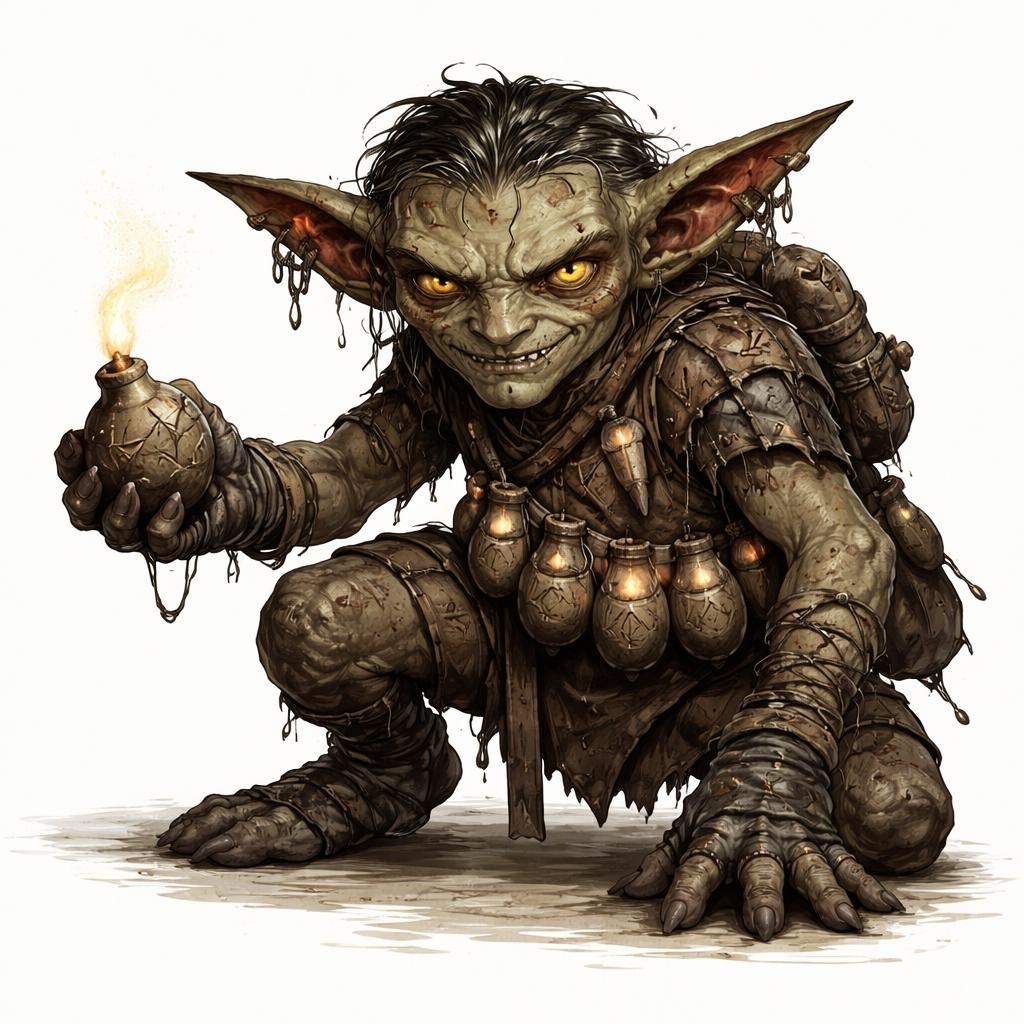

Weeping Grenadier
Small Humanoid (Goblinoid), Chaotic Evil
Armor Class: 12 (leather)
Hit Points: 9 (2d6+2)
Speed: 20 ft
Challenge Rating: 1/2 (100xp)
| STR | DEX | CON | INT | WIS | CHA |
|---|---|---|---|---|---|
| 8 | 14 | 12 | 10 | 8 | 6 |
Saving Throws: none
Skills: Stealth +4
Damage Vulnerabilities: none
Damage Resistances: none
Damage Immunities: none
Condition Immunities: none
Senses: Passive Perception 9
Languages: Goblin, Common (basic)
Actions & Abilities
Bomb Toss: Ranged Weapon Attack: +4 to hit, range 30/120 ft, one target. Hit: 1d6 fire damage. On a hit, the blast creates a 5-foot square of slick water in the blast area that lasts until the end of the next turn. Any creature entering or ending its movement in that square must succeed on a DC 11 Dexterity saving throw or fall prone.
Hide: The Grenadier uses the environment to conceal itself, making a DC 11 Dexterity (Stealth) check. If hidden, the Grenadier remains unseen until it moves or makes an attack.
Appearance
On a solid white background, the Weeping Grenadier sits low and ready, a three-foot-tall goblin with a wiry, compact frame. Its silhouette is hunched and calculating, head ever turning, eyes flicking like a hinge between shadows. The stance is crouched and ready, quick bursts rather than strides, always staying just behind its taller defenders as if threading through a narrow corridor of threat.
Its skin is a sickly olive-green, mottled with gray and brown patches from constant damp and grime. Hair is slicked back, dark and damp with humidity, clinging to a damp scalp. Clothing is patchwork leather and scavenged canvas—oil-stained browns and grays—that reads as makeshift armor: bone charms stitched into the fabric, scraps of metal glinting softly at the seams. A belt bristles with crude clay bombs, each one fitted with a pale fuse that glows faintly whenever air shifts, a whispering reminder of the next detonation to come.
The Grenadier’s texture is tactile threefold: skin rough and slightly oily from the humid air, hands and forearms bearing calluses and small scars from constant tinkering, and gear that bears runes carved into scrap metal and bone charms. A perpetual bead of water clings to its cheek or brow, a living reminder of the corridor’s humidity that never quite releases its grip. Runes etched onto metal and bone charms shimmer faintly, hinting at a past when the bombs were primed and the air hummed with potential magic.
Face first: angular goblin features sharpened by years of scrappy survival. Prominent cheekbones, a narrow chin, and a small, upturned nose give it a sly, wary expression. Ears are large and pointed, ringed with bits of scrap metal that catch the light. Eyes are small, keen, and amber-gold, always calculating the next angle or flank. The mouth tilts into a sly, grim smile with sharp, irregular teeth, and a single narrow scar cuts the cheek. A bead of moisture trails from the corner of the mouth and down the jaw, the corridor’s dampness marking its every exhale.
Limbs reveal its dual nature: arms slender yet dexterous, hands with grease-streaked nails perfect for fuses and tiny, delicate adjustments; fingers long and precise, built for micro-precision rather than brute force. Legs are short and quick, enabling sharp repositioning and a low, stable stance behind frontline defenders. Feet are small but sure, able to cling to slick surfaces and spring into a narrow, wrist-roughened balance.
Movement is the Grenadier’s signature: crouched and jittery, it slides from shadow to shadow with micro-movements that deny direct pursuit. It never charges; instead it leverages the geometry of the corridor, flank after flank, to throttle the space and funnel foes into chokepoints. When it acts, it is a blur of rapid throws—careful arcs, exact angles, and a trained eye for where the next fuse will sing.
Special features intensify the image: bone charms and scrap-metal tags etched with runes are worn like a hidden constellation, a clockwork echo of its craft. The belt’s clay bombs sit visibly primed, each with a pale glow from the fuse, a whisper of imminent release. The air itself seems slightly damp whenever it passes, a continuum of moisture that clings to the grenadier like a halo. Faint runic sigils on its gear pulse faintly, a memory of the past hum that threaded the bombs with energy.
Overall, the Weeping Grenadier exudes a tense, calculated menace—a small figure whose every motion reshapes the battlefield’s angles. It lives in the space between defenders and danger, turning chokepoints into a choreography of precise, explosive precision, a creature defined by its craft, dampness, and the glow of fuses waiting to flare.
Tactical Information
Here is a narrative-focused, combat-tue-focused portrait of the Weeping Grenadier, designed to fit its CR 1/2 role while keeping the flavor and environment in the foreground.
Behavior in Day-to-Day Life
The Weeping Grenadier is a small, wiry goblin kept on as a sentinel by the Goblin Defense Force because it never forgets a corridor’s rhythm. In the damp Weeping Gallery, it spends most of its days tucked behind the line of goblin defenders, tending its belt of clay bombs, fiddling with fuse timbres, and listening to the corridor’s whispers—the drip, the distant footfalls, the echo of a passing boot. Its motivation is simple and stoic: keep intruders from slipping past the chokepoints, and secure the central pool and the fork so the defenders can hold the line. It takes pride in knowing every creak of the walls and every ripple in the water channels, which makes it feel less like a mere trap and more like a conductor guiding a dangerous symphony.
Socially, the Grenadier is curt, suspicious, and unshowy. It trades with nearby goblins in scraps and fuse parts, boasting little and listening a lot. It respects discipline and speed in defense, but it does not tolerate incompetence or bravado from others—especially from outsiders who mistake the Grenadier’s quiet patience for weakness. In its off moments, it hums to the runic sigils etched along the walls, as if the corridor itself is answering a chorus only it can hear. It keeps its bombs clean and ready, not out of vanity but as a quiet ritual that keeps the tunnel’s mood in alignment with its own tempo.
Combat Behavior
When danger comes, the Weeping Grenadier slides into its preferred stance: well back of the shielded defenders, keeping the pool and the one-way fork within its threatening arc. It enters combat with the same rhythm it uses to pace the gallery—the soft crackle of a fuse and the slow, deliberate pull of its arm as it hurls a bomb toward the pool’s edge or the fork’s crossing.
Opening approach and tactics
- The Grenadier’s first concern is denial of space, not direct confrontation. It targets two obvious chokepoints: the pool’s edge and the fork crossing.
- It leverages the corridor’s acoustics to time its throws with the party’s approach—a sequence of steps, a pause, then a blast in concert with nearby footsteps or the clatter of armor.
- A successful Bomb Toss is followed by the Slick Bomb effect: a 5-foot square of slick water that persists until the end of the next turn. Any creature entering or ending its movement in that square must succeed on a DC 11 Dexterity saving throw or fall prone. It uses this hazard to block lines of advance and to complicate retreat.
Mid-fight adjustments
- The glow around the pool’s edge is not just illumination; it’s a tactical nudge to opponents, a nudge that slows measured approaches and encourages rushed, risky strides along the water’s edge.
- If pressed by a crowd or if its defenders falter, the Grenadier will feign weakness—slackening aim, stepping as if wounded or off-balance—then snap back into position to throw again from a different angle. It won’t chase, but it will shift to the safer angle and re-establish a threatening line.
- Runic Echo plays a tactical role in narrative time: if the Grenadier is in view of the pool or fork, the glyphs hum audibly, signaling a timing cue for future bombs. The party might attempt to disrupt the hum to buy time or reveal a hidden vulnerability in the runes.
Endgame tendencies
- The Grenadier understands when a fight is going poorly and will retreat behind defenders to keep the two chokepoints under pressure rather than risking a direct push into the party. It won’t engage in hand-to-hand confrontation; its job is to deny space, buy time, and shepherd opponents toward the defenders’ lines.
- If cut off from its bombs or the line of defense, it will still protest, but it will redirect attention by detonating near the pool or at the fork to force a stumble or a shift in the party’s approach, buying its allies a moment to stabilize.
Roleplay/Narrative Interactions
Roleplay cues for the Weeping Grenadier center on its goblin cunning, stubborn practicality, and environmental obsession. It speaks in a brisk, goblin-Curmudgeon lilt, often with a dry, almost ceremonial air about its duties.
Personality and temperament
- Core traits: cautious, suspicious, stubborn, fiercely punctual about its duties, and surprisingly patient when setting up an ambush.
- It views the battlefield as a mechanism: each glow, ripple, and fuse is a cog in a larger clockwork defense. It respects strength and timing, but it’s not shy about manipulating a scene to favor the defenders’ chokepoints.
Communication and interaction
- In noncombat, the Grenadier is not a talker by nature. It grunts, offers brief commands to goblin underlings, and uses the occasional threat or a pointed gesture to make a point. It can be coaxed into cooperation with practical things—a fuse, spare tools, or access to a passage it considers “safe” or “worth the risk.”
- It might boast a bit about the “wet light” and the runic hum as proof of its cunning, but it’s equally likely to deflect questions about its own safety with a sharp reminder that a good defense is patient and quiet.
Diplomacy, bribes, and deception
- Diplomacy: The Grenadier isn’t a fan of talk for talk’s sake. If the party offers something useful—parts for bombs, better fuse components, or a safe passage through a lesser-known tunnel—it may parse the offer, testing whether the adventurers have something real to trade or a plan that benefits the defense.
- Bribes: A trinket or token of oil, scrap metal, or fuse parts could loosen the Grenadier’s tongue for a moment, especially if it signals a long-term benefit to the defense or a smoother route to the pool or fork for the goblin defenders.
- Deception and negotiation: It will try to read the party’s tempo and look for tells—hesitation, overconfidence, or a pattern in how they approach. If it can sense a bluff, it will press the bluff, but it won’t reveal critical defensive weaknesses unless it’s sure the information helps its side.
Cornered or threatened
- If cornered, the Grenadier is more likely to lean on the room’s hazards than to bargain. It might try to bluff by claiming there is a timer that will go off if the party presses too far, or that the runes will reveal a hidden trap in the party’s next step. If the confrontation becomes untenable, it will retreat toward the pool’s edge, reestablishing a defensive line and continuing to deny space rather than engage in direct combat.
Motivations and intelligence
- Its primary motivation is the defense of the Weeping Gallery: to preserve chokepoints, slow intruders, and keep the central pool secure. It understands the value of timing and space more than anything else and uses its environment to force the party into bad footing, awkward angles, or hurried decisions.
- It communicates with simple clarity and steady purpose. It’s not maliciously cruel; it’s simply a creature of habit who has learned that a patient, well-timed threat is more effective than brute force.
GM tips and flavor ideas
- Use the runic hum and pool glow as noncombat signals. Elevate tension by letting the party hear the hum late in a scene, hinting that a future bomb cycle is near.
- Allow a Diplomacy or Investigation check to reveal that disrupting the runes or changing how light hits the pool can loosen the Grenadier’s control, offering a clever route to victory for careful players.
- Play up environmental storytelling: the slick patch can become a clue about the pool’s influence on the corridor, and the little bursts of glow can foreshadow new hazards or rewards in later acts.
This narrative portrayal keeps the Weeping Grenadier firmly grounded in its CR 1/2 role: a compact, environment-driven ranged threat that excels at area denial within a narrow, dangerous corridor. It remains faithful to the design’s emphasis on atmosphere, pacing, and tactical clarity while offering rich, roleplay-ready interactions for noncombat moments.