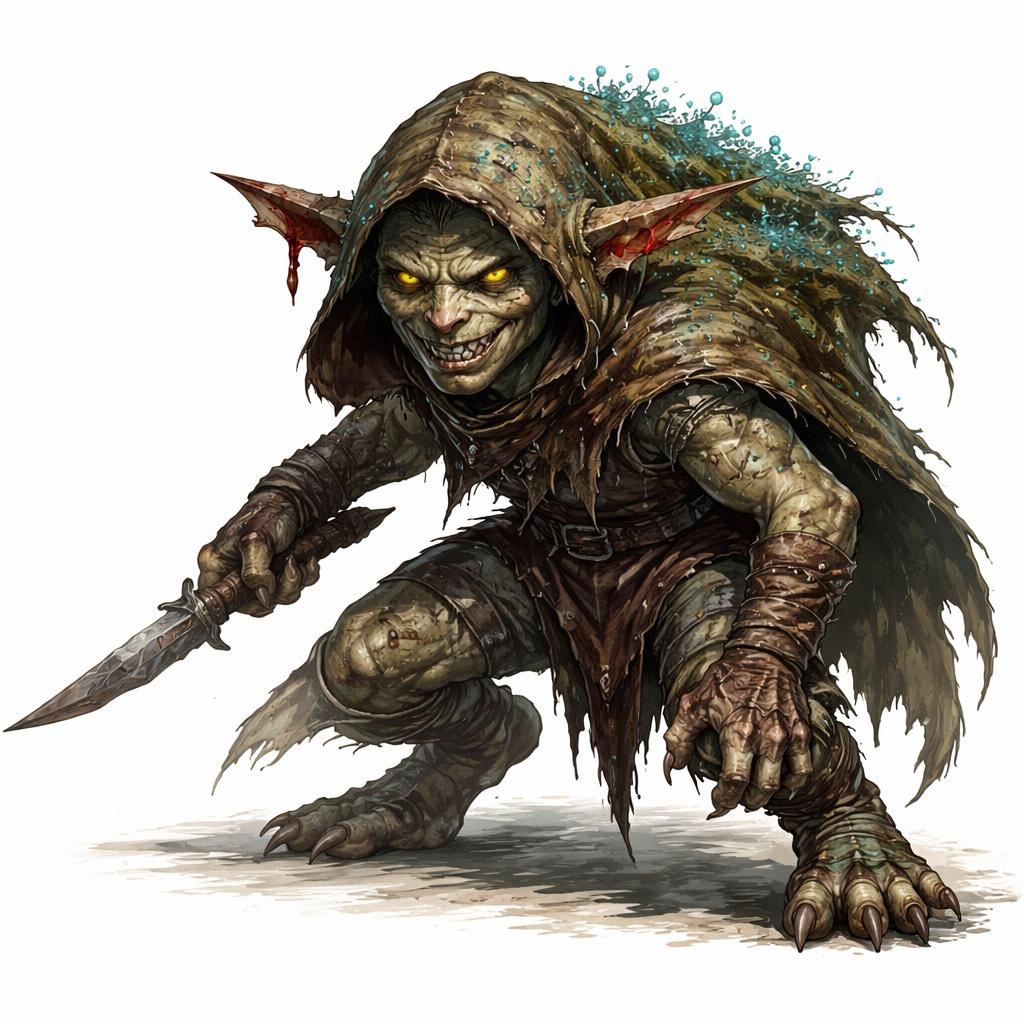

Gloomshank Plate-Runner
Tiny Humanoid (Goblinoid), Chaotic Evil
Armor Class: 13 (Leather Armor)
Hit Points: 7 (2d6)
Speed: 30 ft
Challenge Rating: 1/4 (50xp)
| STR | DEX | CON | INT | WIS | CHA |
|---|---|---|---|---|---|
| 8 | 14 | 11 | 10 | 9 | 8 |
Saving Throws: none
Skills: none
Damage Vulnerabilities: none
Damage Resistances: none
Damage Immunities: none
Condition Immunities: none
Senses: darkvision 60ft, passive Perception 9
Languages: Common, Goblin
Spellcasting
“”
Actions & Abilities
Scimitar: Melee Weapon Attack: +4 to hit, reach 5 ft., one target. Hit: 5 damage (1d6+2) slashing.
Dagger: Melee or Ranged Weapon Attack: +4 to hit, reach 5 ft. or range 20/60 ft., one target. Hit: 3 damage (1d4+1) piercing.
Nimble Escape: Bonus Action: The goblin can take the Disengage or Hide action.
Investigate Decoy Alcove: Action: Investigate or Search the false panel (DC 12 Perception or Investigation). If successful, a second goblin reinforcement bursts from the alcove on its next turn and joins combat.
Appearance
On a stark white backdrop, the Plate-Runner crouches low, a tiny humanoid goblin barely three feet tall but all sparking menace. His frame is wiry and compact, a coil of sinew ready to snap. He tilts forward with a hunter’s balance, weight resting on the balls of his feet, knees bent in a perpetual, skittering prepare-for-spring stance. The silhouette is lean and agile, nothing wasted, every movement a whisper of precision.
His skin reads as sallow olive-green, marred by pale, ashen patches that catch the light as if memory itself is rubbing off. Damp leather armor clung to his frame in places, a dull brown hooded cloak overlaid with mossy greens from the damp gatehouse environs. The cloak’s surface is speckled with blue-green fungal spores that rustle faintly with every breath of air, lending him a faint, otherworldly hue when the runes along his ramp glow softly.
Texture tells the story: skin and exposed flesh feel rough and slightly oily to the touch, a map of fine scars creasing the cheeks and forearms. The leather armor peels in places, patched with scavenged scraps, slick from dampness and wear. The ragged hood and cloak are coarse and mossy to the touch, spores clinging and whispering as he moves. An iron earring, small and dulled by age, hangs from one ear, a rough talisman from a harder time.
His face is narrow and angular, with sharp cheekbones and a pointed snout that keeps its sly, calculating edge even when he grins. The eyes are small, bright, and calculating, a yellow-amber gleam that sizes up every foe. A jagged scar runs across the left cheek, a grim punctuation mark to a life lived in ambush and retreat. His mouth twists into a sly, constant grin, revealing compact, slightly crooked teeth that hint at a mouthful of schemes rather than strength.
Limb-wise, he is all dexterity. Long, slender fingers twitch with quick, capable precision; wiry arms and legs ready to spring. Feet are small but sure on slick surfaces, poised for rapid repositioning along the damp ramp. The overall build favors agility over brute force, a body shaped for ambush, strike, and vanish into shadow.
Movement is the creature’s language. He favors slinking along the ramp, timing his approach and retreat with unsettling exactitude. When he shifts, the armor and skin catch the glow of the runes—an almost shimmer across the plate and flesh that hints at environmental cunning and a life lived in cramped corridors. He sits with the posture of a trap waiting to spring, a low, compact line that makes him nearly invisible against the gray-green of damp stone—until his flash of amber eyes gives him away.
Special features punctuate the image. The blue-green spores clinging to the cloak mingle with the damp air, granting him a distinctive, earthy aura that breathes of damp gatehouses and hidden corners. The runes along the ramp glow with a pale, blue-green bioluminescence, weaving light across armor and skin like a living map of his terrain. Pale scars, a scavenged iron earring, and the spores together craft a practical, battle-hardened look—one that whispers of survival, ambush, and rapid retreat.
In pose and presence, the Plate-Runner is all function and form. He crouches with one knee half-raised, ready to surge sideways along the ramp, one hand steadying himself on a slick plate while the other remains free to snatch at a foe or a foothold. The overall vibe is that of a creature perfectly at home in damp, claustrophobic spaces, where every breath, every flutter of spores, and every glow of glyphs marks him as a master of ambush and retreat in cramped corridors.
This is a creature of texture and glow, camouflage and cunning. The Plate-Runner’s earth-toned armor, spores, scars, and sprung, nimble form combine into a single, striking image: a tiny hunter who looks as if he could melt into a damp wall or erupt into motion in an instant, his bioluminescent glyphs hinting at a magic born of environment and instinct.
Tactical Information
Gloomshank Plate-Runner – tactical narrative framing
Day-to-Day Life and Ambience
In damp, crescent-shaped gatehouses feeding a river trade lane, the Plate-Runner lives a short, sharp life of ambush and misdirection. He is one of a tight-knit, lightly scattered group of goblins who treat this gatehouse as a rebellion of space and shadow rather than a home. By daylight (if goblins bother with it), he skulks behind moss-sheathed stones, oiling a ragged hood and freighting his leather armor with damp patches that cling and clump as he moves. Fungus spores cling to his cloak, giving him a pale, blue-green halo in the dim light of the runes. His demeanor is brisk, practical, and consistently distrustful of outsiders; even polite goblin chatter is a tool for sizing up intruders, not a social exchange.
Socially, he acts as a scout-ambusher rather than a lone hunter. He coordinates with decoys and with any reinforcements that might slither from hidden panels or flood-channel nooks. He treats space as a weapon: a narrow ramp, glinting runes, and a false panel that tempts curiosity are as useful as a blade. His goals are simple: delay, misdirect, and bleed the intruder’s action economy until a better-positioned ally can join the fray. He prefers tactile, environmental leverage over brute force; the runes glow to signal a threat, the damp ramp makes footing uncertain, and the decoy alcove offers a route to late pressure rather than direct conquest.
Combat Behavior
When combat begins, the Plate-Runner behaves like a nimble, tempo-driven ambusher who lives by the leverage of environment. He does not rush in carelessly; he treats the ramp as part of his weapon.
Opening approach
- He begins by creeping along the ramp, advancing from Plate A toward Plate F while watching for the party’s line of sight and threat range. If he’s spotted, he uses Nimble Escape to step back into a safer angle, using the damp surface to slide toward a cover corner or composted niche behind a plate.
- The first contact often comes when a PC steps onto Plate A or B. The rune glow signals his awareness and prompts him to test the PCs’ balance and resolve, not to immediately overwhelm—he wants the party to feel the ramp’s hazard as part of the fight.
Plate interaction and tempo control
- As he reaches each plate, the runes glow pale blue-green. He uses this cue to time his ambush: a quick strike on a target in reach, then a disengage to reset range using Nimble Escape. If a PC blocks his path, he slips past them and repositions toward an advantageous diagonal or toward the decoy alcove.
- If Plate C is triggered by a player stepping on it, the door of pressure momentarily widens; the goblin can choose to drive the confrontation forward or retreat to a safer plate, keeping the party guessing about which plate will “fail” next.
Decoy alcove and late reinforcement
- The decoy alcove is a persistent threat. If anyone spends an action to Investigate or Search the false panel (DC 12), or if the party interacts with it, a second goblin reinforcement bursts from behind the panel and charges in with a subtle surprise advantage.
- In narrative terms, the reinforcement seems to materialize from a hidden crevice, through the flood-channel air, and up to flank or rear the party. This arrival alters the fight’s rhythm: a second target suddenly pressures the flank and splits the action economy.
- The first hit by the reinforcement carries an implied edge—an advantage on the opening strike as he blinks into visibility—representing the surprise element of the late arrival.
Outnumbered or compromised
- If the situation tilts against him (e.g., the party concentrates fully on the ramp or pushes toward the gate), he retreats to a safer plate or sidestep into a water-revealed alcove to reestablish distance and prepare a fresh angle.
- He will not chase through dangerous flood channels unless cornered; instead, he uses the channels as partial cover, forcing ranged or slower opponents to choose between advancing through slick ground or standing and trading blows from a safer position.
- The Plate-Runner’s strengths lie in making a fight feel staged and tempo-driven: he fans out the party’s attention, encourages missteps on the slippery ramp, and uses the decoy to force suboptimal targeting.
Roleplay and Narrative Interactions
Personality and voice
- The Plate-Runner speaks in rough Goblin, with dry taunts about the damp gate, the “blue-green glow,” and the cleverness of his trap. He enjoys the ritual of the ambush, the tension of timing, and the slight fear in intruders who realize they stepped into a trap rather than crossing a simple corridor.
- He is pragmatic, not cruel for cruelty’s sake, and highly adaptable to the party’s approach. He respects cunning and will test a potential ally’s wits with a quick question or a taunt rather than immediately strike at a joke or boast.
Threat assessment and communication
- He treats diplomacy as a possible opening only if it promises him a clearer advantage—perhaps a token, coin, or a map fragment that hints at a bigger gatehouse. Otherwise, he speaks plainly, offering threats in the form of clever traps or bluffing about reinforcements.
- If cornered, he is likely to attempt to feint, misdirect, or retreat toward the decoy alcove or a more advantageous plate location. He is stubborn about his terrain and will defend it with a blend of bluff and quick melee.
Interactions with adventurers
- Bribes or leverage: small coins, a fragment of map, or a rusted key to a gate mechanism could tempt him, but only if the offer directly improves his position—such as reducing a direct confrontation or allowing a safe pass through a still-locked gate at the ramp’s end.
- Deception: he may attempt to mislead intruders about the gate’s true control mechanism, or about the strength and timing of reinforcements, to sow hesitation or misdirection.
- Diplomacy: he’s unlikely to negotiate a long-term truce, but may parley for a single turn of safety if it means buying time to trigger another plate or to signal a decoy’s success in splitting party attention.
Tactical cues for roleplaying in play
- If a PC prods the false panel, emphasize the goblin’s sly grin and a quick, approving hiss at the idea of a “real challenge.”
- If a PC tries to reason with him, respond with a matter-of-fact challenge, like: “Reason with the damp and the glow? There’s no coin in the gate that isn’t paid in fear and footfalls.”
- If forced into a corner, the Plate-Runner’s instinct is to disengage toward the ramp’s safer zones, then reappear to threaten from a new angle rather than fight to the death in a chokepoint.
Notes for GMs using this encounter
- The fight’s flavor comes from environment, timing, and the decoy reinforcement rather than raw damage. Emphasize the pale runes, the slick mossy plates, and the damp air that feels thicker near Flood Channel corners.
- Use the decoy alcove to create a late-phase threat that can swing party dynamics—forcing the party to allocate actions to block reinforcements while keeping up on the ramp.
- Keep the Plate-Runner’s emphasis on positioning and disengage/hide as a core tempo mechanic. He excels at creating one more moment of danger just as the party thinks they’ve gained control of the ramp.
In sum
Gloomshank Plate-Runner is a clean, CR-appropriate melee ambusher whose power comes from environment and timing: six glow-marked plates, a damp ramp, a decoy alcove, and a late reinforcement that shifts the encounter’s rhythm. He fights for control of space, uses Nimble Escape to stay elusive, and leverages a trap-based approach to pressure the party without relying on heavy magic or brute force. In narrative play, he remains a clever, opportunistic goblin whose danger lies as much in the fight’s tempo as in the blade’s edge.