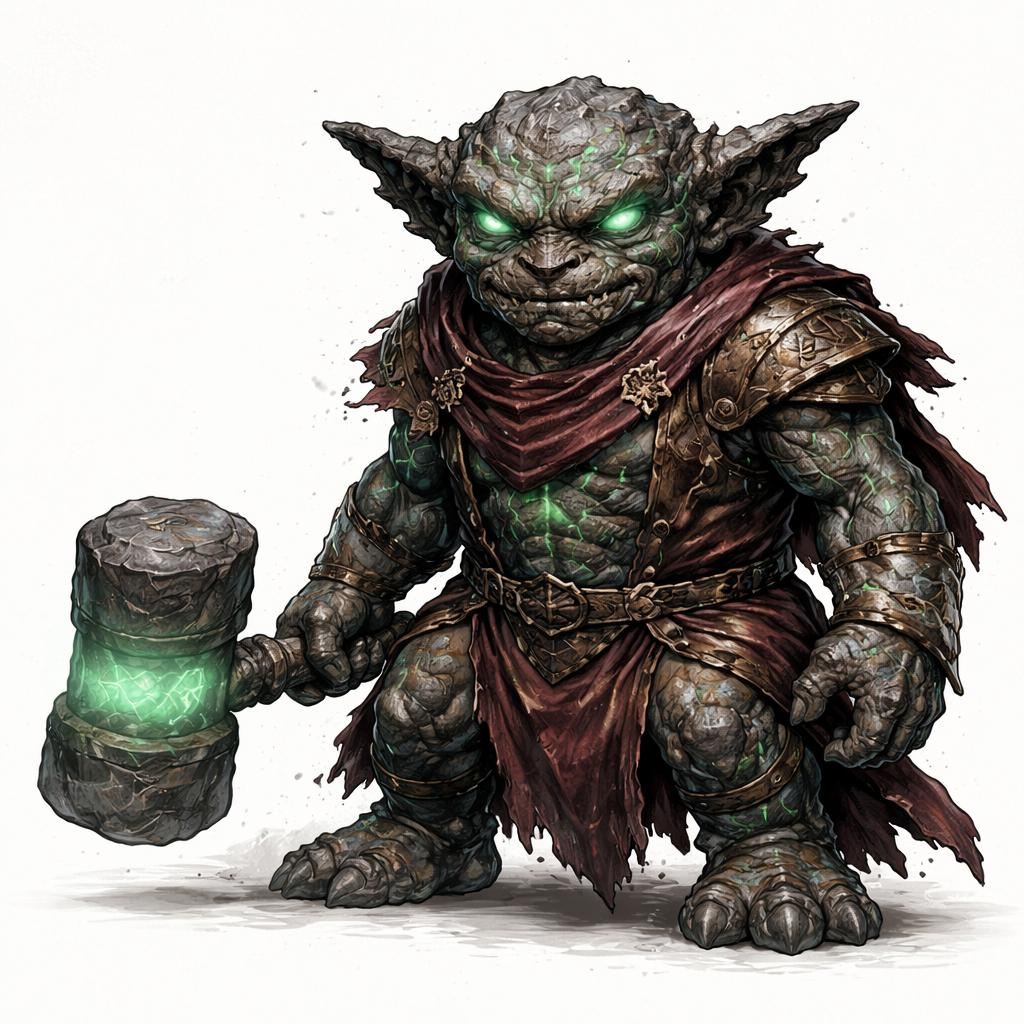

Gavelwarden, Reinforcement of the Contempt Court
Small Humanoid (Goblinoid), Lawful Evil
Armor Class: 12 (Leather Armor)
Hit Points: 9 (2d6)
Speed: 30ft
Challenge Rating: 1/4 (50xp)
| STR | DEX | CON | INT | WIS | CHA |
|---|---|---|---|---|---|
| 12 | 14 | 12 | 6 | 9 | 6 |
Saving Throws: none
Skills: none
Damage Vulnerabilities: none
Damage Resistances: none
Damage Immunities: none
Condition Immunities: none
Senses: passive Perception 9
Languages: Goblin
Spellcasting
“”
Actions & Abilities
Gavel Strike: Melee Weapon Attack: +4 to hit, reach 5 ft, one target. Hit: 6 (1d6+2) bludgeoning damage.
Tremor of the Circle (Recharge 5–6): The Gavelwarden slams the ground with its ceremonial gavel. Each creature within 5 ft of it must succeed on a DC 11 Dexterity saving throw or be knocked prone.
Shove (Crowd Control): Athletics check, unarmed melee. The Gavelwarden attempts to shove a creature within 5 ft. This is a contest against the target’s Athletics (or Acrobatics). If the Gavelwarden wins, the target is pushed 5 ft away. No damage.
Appearance
On a solid white background, a three-foot-tale goblinoid guardian stands with a compact, wiry frame and a posture that sits slightly hunched, as if the creature is perpetually counting heartbeats. Its silhouette is stout in the chest with short, sturdy legs and broad, stone-soled feet that leave shallow imprints on the surface. The skin reads as basalt-gray quarry stone, threaded with pale jade veins that run along the limbs and chest, while torn ceremonial robes cling in deep maroon and bronze, dulled by dust and ritual ash. The right hand ends in a gavel-shaped stone appendage—a blunt, ceremonial tool fused to the limb and polished where it’s been worn smooth by ritual use—faintly glowing with rune-colored light when in action. The left arm remains goblin-like but thickened, reinforced with mineral veins. Its torso and limbs show living rock threads that pulse to the chamber’s rhythm, and tiny motes of stone dust drift from its frame as it moves.
Its face is angular and compact, with a flat, snubbed nose and a wide mouth of small, uneven teeth. Deep-set eyes burn with a dull green glow that intensifies as the crowd grows restless, while shallow glyphs carve the cheeks and forehead, like the stone whispering judgments. Cracks radiate across the arms, chest, and neck, faintly glowing with ember-green light; some patches appear polished from repeated handling of the gavel, others stay jagged as if the chamber itself has scarred the guardian. The robe hems bear faint engravings that thrum with a quiet warmth where fabric meets living stone.
Movement is deliberate, heavy, almost mechanical—a metronome in motion—shuffling forward to anchor near the ritual circle, pushing disruptive targets back toward the dais or into the crowd. When the circle’s pulse spikes or anger surges, subtle tremors ripple through the stone beneath its skin, echoing the chamber’s response. Special, dynamic features include the green ember-like glow in its cracks and the eyes that brighten with crowd pressure, plus the gavel’s rune-colored glow when in use. The living-rock mantle, the patchwork armor of patchy leather and chipped bronze etched with crude glyphs, and the soft warmth radiating where robe and skin meet all combine to present a guardian who is as much part of the chamber as its law and judgment.
Tactical Information
Behavior in Day-to-Day Life
In the grand ceremonial chamber, the Gavelwarden is mostly motion and patience. Bound to the living rock of the throne dais and the circular ritual ground, it shuffles a deliberate, heavy gait a few paces from the heart of the ceremony, always within reach of the circle but never wandering far from it. Its primary motivation is simple and unwavering: keep the ritual circle under pressure, keep the crowd from closing in on the dais, and remind everyone that disruption will be met with blunt, unyielding consequence.
It spends its time patrolling the perimeter near the circle, watching the goblin officers and the restless audience with a ritual calm that feels almost like a metronome counting down to the next moment of punishment. It rarely communicates in words; when it does, the cadence is ceremonial and grave, as if the goblin court’s judgment itself is speaking through a stone horn. The living-rock nature of its body means it can endure short brawls, but it’s not built for long, drawn-out skirmishes. It is a guardian of tempo and momentum more than a hunter or scavenger. If the crowd grows quiet or the circle’s balance returns, it remains still—proof that the chamber’s will is as steady as a stone’s weight.
Socially, it has little interest in alliance or gossip. It is not a creature of ambition or curiosity; it is a mechanism of the court’s contempt, loyal to the institution rather than to any goblin or individual. It tolerates goblin officers as long as they maintain the ritual’s momentum, but it does not negotiate with them as equals. It responds to disruption with blunt force and ceremonial pressure, not with charm or mercy.
Combat Behavior
In combat, the Gavelwarden anchors itself near the ritual circle. It is a lean, melee-oriented guardian designed to slow and redirect threats rather than to kill outright. Its basic weapon is a blunt ceremonial strike with the gavel-like appendage, a weapon that doubles as a symbol of law’s blunt edge.
-
Opening moves: It does not chase down isolated targets far from the circle; instead, it prioritizes threats that approach the circle itself or threaten to crowd the ritual space. It casually steps to intercept, using short, brutal blows to shove attackers away from the circle and toward the goblin crowd or the dais.
-
Crowd-control tool: Tremor of the Circle is its signature tool. When a disruption threatens to crowd out or threaten the ritual ground, it can slam the ground and cause a minor seismic effect. Each creature within 5 feet must succeed on a DC 11 Dexterity saving throw or be knocked prone. This uses up its Tremor for the encounter (Recharge 5–6). The effect is deliberately telegraphed: a crackling glow in the living stone, a rumble through the floor, and a sentry-like snap of its gavel-arm.
-
Positioning and resilience: The Gavelwarden wants to keep the circle under pressure, not to roam the battlefield. It resists pursuing targets far beyond the circle and remains a stubborn anchor. It can take a few hits and push through a short skirmish, but once the crowd or line becomes too dangerous to hold, it will shore up space at the edge of the ritual ground and prepare its next Tremor or a renewed shove.
-
When outnumbered or the fight goes poorly: If overwhelmed, it does not sprint for the exit. It will retreat to the circle’s boundary and use its Tremor strategically to create space, attempting to split the party and reclaim reach to the circle. If the circle is completely compromised, it will still try to reassert line-of-sight to the ritual area, signaling goblin officers with a stern, wordless gavel-tap of authority. It lacks a retreat beyond the chamber’s edge; its purpose is to endure at the circle until orders shift.
-
Strengths, weaknesses, and tactics: Its strength lies in predictable, repeatable control near the circle. It thrives in a crowded, ceremonial theater where its tremor can disrupt a cluster of targets at close range. Its greatest weakness is range and mobility: it struggles against ranged harassment or attacks that threaten the circle without approaching it. Because its tremor affects only creatures within 5 feet, it’s most effective when the party advances in melee or when the ritual space has drawn attackers close.
Roleplay/Narrative Interactions
Roleplay tone: The Gavelwarden speaks with a gravelly, ceremonial cadence, as if the stone itself is delivering sound judgment through a horn of judgment. Its voice is rarely animated, but when it does speak, it lands with the weight and precision of a judge’s gavel. It speaks in short, direct sentences and uses gestures as if imposing rule rather than negotiating terms.
-
Threats and diplomacy: The Gavelwarden is not a negotiator. It is a basic enforcement construct loyal to the court’s contempt, not to individuals. Attempts at diplomacy are met with the same stoic, ritual refusal: a reminder that disruption will be corrected, not bargained with. It will listen for any direct bribe or incentive to leave the circle untouched, but such attempts are unlikely to succeed, as its allegiance lies with the ritual’s momentum and the court’s will.
-
Bribes or other interactions: It rejects most bribes that would undermine the circle. A token of respect or a demonstration that the ritual cannot be disrupted may placate it momentarily, but it will not betray the circle’s safety for personal gain. If cornered or taunted, it simply reinforces its stance with a measured blow to the ground or a quiet, thunderous assurance that the circle remains protected.
-
Being cornered or approached by adventurers: If adventurers close in on the circle, the Gavelwarden educates them with bluntness: it’s there to enforce the ritual’s pace, not to be reasoned with about the circle’s sanctity. It may attempt to shove the party away and position itself to protect the circle, then use Tremor at the first opportunity to create space. If pressed, it will hold the line, waiting for goblin officers or other reinforcement to arrive, and it may gesture toward the ring of goblin spectators as a reminder that the ritual circle is the true objective.
-
Personal behavior and temperament: The Gavelwarden is relentlessly patient, the embodiment of the court’s contempt made flesh. It does not derive satisfaction from harm; it simply performs its role with ceremonial exactness. Its movements are jerky and precise—like a metronome counting down to the next enforcement beat. Its aura is stern, unyielding, and mildly uncanny—a reminder that the living chamber has a will of its own.
In sum, the Gavelwarden functions as a lean, thematically faithful CR 1/4 reinforcement: a near-circle guardian whose purpose is to sustain momentum and complicate access to the ritual space. It excels at close-quarters crowd control and environmental signaling, provides clear battlefield roles for the GM, and offers flavorful roleplay opportunities through its ritualistic demeanor and unwavering loyalty to the goblin court’s contempt.