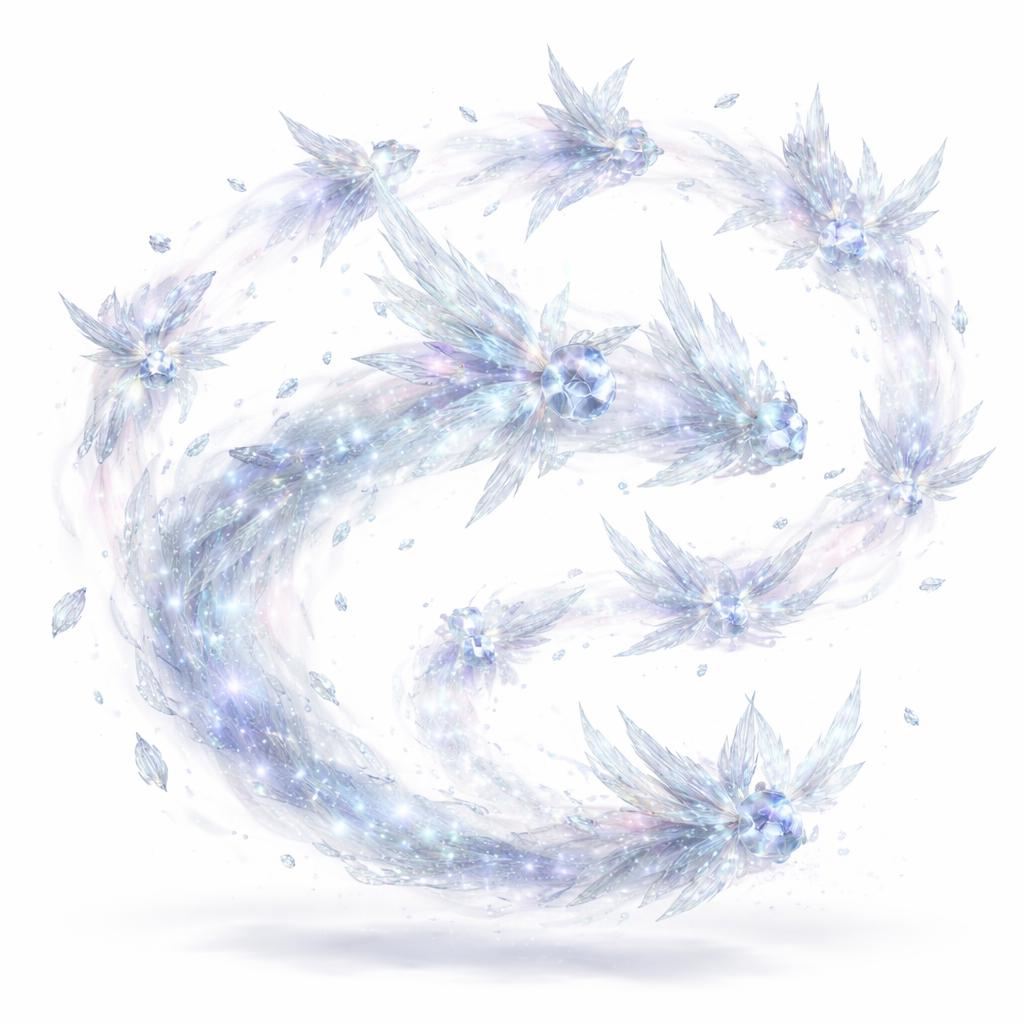

Echo-Chaff (Chaffling)
Tiny Aberration, Neutral
Armor Class: 12
Hit Points: 9 (3d6)
Speed: 20 ft., fly 20 ft. (hover)
Challenge Rating: 1/4 (50xp)
| STR | DEX | CON | INT | WIS | CHA |
|---|---|---|---|---|---|
| 4 | 16 | 12 | 3 | 10 | 6 |
Saving Throws: none
Skills: Stealth +6
Damage Vulnerabilities: none
Damage Resistances: none
Damage Immunities: none
Condition Immunities: none
Senses: Darkvision 60 ft., Passive Perception 10
Languages: None
Actions & Abilities
Claw: Melee Weapon Attack: +4 to hit, reach 5 ft., one target. Hit: 4 (1d4 + 2) slashing damage.
Dash: The Echo-Chaff uses its movement to dash, gaining extra movement this turn (total movement equals its speed + bonus dash).
Hide: The Echo-Chaff takes the Hide action, attempting to blend into the Outer Memorial Field and remain unseen as it relocates.
Dodge: The Echo-Chaff takes the Dodge action, giving it disadvantage on attack rolls against it and advantage on Dexterity saving throws until the start of its next turn.
Memory Echo (Passive): The presence of multiple Echo-Chaffs in a space creates a narrative distraction around any central dais or guardian. The DM may describe enhanced crowding, shifting shadows, and disruption of focus as a narrative cue or apply a minor mechanical distraction at GM’s discretion.
Death Burst: When the Echo-Chaff dies, it releases a memory-flash in a 5-foot radius. All creatures within 5 feet must succeed on a DC 10 Wisdom saving throw or take 1d4 psychic damage and have disadvantage on their next attack roll for that creature until the end of its next turn. On a successful save, they take no damage and have no lingering effect.
Appearance
Against a solid white background, a constellation of tiny, coin-sized motes hovers in buoyant, weightless grace. Each is a pale azure or silver shard of translucent crystal dust, soft to the eye yet hard to pin with one glance. They carry a faint internal shimmer—memory-light that hints at recollections just beyond reach—and in certain lights, flecks of opalescent pink or violet ripple through their surfaces, like distant prisms alive with memory.
There is no face to read here, only a tiny, faceted core at the center of each mote. When memories swell nearby, that core gleams briefly with a memory-echo, a flicker of light that suggests a story passing through. The surface is gem-like and faceted, catching light and spitting it into brief afterimages as the motes drift. Their texture resembles crystalline dust—soft to perception, impossible to trap with the eye.
No limbs exist in the traditional sense; propulsion comes from delicate crystalline winglets and a trailing memory-dust that circles each mote, tugging it forward with a gentle, almost miraculous lift. In groups, they fuse into shifting, light-woven chains or coil into radiant, serpentine forms, as if a living lattice were composing a chorus of light. When many gather, their bodies subtly imitate the Guardian’s cadence, a rhythmic shimmer that unites many into a single, coherent movement.
Movement is lively and purposeful: quick bursts toward living targets in melee range, then a hovering, crowding presence that blocks lines of sight. They do not retreat easily; they press and weave, creating pressure, openings, and misdirection through graceful, synchronized motion. A distinct memory-hum fills the air around them, punctuated by a soft chime as they glide and interact.
Special features radiate from their being. Memory-light pulses travel through the group, growing brighter when concentrated at focal points, and the air hums with memory-energy as their glow intensifies. When a mote dies, it releases a five-foot-radius memory-flash that briefly brightens nearby tokens and leaves a soft afterimage in the air. Destroyed chaffs reveal hidden ones in the surrounding field as if the tokens themselves momentarily glow to disclose clusters. The whole creature presents as a living, ever-shifting sculpture of memory and light—a luminous swarm that can form a glow-drawn chain, a radiant coil, or a solitary, hovering beacon—all visible and striking against the white backdrop.
Tactical Information
Echo-Chaff (Chaffling) are small, swarm-like, memory-born minions whose purpose is pressure and distraction. In play, they function as a low-CR nuisance that reshapes the battlefield and splits attention, making space for more dangerous threats or for challengers to be bumped off the central dais.
Behavior in Day-to-Day Life
- Habitat and presence: Echo-Chaffs constantly spill forth from the Outer Memorial Field, where memorial tokens and shifting shadows provide cover and ambush opportunities. They drift in clusters, flickering with pale azure light, their bodies leaving faint memory-echo afterimages as they move.
- Motivation and temperament: They exist to press, distract, and occupy. They care little for defense or offense beyond maintaining a steady pressure on anyone who stands on or near the central dais. They are unambitious, simple creatures—driven not by intellect but by a relentless compulsion to swarm toward concentration and action.
- Social dynamics: They have no true leadership or complex social structure; they operate as a mindless swarm. Some chaffs may momentarily imitate the Guardian’s cadence or a nearby chant, a reflexive memory-feature that helps them blend with—and bait—their target. In crowds, they feel calmer when many are present; in solitude, they waver and drift.
- Daily activity pattern: They patrol the Outer Memorial Field in search of living targets within melee range, especially those focusing on the dais or attempting to reposition on the Archive Hub. They do not retreat from danger on their own; injury simply slows them, and if pressed they recombine with other chaffs from nearby tokens or shadows.
- Interaction with environment: The tokens and debris of the field serve both tool and trap. When a chaff is destroyed, the token it stood near may glow briefly, revealing other hidden chaffs and inviting new ambushes in the next round. They are most potent when the Field can provide cover and surprise angles.
Combat Behavior
- Opening approach: Echo-Chaffs surge toward the closest target on or near the central dais, prioritizing the Memory Guardian and any intruder attempting to position on the dais. They cluster to threaten the same target, forcing the Guardian and players to split attention and space.
- Tactics and mechanics in play:
- Swarm pressure: Each chaff aims to occupy space that a target would otherwise use, creating a crowding effect and making it harder for a single person to maneuver freely around the dais.
- Focused disruption: When three or more chaffs are within 5 feet of the Guardian, narrate a moment where the Guardian’s attention wavers—a brush of memory-dust across their senses, a stuttering in response to the chorus of echoes. If your rules allow, grant a small, temporary perception penalty to the Guardian for a round.
- Death burst (narrative and mechanical cue): When a chaff dies, it releases a small memory-flash within 5 feet. Any creature there must succeed on a DC 10 Wisdom saving throw or take 1d4 psychic damage and suffer disadvantage on their next attack roll for that creature until the end of its next turn. On a successful save, the target takes no damage and has no lingering effect.
- Endurance and limits: Chaffs are Tiny, with low HP and AC, so they are easily cleared by area effects or focused strikes. They rarely win a fight outright; their value comes from the pressure they apply and the openings they create for other threats or for repositioning on the dais.
- Exit and re-entry: If overwhelmed or losing effectiveness, chaffs melt back into the Outer Memorial Field’s tokens and shadows, then reemerge in subsequent rounds to keep up the pressure—never truly defeated, only temporarily routed.
- Terrain and encounter flow: In the Outer Memorial Field, chaffs can use cover to approach unseen and to vanish into shadows if pressed. The Inner Memory Archive Dais and Galleries pose a threat to chaffs due to tighter space and the Guardian’s protective focus around the dais; still, they can slip through gaps or be drawn into the crowd to delay direct access to the Archive Hub. The Center Memory Echo Chamber magnifies the strategic value of keeping the Guardian busy, while the South Dome’s corridors naturally bias the Guardian’s attention elsewhere, giving chaffs additional routes for pressuring the dais.
- Tactics against different party setups: If the party concentrates on the Guardian, chaffs slow and reduce efficiency by crowding the dais and forcing repositioning. If the party fights the chaffs first, more chaffs may surge from tokens, briefly easing the Guardian’s burden but increasing the risk of a second wave that splits attention even more.
Roleplay/Narrative Interactions
- Communication and behavior: Echo-Chaffs do not speak. They communicate in a braided chorus of faint chimes and memory-like flickers, a flavor of understanding rather than language. They respond to threats with a predictable pattern—swarm, crowd, press, and occasionally imitate a cadence that echoes the Guardian’s own movements.
- Threat responses: When pressed or cornered, they do not bargain or negotiate. They recoil momentarily into shadows or tokens, then surge again, maintaining pressure rather than fleeing in fear. If surrounded or defeated in rapid succession, they scatter back into the field’s tokens, re-forming anew in a round or two.
- Diplomacy, bribes, and deception: Given their nature as disposable pressure units, they are not amenable to bribes or reasoned diplomacy. They respond to ritual or token-based cues that tie into the Warren Core’s lore (for example, ritual chants carved into tokens or a token activation that temporarily dampens magical effects). A clever ruse might manipulate their imitation of the Guardian’s cadence to mislead other threats, but straightforward negotiation is not in their toolkit.
- Personality in non-combat scenes: In scenes that emphasize lore or history, Echo-Chaffs might be described as the “breath of the Warren’s memory” or “the chorus of the Core’s defense.” Their presence is unsettling but not malevolent; they are an expression of the Core’s defense mechanism—repetitive, inexhaustible, and unswervingly steady. They are therefore more likely to be studied, exploited, or rerouted by wardens and capable players rather than befriended or cajoled.
- Cornered or approached by adventurers: If adventurers confront a cluster directly, the chaffs respond with a perpetual motion of small, shimmering shapes that briefly block sight and dampen the air with memory-chime. If enough chaffs are destroyed, the field may glow and reveal hidden chaffs, offering players an opportunity to plan ambushes or disrupt a future swarm. They will not surrender; they will only retreat into the field, waiting for opportunities to return.
Notes for the GM
- Use the three-zone layout to emphasize crowd control and attention allocation. The Outer Memorial Field is where chaffs thrive; the Inner Archive area tests their ability to infiltrate and press; the Center Echo Chamber is where their pressure intersects with the Guardian’s central role.
- Scaling and pacing: If players are too comfortable, increase chaff counts in the Outer Memorial Field or add occasional “sentinel chaffs” that rally nearby chaffs for a brief window of slightly tougher engagement. If players are overwhelmed, emphasize the chaffs’ ability to slip away and reappear, maintaining a constant background pressure rather than a single, run-away encounter.
- Thematic tie-ins: The death-burst effect reinforces the memory-echo theme; every bite of memory is a small, painful reminder that the Core’s defenses are listening to the memory feeds as much as to the living intruders.
If you’d like, I can tailor this Echo-Chaff concept to a specific game system (D&D 5e, Pathfinder, or a homebrew system) by providing a fully converted stat block with system-specific mechanics, or generate a few more variants to reflect different party compositions and dungeon pacing.