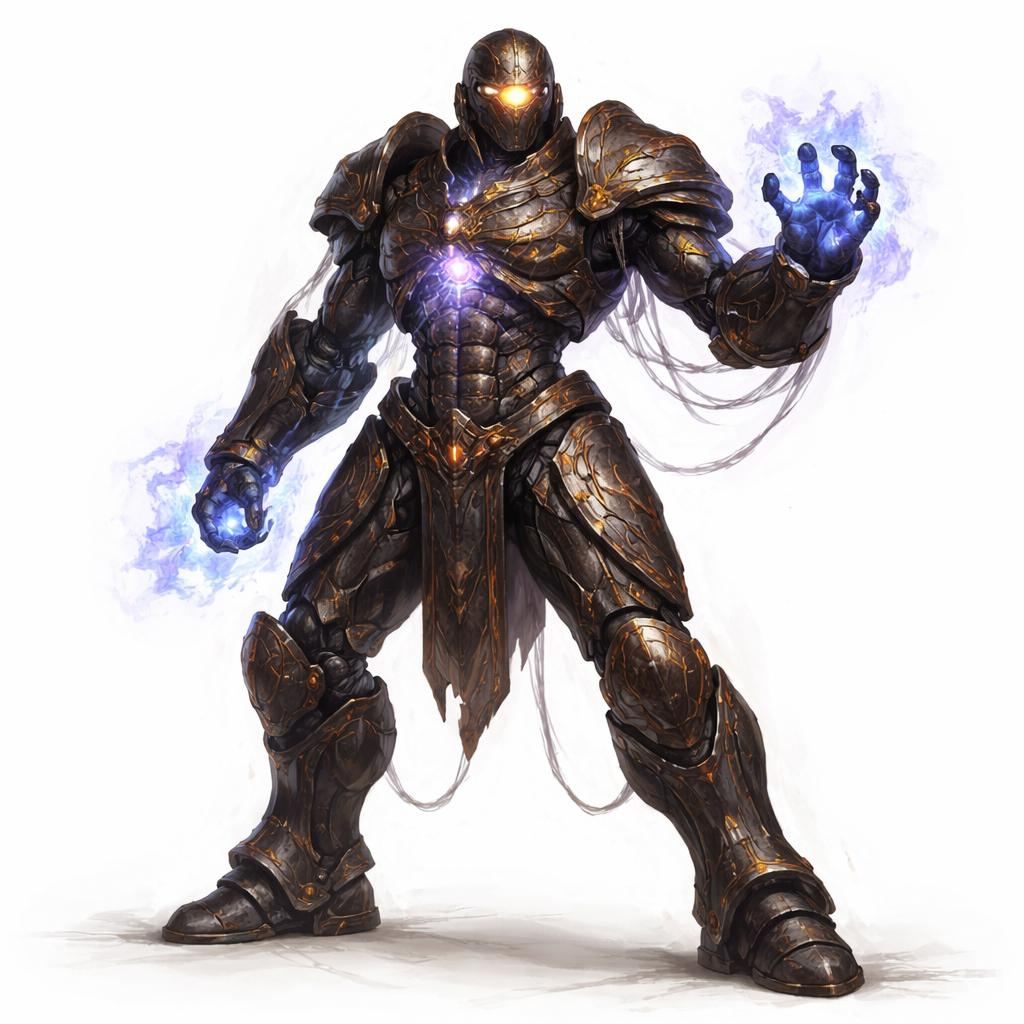

Ironbound Idolwarden
Medium Construct, Lawful Neutral
Armor Class: 14
Hit Points: 68 (9d8 + 27)
Speed: 25ft
Challenge Rating: 3 (700 XP)
| STR | DEX | CON | INT | WIS | CHA |
|---|---|---|---|---|---|
| 14 | 12 | 16 | 10 | 11 | 5 |
Saving Throws: Con +5, Wis +3
Skills: Perception +3
Damage Vulnerabilities: none
Damage Resistances: poison
Damage Immunities: lightning, poison
Condition Immunities: charmed, exhausted, frightened, paralyzed, petrified, poisoned
Senses: Darkvision 60 ft., passive Perception 13
Languages: Common
Spellcasting
Spellcasting. The Idolbound Idolwarden is a 3rd-level spellcaster. Its spellcasting ability is Intelligence (spell save DC 13, +5 to hit with spell attacks). The Idolwarden has the following spells prepared:
Cantrips (at will): Arcane Bolt, Ray of Frost, Mage Hand
1st level (4 slots): Magic Missile, Shield, Mage Armor, Absorb Elements
2nd level (2 slots): Scorching Ray, Mirror Image
3rd level (1 slot): Counterspell
Notes:
– Arcane Bolt is a custom cantrip used as the idolwarden’s primary ranged attack; it has a +5 to hit, 60 ft. range, and deals 1d8+3 force damage on a hit.
– The Idolwarden relies on cantrips for consistent ranged pressure, with 1st- and 2nd-level spells for defense, control, and additional damage. Counterspell gives it a moment-to-moment ability to disrupt enemy spellcasting.
– Mage Armor and Shield are typically used to boost AC before or during combat; Absorb Elements provides resistance against triggering environmental hazards when the ward is exposed to elemental effects.
– Scorching Ray offers a multi-attack ranged burn at 2nd level; Mirror Image provides survivability against targeted strikes.
– Counterspell at 3rd level is a reaction; it can interrupt a spell cast within 60 ft, fitting the Idolwarden’s role as a vigilant corridor guardian.
Special notes:
– The idol core’s presence may influence spell usage in storytelling terms (e.g., a tense surge opens a brief window to amplify traps or extend the Trapweave Field). Casts can be described as leveraging the hub’s power without adding mechanical complexity to the block.
Actions & Abilities
Arcane Bolt: Arcane Bolt. Ranged Spell Attack: +5 to hit, range 60 ft., one target. Hit: 1d8+3 force damage. If the Idol Mechanism Core is within 60 feet, the attack gains +1 to hit and +1 damage (to 1d8+4 and +6 to hit).
Trapweave Field (Recharge 5-6): Trapweave Field (Recharge 5-6). Area 20 by 20 feet within 60 ft. Creatures in the area when it appears must succeed on a DC 12 Dexterity saving throw or take 2d6 piercing damage and have their speed reduced by 10 ft until the end of their next turn. On a successful save, they take half damage and aren’t slowed. The field lasts until the start of the Idolwarden’s next turn.
Chain Lash: Chain Lash. Melee Weapon Attack: +4 to hit, reach 10 ft., one target. Hit: 1d6+2 bludgeoning damage.
Appearance
On a stark white background, the Ironbound Idolwarden presents a compact, medium construct—about 5’10″ tall—with a lean, athletic humanoid silhouette. Its frame is powersfully balanced for narrow corridors: broad shoulders knit into a tapered waist, sturdy legs with precise pivots, and a calm, upright stance that speaks of discipline.
Its surface is dark hammered steel, a patina of rust and oil-darkened creases giving it an ancient, ritual-wrought look. Coppery runes trace every seam and rivet, glowing with a muted blue-violet aura that brightens when arcanum surges through the machine. The helm-lens eye glows, alternately amber or violet, shifting with focus and power.
The chest reveals a rib-like lattice that frames the Idol Mechanism Core—visible behind the ribs and pulsing with runic light. When energized, threads of light weave from the core into the surrounding armor, giving the whole figure a living, sanctified glow. A faint, enclosing magic aura forms around the core, subtly reinforcing the silhouette with a cold, warded glow.
The head is a smooth-visor helmet with a single forward-facing eye; there is no mouth—only a narrow vent and occasional micro-sparks of arcane energy along the jawline when it speaks in a clipped, metallic tone.
Limbs are robust yet articulate. The arms end in broad gauntleted hands with articulated fingers capable of delicate manipulation or hard strikes. Forearms cradle arcane conduits that glow when casting, with subtle tubing and runes that serve as foci for bolts and traps. The legs are stout, with reinforced knees and small feet built for precise, controlled movement.
First impressions are of ritual ironwork fused with siegecraft: welded seams, hammer marks, heat-kissed edges, and engraved sigils that feel ceremonial as much as functional. Chains overhead and the surrounding wargear motif echo its disciplined, siege-centered aura. A cold aura clings to the plating, hinting at dormant wards and dormant power.
Pose: poised in a siege-ready stance, slightly angled toward the viewer. The left hand rises as if to shield or channel energy, while the right rests near the hip, ready to unleash or trap. The overall presence is a compact guardian—calm, calculated, and immensely determined to dominate the corridor it patrols.
This fusion of ironwork precision and ritual magic makes the Idolwarden feel forged as much to sanctify as to strike—a dynamic, electrifying guardian whose runes glow brighter with power and whose core hums with restrained, booted energy.
Tactical Information
Behavior in Day-to-Day Life
The Ironbound Idolwarden is a disciplined heartbeat in a long, cold corridor. It spends most of its life scanning and pacing the central aisle, its movements measured and economical, never wasting motion. Its primary motivation is simple and unwavering: keep the Idol Mechanism Core safe and the corridor’s line of sight unbroken. It treats the weapon and armor racks as both cover and tools, inspecting them with methodical care, checking for shifting plates or newly triggered runes that might weaken its domain. When idle, it performs routine calibrations—twisting a rune here, nudging a plate there—so that floor traps and runic wards remain synchronized with the Idol Core’s pulse.
Interactions, if any, are sparse and purposeful. The Idolwarden does not seek company; it tolerates only the presence of the corridor’s architecture, its own construct kin if they are nearby, and, of course, the Idol Mechanism Core. It communicates in a clipped, metallic baritone that sounds almost polite when issuing warnings or commands to intruders. In its own chamber of purpose, it analyzes patterns—where foes come from, how they group, how they react to the traps, and which sequences of bolts best thin a crowd. It does not hunger or sleep; it merely waits for the next breach in the hub’s security, ready to respond with precision.
Its temperament is stoic and unyielding, a craftsman’s patience in motion. It does not rage or panic; it evaluates, positions, and strikes in cadence with the corridor’s runes. When its allies are present (if any iron-clad guardians share the hub), it maintains a professional, almost ritualistic partnership—each guardian watching a different arc of the corridor, ensuring the Idol Core remains within sight and within influence. Above all, it respects the architecture that sustains its power and the core that powers its discipline.
Combat Behavior
When a party enters the corridor, the Idolwarden does not rush. It steps back behind the racks, using their angled surfaces as partial cover and as a mesh of angles to complicate line-of-sight—a tactical rebuke to melee chargers. It begins with calm, practiced Arcane Bolts, selecting targets who press too close or spread too far from the central aisle. Its bolts stream in measured bursts from its gauntlets, each bolt guided by a precise sightline, dealing a modest but steady 1d8+3 force damage. If the Idol Mechanism Core is within 60 feet, the warden’s accuracy and damage receive a small boost: +1 to attack rolls and +1 damage on those bolts, making the corridor feel all the more lethal for anyone attempting to breach the waxy light of the core’s aura.
The corridor’s architecture is its strongest ally. When the party advances, the Idolwarden often invokes Trapweave Field, weaving a 20×20 foot patch of runic floor that crystallizes in the aisle. Creatures in the area must make a DC 12 Dexterity save or take 2d6 piercing damage and have their speed reduced by 10 feet until the end of the next turn. A successful save halves the damage and suppresses the slow. This field is not merely damage; it disrupts momentum, forcing adversaries to break rhythm, hesitate, or seek cover behind the racks. The Warden times it to ensure it keeps the central bloodline of the corridor open for its ranged assault, while pushing foes toward the core’s influence or into other traps.
If the Idol Mechanism Core remains intact, the Core emits a rare but noticeable surge in response to imminent danger. The Warden receives a subtle boost—its next Trapweave Field grows in scope, extending slightly beyond its normal footprint (about 5 feet more) and applying the slow to any creature that fails the save regardless of the result. This Idol Surge is a narrative cue as much as a mechanical one: it signals the core’s willingness to intervene, but it should be rare enough to avoid trivializing the players’ strategies.
When outnumbered or pressed, the Idolwarden leans on environmental synergy. It doesn’t abandon the fight; it pivots to safer zones, moves behind racks to maintain line-of-sight while reloading and re-targeting, and uses a sequence of bolts to thin the crowd before re-asserting control with another Trapweave Field. If the Core is damaged or destroyed, the warden becomes more conservative—its actions emphasize zoning and hit-and-run tactics, trading a steady stream of bolts for careful, calculated trap placements aimed at breaking enemy lines and funneling foes back toward the core’s influence.
Endgame, or a drawn-out engagement, may see the warden attempt a more ambitious Trapweave weave, designed to corral intruders toward a weapon rack that can be tipped or used as an improvised hazard. If the corridor’s traps begin to overwhelm, it may withdraw to a safer parallel, keeping the core within its sight, waiting for the right moment to reassert pressure with a decisive volley or a well-timed field.
Roleplay/Narrative Interactions
In non-combat moments, the Idolwarden remains courteous but curt, its speech a metallic whisper that seems to echo from the iron ribs of its own chest. If pressed or questioned, it answers with facts, lore of the idol hub, and warnings about “duplicates.” It is not cruel, merely efficient, and it treats any attempt at diplomacy as a potential test or puzzle.
Diplomacy or bribes, if offered with genuine intent, are treated as tests of character and worthiness. The warden respects those who approach with a plan that respects the hub’s security—proof, perhaps, of a desire to preserve or responsibly appropriate the idol’s power. It might suggest a non-violent concession: solve a riddle of the idol hub to unlock a passage, provide a repair-portion to a damaged trap, or demonstrate that you can navigate the corridor’s hazards without triggering a trap that would jeopardize the core.
If cornered or approached aggressively, it responds with a firm, almost ritualistic warning. It will remind intruders that the hub’s memory is not theirs to claim and that the core’s power is bound to its discipline. It may reveal hints about the hub’s history—the copies carved from fallen foes—and how those echoes can become dangerous if the party disturbs them too deeply. The idol imagery in its chest-side core flickers briefly, hinting at the memories the hub’s magic copies from, which can be both a warning and a well of potential clues for adventurers who seek to understand the larger history.
Intelligence and temperament shape its interactions. It rarely lies; it speaks in precise, factual terms and offers no easy bargains. Yet it is not unkind. A party that demonstrates patience, careful observation, and a respect for the corridor’s architecture might earn it a cautious level of trust. It could provide a hint about how to disable or pass the hub’s defenses if they can prove their intentions align with the legion’s protection of the idol hub. If a party begins to dismantle or loot carelessly, the Idolwarden will treat it as an assault on the hub’s integrity and respond with sharpened resolve, tightening its defenses and increasing its patrol hesitations.
In sum, the Idolwarden is not just a guardian; it is a patient steward of a ritualized battlefield. It values discipline, precision, and respect for the corridor’s architecture, mirroring the Iron Bound Maw Legion’s iron-forged, ritual-tech ethos. Its interactions—whether in quiet patrol or tense negotiation—remain consistent with a construct that believes its purpose is to maintain a balance between the corridor’s deadly environment and the core that powers it.