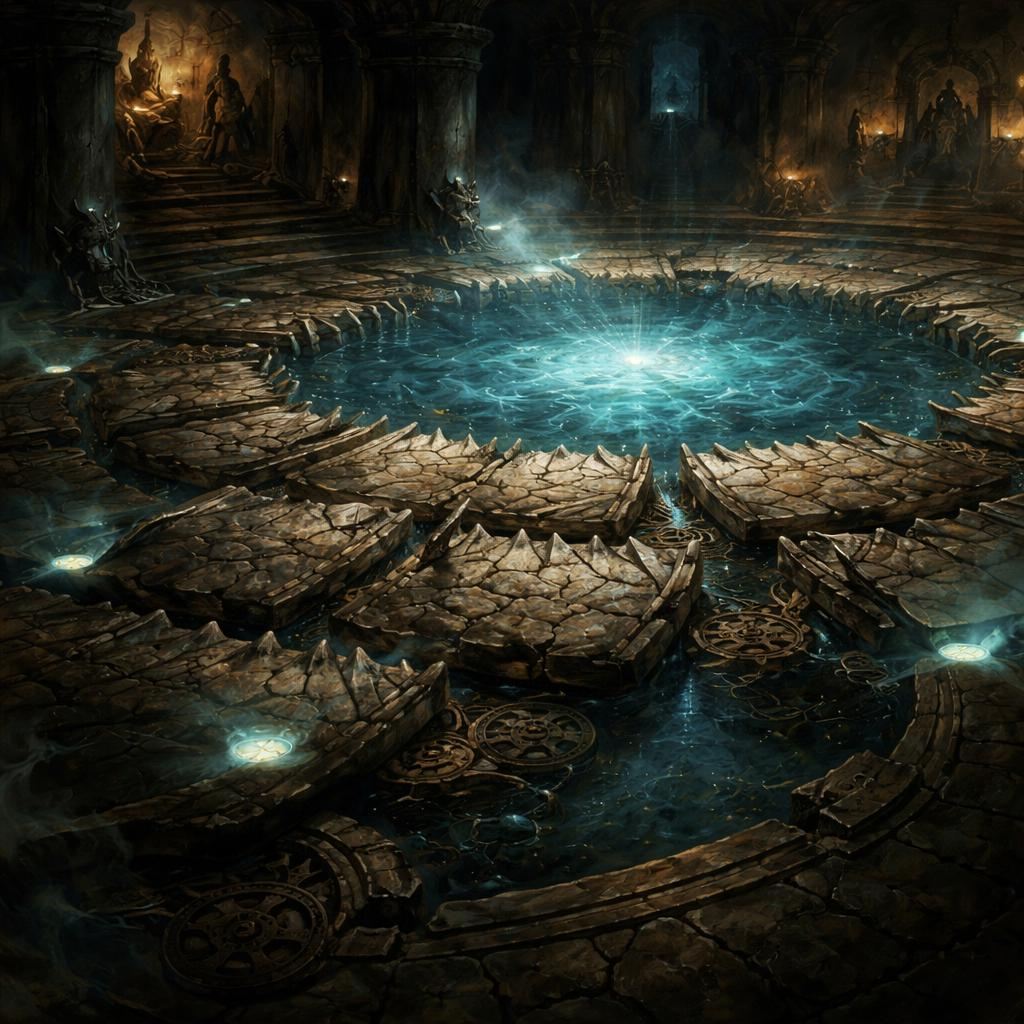

The Mawbound Ritual Pool
Complexity: Complex
Type: Environmental trap with hybrid mechanical and magical puzzle components (mechanical floor mechanics plus warded runes).
Severity: Dangerous (non-damaging hazard with potentially party-wide time costs and tactical disadvantages).
Trigger: Stepping onto a maw-engraved plate that is not part of the current approved sequence triggers the plate to rotate or slide along a concealed track toward the pool’s edge. Movement is staggered and feels alive; plates realign as clues shift from one phase to the next.
Effect: Dexterity saving throw DC 14. – Success: The character remains on course and continues the puzzle without being dragged. – Failure: The character is gently dragged toward the pool’s edge (up to 5–10 feet). They gain disadvantage on the next step as they must reorient after the misstep. A misstep can also slide the character to a lower tier (a separate platform) with its own safe/non-safe plates. A failed save costs a full round to reorient and resume the puzzle on the following turn. No direct damage occurs from the trap itself.
Damage Output: None. The hazard is environmental and positional rather than harmful in a direct sense. (N/A)
Detection DC: Perception DC 15 to notice irregular plates and subtle seams; Investigation DC 14 to recognize patterns indicating a safe sequence; Arcana or Religion DC 12–15 to sense warding or ritual significance; Passive Perception 10 + proficiency modifier; Optional magical detection: Detect Magic reveals transmutation/enchanted auras around the plates and pool, hinting at active ritual protection
Disarm DC: Option A — Correct sequencing (puzzle path): Investigation DC 14–16 to identify safe plates and their sequence; Arcana or History DC 14–16 to infer ritual patterns from inscriptions. Option B — Hidden master control plate (physical disarm): Location: Behind a statue/pedestal on the northeast, hidden by rubble or a rolled textile; Perception DC 15 or Investigation DC 15 to locate the control; Thieves’ Tools DC 15 or Sleight of Hand DC 15 to disengage the master control. Option C — Magical bypass: Dispel Magic DC 17 or ritual cancel to dampen wards and slow or prevent missteps for a number of rounds. Option D — Ritual completion (story-driven): Arcana or Religion DC 14 combined with Performance or Sleight of Hand DC 14 to place components and complete the ritual; Multiclassed or pooled checks are possible; success neutralizes or temporarily silences the hazard
The chamber is damp and lime-washed, with phosphorescent fungi clinging to the edges of the pool. The floor around the pool is etched with dozens of maw-like glyphs; each plate bears a different tooth arrangement, and some show more wear from repeated proximity to the pool’s edge. When the party steps, a subtle grind-sigh echoes as a jawline slides open or closed along hidden tracks. The pool at the center shimmers with ink-blue light; glyphs along the edge glow softly as a correct plate is stepped upon, offering a silent, magical nudge toward the right sequence. If a misstep occurs, the jaws tilt and pull the traveler closer to the edge; the pool’s surface ripples in response to misalignment, and the runes brighten in a way that hints at the next correct path. If several missteps pile up, mist rises up from the pool and shrouds the room, muffling voices and making footing uncertain. A lower tier acts as a separate stage with its own safe and dangerous plates, forcing the party to rethink the approach.
Maw-Engraved Ritual Pool Chamber — Gameplay Notes for the DM
Overview reminder
- This is a complex, multi-round environmental trap with both mechanical and magical components.
- Target level around ACL 9; Dex save DC 14 to avoid being dragged a few feet toward the pool edge on a misstep.
- No direct damage from the trap itself; danger comes from missteps, loss of momentum, and the need to reorient and reattempt.
- It supports round-by-round play, with plate sequencing, tiered movement, and optional disarm paths.
- Trap Activation
- Trigger: Any step onto a maw-engraved plate that is not part of the approved sequence activates the mechanism. Plates rotate or slide along concealed tracks toward the pool edge. Movement is staggered so the floor feels alive and irregular.
- Environmental cueing: When a misstep occurs, the floor gives a muted grinding sigh, a faint tremor runs through the chamber, and the pool surface ripples. Glyphs along the pool edge glow faintly, then brighten if a misstep is near the critical plates.
- Immediate consequence on activation:
- If a PC is on the plate that is part of the active safe path, nothing happens to them beyond the normal misstep resolution (if their step is not on a safe plate, the misstep resolution applies).
- The next character choosing a plate must carefully watch and adapt to the shifting pattern.
- Optional time pressure: If several missteps occur in quick succession, glyphs intensify and ambient magic in the room is siphoned, dimming phosphorescent light and making detection slightly harder until the puzzle is reset.
- Detection and Disarm Notes
- Detection clues (checks DCs):
- Perception DC 15 to notice irregular seams and shifting patterns.
- Investigation DC 14 to identify possible safe plates and pattern hints.
- Arcana or Religion DC 12–15 to sense warding or ritual significance.
- Passive Perception baseline is 10 + relevant modifiers; trained characters may notice clues without rolling.
- Detection methods:
- Visual: Teeth engravings differ in size/angle; some teeth show more edge wear, suggesting “commonly used” or dangerous paths.
- Auditory: Muted grinding as plates move; faint floor tremor when a plate shifts.
- Tactile: Some plates feel cooler (safer) or warmer (riskier) to touch depending on phase.
- Glyphs: Pool edge glyphs glow faintly when the correct plate is stepped on, providing partial magical hints without revealing the full sequence.
- Detect Magic: Divination reveals transmutation/ enchantment auras around plates and pool; hints that the floor is an active ritual protection.
- Disarm notes (how to bypass or stop mid-sequence):
- Option A — Correct sequencing (Puzzles and Safe Path)
- To bypass: Identify the safe sequence of maw-plates.
- Checks: Investigation DC 14–16; Arcana or History DC 14–16 to infer ritual patterns from inscriptions.
- Outcome: Completing the correct sequence locks the plates in a safe state for a set duration (e.g., 10 minutes or until a related ritual completes). The party gains a window of safer passage.
- Option B — Hidden master control plate (physical disarm)
- Location: Behind a statue on the northeast side, concealed by rubble or a rolled textile.
- How to discover: Perception DC 15 or Investigation DC 15.
- Disarm action: Thieves’ Tools or Sleight of Hand DC 15 to disengage. Bypasses plateau triggers for a fixed duration (e.g., 1 hour) or until a longer ritual completes.
- Consequences of failure: Backup activation increases puzzle difficulty (e.g., DC to solve next attempt rises by 2; or an additional plate becomes active).
- Option C — Magical bypass (Dispel Magic / countermeasures)
- If the warding is known, a successful Dispel Magic DC 17 or ritual cancel dampens wards, temporarily reducing movement or preventing missteps for several rounds.
- Option D — Ritual completion (story-run path)
- Long-term bypass: The party completes a ritual around the pool (placing a relic, reciting a phrase, or aligning symbols). This neutralizes the trap for the duration the story requires.
- Requires a multi-check approach (e.g., Arcana/Religion plus a component handling check like Performance or Sleight of Hand).
- Option A — Correct sequencing (Puzzles and Safe Path)
- Complex Trap Mechanics: Suggested Tactics and Variations
- Tactics for the DM:
- Vary plate movement pace to keep players guessing: sometimes one plate shifts, sometimes a cluster moves in quick succession.
- Targeted hints: If a PC consistently fails saves, shift more clues toward that character’s strengths (e.g., more glyph-based hints to someone with Arcana or Investigation focus).
- Encourage teamwork: require party-wide communication to map the sequence; allow one or two characters to study runes while others cross plates.
- Use tiered risk to reward: sliding to a lower tier creates a separate sub-puzzle with its own safe plate subset, inviting risk-reward decisions.
- Variations by party level and capability:
- Higher difficulty (tighter timing): Increase DCs by 2 (Perception 17, Investigation 16, Arcana/Religion 14–17) or reduce the safe window after completing the sequence.
- More puzzles: Add a second pool or a separate tier that requires a distinct sequence to be completed within a number of rounds (e.g., 6 rounds) or trigger an additional hazard if not solved.
- Social route: Allow Insight or Bardic Knowledge/roleplay moments to reveal symbolic meanings and deduce the safe order through dialogue with a trapped water-spirit or warded relay.
- Multi-party coordination variant:
- The puzzle can require two or more PCs to operate in different areas of the chamber (one on safe plates, another solving runes behind a barrier) and only succeed if both streams of actions are synchronized.
- Initiative, Round Actions, and Round-by-Round Effects
- Trap initiative: +2. The trap rolls initiative like a PC each round to determine its turn order relative to the party. Treat its actions as a sequence of ongoing effects rather than a single attack.
- Turn structure on the trap’s turn (each round):
- Plate movement action: The trap causes one or more maw-plates to rotate or slide toward the pool edge. Movement uses existing physical rules for sliding, with DCs and repositioning as described in the trap’s activation.
- Glyph feedback: If a character is stepping toward a safe plate or near the correct glyph, the glyphs glow brighter for a moment, offering a subtle hint; if wrong, glow intensifies and more plates shift.
- Tier interaction: If any character is on the lower tier, the trap may reset or re-sequence some plates, making the next approach more challenging.
- Environmental effect: If multiple missteps have occurred, a light mist blankets the chamber in the rounds following, giving partial concealment and forcing increased attention to footing and steps.
- Disarm counterplay: If the party uses a disarm option (A, B, C, or D), the trap’s state may shift toward a safe window (Option A) or remain active with heightened DCs (Options B–D), depending on the success of the check.
- Reorientation and reset mechanics (per round):
- On a failed save (Dex DC 14): The character is dragged toward the pool’s edge up to 5–10 feet. They gain a “reorientation” state on their next turn, requiring their action to stabilize and re-evaluate the puzzle. They may attempt to re-enter the current plate or switch to a different plate as determined by the DM.
- Lower tier consequences: If a character slides to a lower tier, the lower tier has its own safe/non-safe plates. The player uses their action to regain footing and figure out how to progress from the new position. The lower tier’s plates may re-sequence randomly after a defined number of rounds (e.g., every 2 rounds) to keep the puzzle dynamic.
- Dynamic hazards and escalation:
- If missteps accumulate, pool glyphs intensify, light dims, and ambient magic is siphoned; detection checks may suffer (DM decides on a temporary -1 to relevant checks or a brief visibility penalty).
- If the party fails to reset promptly, the pool brooks a stronger silt of mist and a minor water surge may momentarily push a few plates or shift the pool’s edge, increasing the chance of getting dragged and creating a sense of urgency.
- Round-by-Round Breakdown (Phase Outline)
Phase A: Discovery (Round 0)
- PCs enter; Perception 15 and Investigation 14 yield clues about shifting plates, patterns, and the glyphs at the pool edge.
- Party may prepare tools or discuss sequencing; no drastic trap action occurs yet.
Phase B: First Steps (Round 1)
- A safe plate is chosen by the party. Dex save DC 14 applies if the plate is not part of the approved sequence.
- Success: Safe passage; glyphs glow if on the correct plate (soft hint toward the sequence).
- Failure: Drag toward the pool edge (up to 5–10 feet); the character enters a “reorientation” state on their next turn.
Phase C: Puzzle Progress (Rounds 2–3)
- Plates shift in a patterned sequence; the party must deduce and apply the safe order.
- Missteps continue to push toward the pool’s edge on failed saves; lower-tier transitions may occur if a misstep pushes a character off the current platform.
- Glyphs provide increasing hints if drag events occur, signaling which plates are currently “hot” or safest to step on next.
Phase D: Resumption or Completion (Round 4)
- The party either completes the correct sequence (plates lock in place, reducing further missteps for a time) or disables the wards (via Dispel Magic, master control, or ritual completion).
- If completed via a disarm or ritual, the trap enters a safe state for the duration of the ritual or the set time window.
Phase E: Escalation (Round 5+ if not solved)
- If missteps continue without resolution, environmental effects escalate:
- Increased mist, reduced visibility, and a higher risk of stepping onto a dangerous plate.
- Possible initiation of a second, separate pool or additional hazard (as a hard-mode variant) to reward party members who pre-plan or prepare.
- Quick Reference: Stats, Checks, and Outcomes
- Dex save DC: 14
- Drag distance on failed save: 5–10 feet toward the pool’s edge
- Reorientation on failed save: Next turn spent stabilizing and reattempting
- Tiered risk: Sliding to a lower tier resets some plates and randomizes sequence after a defined number of rounds
- Pool edge glyphs: Glow brighter with wrong steps; provide hints
- Perception DC 15; Investigation DC 14; Arcana/Religion DC 12–15 for detection
- Detect Magic: Reveals transmutation/enchanted wards around plates and pool
- Disarm options:
- A) Correct sequencing: Investigation DC 14–16; Arcana/History DC 14–16
- B) Master control plate: Perception DC 15; Tools/Sleight of Hand DC 15
- C) Dispel Magic: DC 17 (or ritual cancel)
- D) Ritual completion: multi-check approach
- Tips for Smooth Running
- Keep a simple board or map and use tokens to mark safe vs. dangerous plates. Use a separate marker for plates that are in motion.
- Track rounds with a timer or round-counter token, especially when you escalate to Phase E.
- Encourage players to share clues: assign quick map-checks so the party can coordinate plate sequence across party members.
- Use the glyph indications as nonverbal cues (glowing pool edge when near a safe plate; brighter glow when near danger) to help players keep track without constant verbal reminders.
- Prepare a few “fail-forward” outcomes: a misstep sequence can still yield partial progress if players pivot quickly; this keeps tension without causing a dead end.
- Have a clear “Disarm” plan ready: if the party uses one of the disarm options, decide in advance how that changes the trap state for the next few rounds (e.g., Option A reduces misstep risk for 10 minutes; Option B disables triggers for 1 hour; Option C tames movement for a number of rounds).
- If you want a “story-run” moment, keep the ritual completion option open and narrate the glyphs and runes aligning as players place components or recite phrases.
With these notes, you can run the Maw-Engraved Ritual Pool Chamber as a tense, atmospheric, multi-round puzzle encounter that challenges players to observe, reason, coordinate, and adapt without relying on pure brute force.