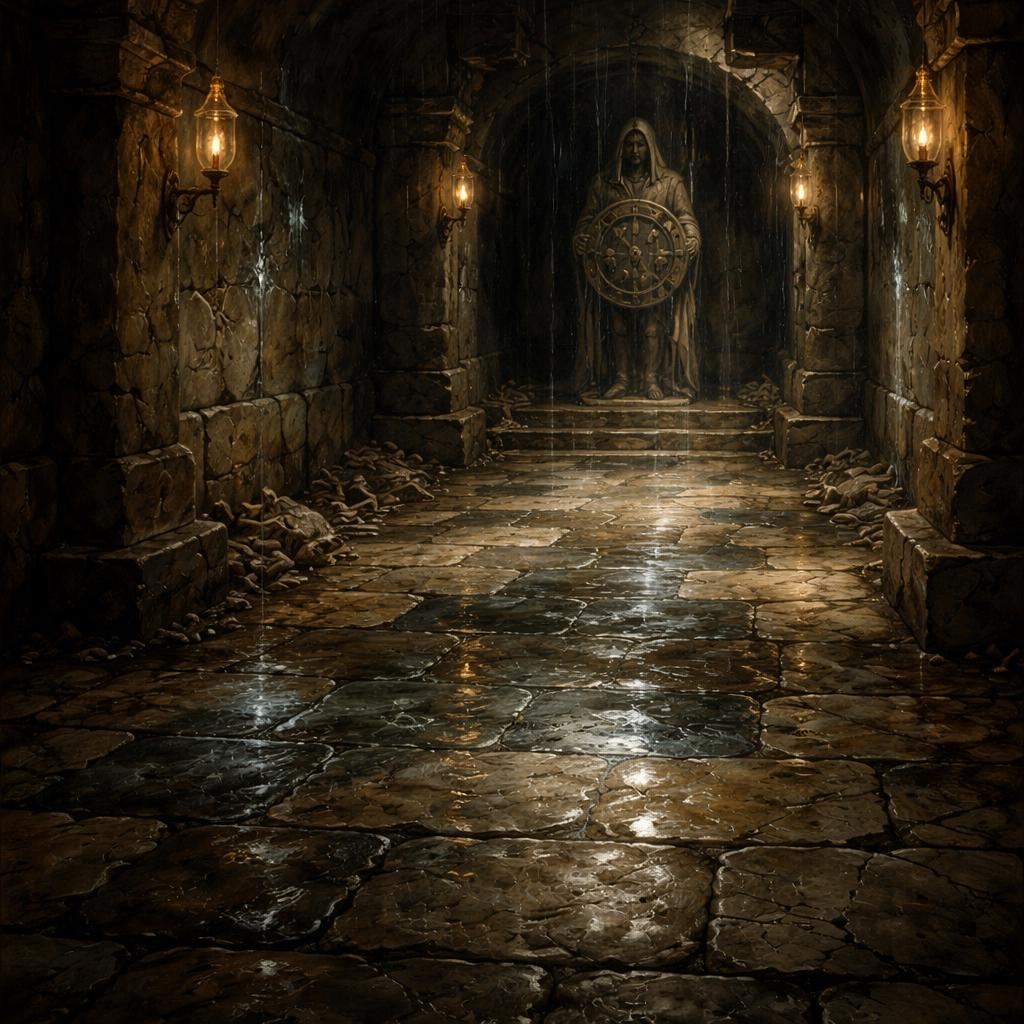

Dripstream Corridor
Complexity: Complex
Type: Environmental (terrain-based) with minor magical ambience; mechanical components integrated into the architecture and ritualized moisture cues.
Severity: Dangerous
Trigger: Any creature steps onto the damp floor tiles.
Effect: The damp surface renders footing treacherous. Each 5-foot segment of damp floor requires a Dexterity saving throw to avoid losing footing.
Damage Output: 3d10 bludgeoning damage from hitting hard stone, plus 2d6 cold damage if you land on an icy damp patch. Optional escalation: a direct 4d10 bludgeoning if the slip drops you into a deeper moisture pool. (Bludgeoning; Cold (from icy damp surfaces); optional additional Bludgeoning for deeper pools.)
Detection DC: Perception DC 14–15, Investigation DC 12–15
Disarm DC: Thieves’ Tools DC 15
The corridor is carved from pale, weathered stone, its 30 feet of width revealing a careful mosaic of damp and dry tiles. The floor reflects a low, slick sheen, and water beads along the joints, seeping in small rivulets toward hidden channels beneath. Ceiling drips fall in a measured rhythm, sometimes matching the tempo of the party’s steps. The walls bear faded carvings of raindrops, rivers, and runes that pulse faintly with moisture, casting a ghostly glow on stone that has seen centuries of rain and ruin. Footprints in the damp sections hint at those who crossed before you—some careful, some hasty. At the far end, a statue guards a subtle, hidden wheel; rotating it reveals a slit and a plate concealing a valve. If moisture rises, the runes brighten, and the corridor’s air fills with the metallic tang of mineral-rich seepage. The trap is as much an invitation to listen as to watch your step: the cadence of dripping and the whisper of old water channels hint at the corridor’s purpose and its peril.
Dripstream Corridor — DM Gameplay Notes
Overview for running
- This is a complex, multi-round environmental trap that uses a damp, slippery floor, rising water, and a hidden valve to control moisture flow. It rewards careful detection, cautious movement, and (if desired) clever noncombat solutions to shut off the trap mid-sequence.
- The trap has its own cadence across rounds. Treat it like a mini-encounter: it activates when a creature steps onto damp floor tiles, then escalates over several rounds unless the valve is found and disabled.
Trap Activation
- Trigger: Any creature steps onto one or more damp floor tiles in the 30-foot-long corridor (and any movement that ends on those tiles).
- Sequence start: The moment a creature enters or ends their movement on damp tiles, the moisture-activated effects begin. Drips become more audible, glyphs glow faintly, and the floor becomes difficult terrain.
- Environmental cues: The ceiling drip cadence accelerates slightly with movement; the wall runes glow more brightly when moisture is present; a slick sheen appears on patches of the masonry.
Detection, Clues, and Initial Checks
- Visual cues: Wet sheen on patches of floor, glistening joints, faint glows in damp-streaked runes.
- Auditory cues: Subtle drip cadence, increasing when someone steps on damp tiles.
- Olfactory cues: Mineral metallic scent in the air.
- Perception checks (for noticing the danger before stepping on damp tiles):
- Perception DC 14–15 to notice slick patches, dripping, and faint shimmer.
- Passive Perception 12; higher if trained in Perception, Survival, or Nature.
- Investigation checks (to deduce the pattern and a hidden drainage feature):
- Investigation DC 12–15 to infer a pattern to the wet spots and the walkway’s edges.
- If players want to proactively understand the mechanism:
- Arcana or History DC 15 can identify moisture as a control mechanism tied to ancient drainage magic.
Disarm Notes (How to stop or bypass mid-sequence)
- Core disarm: The hidden drain valve behind a statue at the corridor’s far end. Closing or disabling the valve neutralizes ongoing moisture flow and reduces the risk of further slipping.
- Primary disarm methods (each can be attempted as an action, not an entire minute—see below for timing):
- Thieves’ Tools or Disarm attempt to manipulate the valve mechanism: DC 15. Advantage if the valve is exposed and well lit.
- Investigation or Perception to locate the valve plate behind the statue (DC 12–15), followed by a DC 15 Sleight of Hand or Thieves’ Tools to close the valve or block the line.
- Bypass option: If players cannot or do not disable the valve, a careful crossing along dry patches and along the corridor’s edge requires an Acrobatics or Athletics check DC 15 to navigate treacherous footing.
- Timing and mid-sequence stops:
- Disabling the valve is a separate, longer action (takes about 1 minute in real time). If a party member spends a full minute to work on the valve during the encounter, the trap’s flow can end earlier or be slowed significantly, reducing subsequent water effects.
- If the valve is closed mid-sequence (by a successful tool/valve attempt), ongoing moisture flow stops, and the damp floor will gradually dry in subsequent rounds. Do not retroactively erase any slip damage already suffered; instead, the risk of new slips is greatly reduced for the rest of the encounter.
- Hints for discovery:
- The valve plate is behind a statue; rotating the statue using a carved wheel (wheel marked with raindrop motifs) reveals access. DC 15 Investigation reveals the wheel behind the statue.
- Runes glow more brightly in moisture; DC 15 Arcana or History helps identify the drainage magic link.
Trap Statistics (for quick reference)
- Dex save DC: 14 to avoid loss of footing on damp tiles.
- Primary damage on a failed save or failed movement check: 3d10 bludgeoning from a slip/fall; plus 2d6 cold damage if landing on an icy damp patch.
- Movement: Damp tiles are Difficult Terrain; moving through them costs extra movement (halved movement speed in those tiles while actively crossing without slipping).
- Secondary effects: If multiple slips occur in quick succession, rising water can reach knee-height within 2 rounds, imposing additional movement checks and Swim/ Athletics challenges.
Initiative and Round Actions (Complex trap, multi-round)
- Initiative: The trap uses its own initiative. Treat it as a non-sentient hazard with an initiative bonus of +0. Roll initiative for the trap at the start of the encounter. It acts on its own turns each round.
- General cadence: The trap does not “attack” in the conventional sense, but it has escalating environmental effects that occur on its turns. The effects can be mitigated or accelerated by player actions (detection, disarm, careful movement).
- Round-by-round framework (Phase-based escalation):
Phase 1 — Round 1 (Activation and first checks)
- Trigger processing: All characters on damp tiles must attempt Dex saves DC 14.
- Outcomes:
- Success: Maintain footing, continue through the corridor as Difficult Terrain; no extra effects this round beyond hazard.
- Failure: Slip 5 feet or fall prone in the damp tiles. If a fall occurs, take 3d10 bludgeoning damage; if landing on an icy patch, add 2d6 cold damage.
- Additional notes: If any character falls prone, their movement on subsequent turns is reduced (half speed or other DM fiat) until they stand up.
Phase 2 — Rounds 2–3 (Rising water and increased hazard)
- Triggering condition: If at least one slip occurred on Round 1, the water in the damp corridor begins to rise. Within 2 rounds, knee-height water is established across the damp section.
- New hazard on Round 2:
- Movement through damp tiles is now more difficult: Swimming checks are required to move through standing water; DC 12 Athletics or Swimming checks to progress.
- If a character attempts to push through, they may be slowed for 1 round if they fail the check.
- Dex saves: DC to avoid slipping increases to 15 in Round 2; if you fail, treat as a slip with consequences as in Phase 1.
- Additional effects: Any water rising can also nudge a prone character or push a character back 5 feet if they fail a movement check.
Phase 3 — On-going escalation (Round 4+ if not disabled)
- Water level continues to rise if not disabled or if multiple slips keep occurring.
- Depths: Knee-high water can become waist-high if not addressed within this phase (approximately rounds 3–4 depending on party actions).
- New checks:
- Athletics/Swimming DC 12 to push through waist-high water; disadvantage on Acrobatics while navigating water-laden floor due to slickness.
- Optional knockback or prone risk if failed Dex save (DC 15) when water depth increases.
- Optional environmental shock: A larger drip or a temporary wave can occur, knocking a PC prone or slowing movement for 1 round if a patrol of water collides with a PC (GM’s discretion).
Visuals and ambience to support rounds
- Drenched, glistening floor tiles; glow from wall runes intensifies with moisture.
- Dark waterline along the damp corridor appears; the running water produces a soft plinking as it collides with the stone.
- The statue at the far end with the hidden valve glints slightly as moisture increases.
Tactics, Variations, and DM Tips
- Variations by party level:
- Lower level (ACL ~3–4): Dex DC reduces to 13; damage on slip reduced (2d10 bludgeoning; 1d6 cold). Water rising occurs later or less aggressively (knee-height rather than waist-high, or skip the water-rise entirely if preferred).
- Higher level (ACL ~6–7+): Dex DC raised to 15–16; add another round of water rising or keep knee-high, but add a second rising-wave hazard that requires a separate Swim/ Athletics check to avoid being knocked back.
- Targeting and engagement:
- The trap is environmental; avoid “automatic punishing” by focusing on the party’s choices. If players are careful and spread out, fewer slips occur.
- If the party aggressively charges through, expect more slips and faster water escalation, possibly making the corridor impassable unless someone disables the valve.
- If a PC uses a spell or ability to dry or manipulate moisture (e.g., create/dry water), allow it to influence the disarm process, but maintain the general system rules (spells follow normal cantrip/r spell rules).
- Disarm-focused play:
- If players spend the minute to disable the valve, describe the valve closing with a grinding sound, the damp floor drying over the next few rounds, and the rising-water effect halting immediately.
- After valve closure, you may allow the party to cross the corridor with a DC 12 or lower Perception/Investigation check to locate dry patches and finish the crossing with minimal risk.
- Time management and pacing:
- Track rounds carefully. If a PC starts moving before round 1 ends, the trap’s sequence begins on that turn and persists into the following rounds.
- Use environmental cues (glowing runes, dripping cadence) to remind players of the trap’s state; this helps maintain tension without needing constant stat tracking.
Tips for running smoothly
- Prepare a quick cheat sheet with round-by-round effects: Round 1 (Dex save, possible slip); Round 2 (water rises to knee; DC 15 Dex saves; swimming/ Athletics checks to maneuver); Round 3–4 (potential waist-high water, increasing checks; possible knockback). This keeps you from flipping through pages during play.
- Have the valve and statue clearly described so players know where to look. A short statue description and wheel location helps players plan disarm attempts.
- If the party is split or spread out, be mindful of corner cases: those on damp tiles in different sections may experience different outcomes in the same round (some slip, others succeed).
- If using miniatures, place markers for damp tiles, water depth, and the valve location to maintain spatial awareness.
- Consider a “soft reset” if the party uses the valve to shut off the trap: describe the moisture receding, the runes dimming, and the corridor returning to normal; then allow a follow-up skill challenge to move past safely.
End-state possibilities
- Valve closed successfully: Moisture flow stops; damp tiles dry out over the next several rounds. Movement becomes normal but still cautious due to the floor’s wear.
- Valve not closed: Water hazard escalates as described, increasing the risk of slips and movement penalties; the party must either weather the rounds or risk a more dangerous crossing.
Seasoning notes
- The trap’s theme—ancient rain-channel drainage and ritual glyphs—lends itself to lore hints. If PCs study the runes, give supplementary clues about the temple’s guardians or how the drainage system once functioned, rewarding successful Arcana/History checks (DC 15).