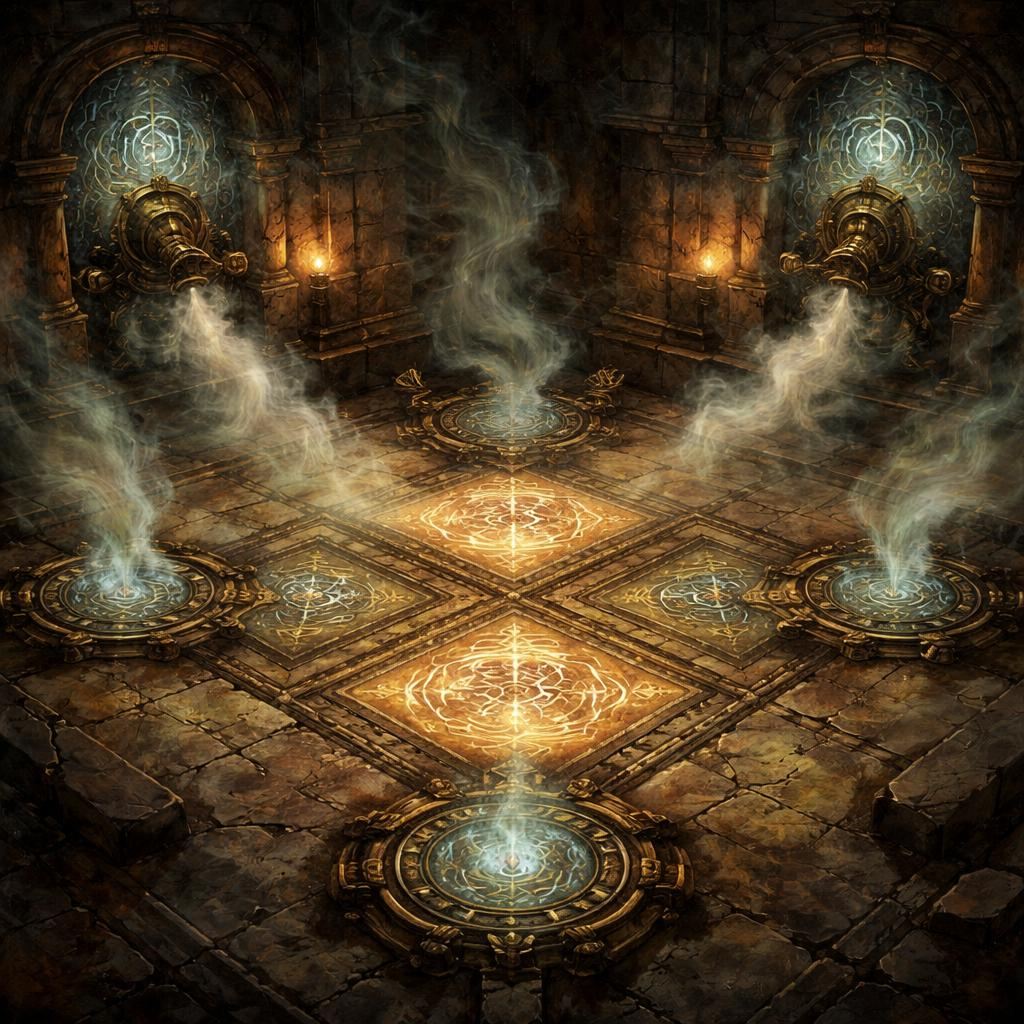

Echoes of the Rhythm Vault
Complexity: Complex
Type: Environmental
Severity: Dangerous
Trigger: Vent valves, pressure plates, and rhythm-etched floor tiles activated by movement
Effect: Gas Diffusion: Provides a DC-12 Constitution save to avoid temporary disorientation (advantage on next Perception or Investigation check for one round if failed). Vapor Glyphs: When observed with Arcana/Investigation (DC 14), reveals a glyph pattern on a valve or plate that indicates the correct valve sequence.
Damage Output: ()
Detection DC:
Disarm DC:
The chamber feels hollow and ancient, its walls lined with wind-carved reliefs of metronomic glyphs and spiraled vents. The floor is a mosaic of four rhythm-etched tiles, each bearing a faint, almost inaudible cadence that resonates when stepping in the correct tempo. Dust motes drift in the thin air, and a faint coppery scent hints at long-dormant mechanisms breathing again. A row of four alcoves punctuates the back wall—each containing a valve labeled A through D. When intruders move with the wrong rhythm, a pale green haze leaks from the vents in a cautious, measured puff. The glyphs around the alcoves glow softly in response to the rhythm, and a subtle hum grows louder as the hazard escalates. If the correct tempo and order are found, the glyphs brighten to reveal a clear path, the gas dissipates, and the vents seal, leaving the room quiet and safe once more. If players ignore the glyphs or push too aggressively, the room fogs further, and a second, stronger wave of gas fills the chamber, challenging the party to read and react with greater speed and precision.
Gameplay Notes for the DM: Echoes of the Rhythm Vault
Overview for running
- This is a complex, multi-round environmental trap with mechanical and magical components. It unfolds like a short puzzle encounter: players detect clues, read Vapor Glyphs to learn a valve sequence, and either solve the sequence to deactivate the gas or suffer escalating hazy effects.
- The hazard is nonlethal but disorienting, designed to slow the party and reward careful observation, teamwork, and arcane insight. It scales to a party around level 5.
- The encounter centers on: rhythm-etched floor tiles (triggering cadence), hidden pressure plates, four wall vent valves (A, B, C, D), and Vapor Glyphs that indicate the correct valve order.
- Trap Activation
- When the party enters the chamber and begins moving, the rhythm-etched floor tiles emit a faint cadence and the wall vents hiss. If party members step on the rhythm tiles in the correct tempo and also trigger nearby pressure plates, a vent gas burst begins and the hazard escalates.
- If movement is too erratic or a pressure plate is triggered out of rhythm, the first gas pulse occurs immediately, starting the sequence in a partial state and increasing urgency.
- Gas diffusion starts immediately after activation and lingers in the room for 1–2 rounds if not deactivated.
- Detection and Disarm Notes
- Clues to detect the trap
- Perception DC 13–15: Warmth at vents, faint hissing, and the floor’s unusual cadence. A careful observer notices the rhythm tiles and the general layout of valve alcoves.
- Investigation DC 14: Identifies rhythm-etched floor patterns and reveals hidden mechanisms under the floor panels (pressure plates) and the vent placement.
- Arcana DC 14: Detects and interprets Vapor Glyphs around the valve alcoves or on the floor; glyphs glow faintly when near the correcto tempo and hint at a valve sequence.
- Disarming mechanics
- Primary method: Read the Vapor Glyphs (Arcana or Investigation DC 14) to determine the correct valve sequence.
- Valve manipulation: Use Thieves’ Tools or a similar tool to rotate/adjust valves. DC 12–14 depending on device resistance; higher DC if valves feel particularly stubborn or magically reinforced.
- Correct sequence example (use as a baseline): A → C → B → D (the glyphs can indicate the order; the exact letters/numbers are variable in-session but must be consistent with glyph clues). The glyphs glow to show the pattern when read successfully.
- Bypass option: Players can try to bypass the sequence by stepping on a particular tile or path that skips the sequencing entirely. This is high risk: DC 15 Perception or DC 14 Investigation to spot a bypass route; success means skipping the sequence but increases risk of misstep on later tiles.
- If the party fails to glean pattern, give escalating hints across rounds (subtler glyph cues, or brass accents resembling the sequence) to avoid a dead-end wall.
- Detection and Clues by Mechanic
- Vapor Glyphs reveal the valve sequence when read with Arcana or Investigation (DC 14).
- Glyphs glow briefly when stepping on rhythm tiles in the correct tempo, serving as a hint mechanism.
- The four valves (A, B, C, D) have tactile/resistance variance; some may require a tool or a precise torque to move.
- Role-Playing the Trap (Flavor Text)
- Gas appearance: pale green haze with a faint ozone/copper scent.
- Visuals: carved vents along the walls glow softly as gas flows; glyphs pulse with the rhythm.
- Sound: the rhythm tiles “sing” a faint cadence when the correct sequence nears.
- Initiative and Round Actions (Trap as a Complex Encounter)
- Initiative: The trap has its own initiative track. Initiative bonus is +0; it rolls a d20 at the start of the encounter and acts on its own initiative count each round (separate from players). For pacing, you can anchor it to a fixed cadence (e.g., acts on 12 after the party or on a fixed 1-round timer).
- Round structure and actions (per round, starting Round 0 with entry):
- Round 0 (Initiation):
- Trigger event: Movement on rhythm tiles and pressure plates starts the hazard.
- GM actions: Describe gas starting to diffuse; glyphs glow faintly if players have glimpsed them; players may begin Perception/Investigation checks to identify tiles and glyphs.
- Round 1: Gas Diffusion
- Primary effect: Con save DC 12 to avoid temporary disorientation.
- On failure: target gains advantage on the next Perception or Investigation check for one round.
- Glyphs: If a player uses Arcana/Investigation DC 14, glyphs reveal the correct valve sequence.
- Environmental change: Gas begins to fill the chamber more evenly; visibility reduces slightly.
- Round 2: Valve Sequence Attempt or Glyph Verification
- Players may attempt to rotate/manipulate the valves in the order indicated by the glyphs.
- If the sequence is correct: gas stops; vents seal; trap deactivates.
- If incorrect: second gas pulse occurs (Con save DC 14). On failure, disorientation effects persist longer; the next cycle becomes harsher or an additional hazard can be introduced (e.g., slowed movement, more fog, or a louder cadence).
- Round 3: Escalation (optional)
- If the party has not deactivated the hazard, the second wave is released with greater potency and a longer duration (DCs may increase to DC 14–16).
- Reduced visibility persists; environmental fog thickens; the rhythm tile cadence intensifies to indicate urgency.
- Round 4 and beyond: Persistent hazard or deactivation
- If disabled, the room returns to safe state and motion-trigger triggers are neutralized.
- If not disabled, hazard persists with a steady, disorienting presence and may require a final attempt at disarming or a safety bypass by stepping on the correct non-trigger tile (if such bypass exists in your setup).
- Round 0 (Initiation):
- Round-by-Round Effects Summary (Phase-based)
- Phase 1: Entry and detection (Round 0)
- Gas begins diffusing; players may detect triggers.
- Rhythm tiles may indicate the correct tempo; glyphs glow in proximity to correct tempo.
- Phase 2: First diffusion and glyph reveal (Round 1)
- Con save DC 12 for disorientation.
- Arcana/Investigation DC 14 can reveal sequence.
- Phase 3: Sequence execution or second pulse (Round 2)
- If sequence correct: gas stops; hazard deactivates.
- If wrong: DC 14 Con save; possible stacking disorientation; potential second wave.
- Phase 4: Escalation or deactivation (Round 3)
- If not deactivated, second wave with higher potency; visibility further reduced.
- Phase 5: Resolution (Round 4+)
- Hazard ends on correct deactivation; bypass path success ends it sooner.
- If not deactivated after escalation, you may escalate to a higher-tier hazard (optional Deadly variant) or force party to cooperate in completing the sequence with more challenging checks.
- Tactics and Variations for the DM
- Vary the DCs and timing to match party composition
- Easier variant: DCs lowered by 1–2 and a longer window for valve manipulation; less gas potency.
- Harder variant: DCs increased by 2–3; second wave more potent; glyphs require cross-checking multiple talents (Arcana and Investigation) to deduce the sequence.
- Targeting and pacing
- Focus on a single target to pin down the hazard; or spread out checks so multiple party members are involved (Perception, Investigation, Arcana).
- Encourage teamwork: one member reads glyphs, another aligns valves, another oversees the rhythm tiles to avoid missteps.
- Environmental manipulation
- If allies move quickly, you can grant advantage on checks that rely on rhythm or glyph interpretation (narrative flavor but track with the GM’s discretion).
- If an NPC or PC uses magical means (summonings, divination, or read magic) to reveal glyphs, give a temporary hint that accelerates solving.
- Bypass path dynamics
- The bypass tile/route adds tension. If players attempt it, apply a high-risk/high-reward dynamic: success grants rapid escape from the hazard; failure triggers heightened gas release or a misstep that sets back progress by 1 round.
- Practical Stats for Quick Reference
- Gas Diffusion (primary hazard)
- Save: Constitution DC 12 (disoriented on failure; advantage on next Perception or Investigation check for 1 round)
- Duration: Gas lingers 1–2 rounds after trigger
- Vapor Glyphs
- Arcana or Investigation DC 14 to reveal valve sequence
- Detection DCs
- Perception: DC 13–15 (heat, hissing, rhythm tiles)
- Investigation: DC 14 (rhythm tiles and hidden mechanisms)
- Arcana: DC 14 (read glyphs and deduce sequence)
- Disarm Checks
- Arcana or Investigation DC 14 to identify glyphs and sequence
- Thieves’ Tools or suitable tools to manipulate valves, DC 12–14 (depends on device resistance)
- Bypass route: Perception DC 15 or Investigation DC 14 to spot the bypass tile/path
- Optional Deadly Variant
- If used, second wave DCs increase (e.g., DC 16 for disorienting save), and glyphs require nonstandard interpretation (e.g., counting rhythm beats and mapping to valves not immediately obvious)
- Final DM Guidance
- Use a measured, cinematic narration: the floor tiles’ cadence, the glow of glyphs, the hiss of vents, and the smell of ozone. Let the players feel the ancient room’s memory as a character in the scene.
- Let the glyphs’ hints be a cooperative puzzle: some players may see numbers, others symbols, and a clever read of the glyphs by Arcana or Investigation should unify the sequence for everyone.
- Track the room’s visibility and air: as rounds progress, visibility decreases; light sources and torch placement matter for Perception checks.
- If your party is strong in magic, provide quicker glyph feedback; if they’re problem-solvers but weaker in arcane lore, emphasize mechanical clues and rhythm tiles to guide them.
- Tie-ins: consider linking this chamber to a larger ruin puzzle that requires solving the rhythm vault to access a deeper chamber or a relic.
This set of notes should help you run Echoes of the Rhythm Vault smoothly across multiple rounds, maintaining tension, fair checks, and satisfying puzzle solving.