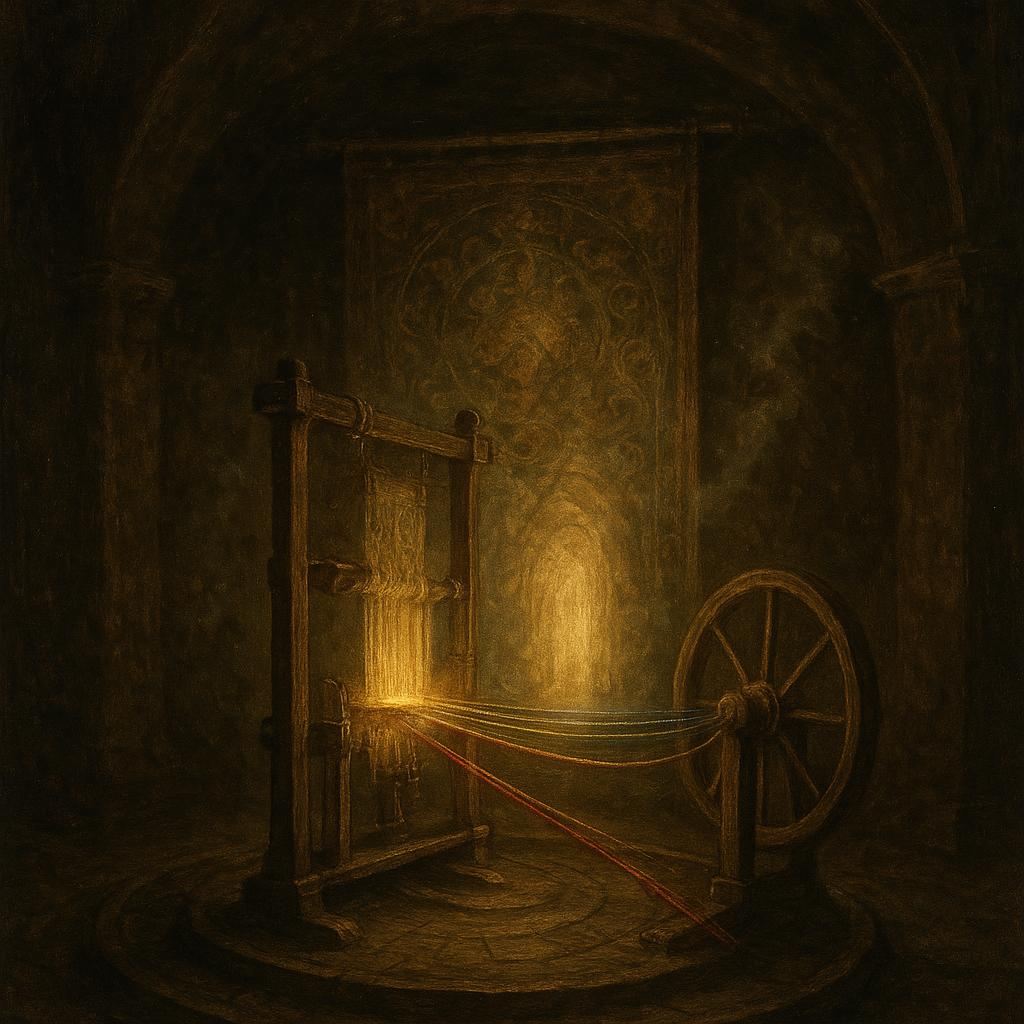

Weave of Remembered Threads
Complexity:
Type:
Severity:
Trigger:
Effect:
Damage Output: ()
Detection DC:
Disarm DC:
Detailed Description:
The chamber is a circular, sunken studio. In the center sits a crystalline loom whose threads shimmer with moonlit color. A living tapestry hangs behind it, a centuries-old memory map that rotates at a measured pace, its symbols glimmering and rearranging as if being rewritten by a patient, unseen hand. Seven color tokens hover around the loom in a ring: Crimson, Amber, Sunlit Yellow, Verdant Green, Azure Blue, Indigo, Violet. When a token is chosen, the loom whispers in a choir of needles. If the color aligns with the next color in the loom’s current target sequence, the loom’s hum rises in warmth and the palette around the loom brightens, advancing the phase. If a color breaks the first N colors as a prefix, the tapestry shivers and rotates to a new pattern, and ghostly memory motes drift through the air. Should a bad sequence be pressed again, the motes thicken and drift wider, and a faint memory-scent lingers. The moment the party threads Indigo, Crimson, Verdant, Violet, and Azure in the correct order for the loom’s mood, the tapestry parts to reveal a doorway, and the loom’s hum settles into a satisfied drone.
Memory motes drift through the room when missteps occur—tiny motes that resemble whispers of long-forgotten scenes. They shimmer and fade as soon as progress resumes. The doorway behind the tapestry glows faintly and then spills light once the final sequence is completed, inviting the party forward.
Gameplay Notes for the Atelier of Threads, Weave of Memory
Purpose of these notes
- These notes are designed to help you run the trap as a complex, multi-round environmental puzzle. Treat the loom, tapestry, and Memory Motes as a living, evolving encounter that cycles through phases based on players’ color inputs. Progress is made by entering correct color prefixes; missteps provoke memory-based hazards and alter the tapestry’s pattern, delaying progress until the party corrects course. A full, correct sequence reveals a doorway.
- Activation, Trigger, and Initial Setup
- When the players enter the atelier and begin interacting with the loom:
- The loom awakens in Phase 0 (baseline). A color-token rack around the loom presents seven colors in a circle: Crimson, Amber, Sunlit Yellow, Verdant Green, Azure Blue, Indigo, Violet.
- A fixed target sequence exists for the session (example: Indigo – Crimson – Verdant – Violet – Azure). The exact sequence can be adjusted to fit your campaign lore; keep the prefix rule intact.
- Clues in the room (hints in tapestry hues, humming voice tones, scent cues, and color-tinted glimmers) help players deduce the mood and the likely prefix that aligns with the loom’s current phase.
- Triggering the trap
- The trap’s primary trigger is a color input from players. Each attempt that does not start as a valid prefix of the evolving correct sequence triggers Memory Motes and subtly rotates the tapestry to a new visible state.
- A correct input that matches the next color in the current target sequence advances the loom to the next phase (Phase 1, Phase 2, etc.). A complete 5-color sequence completes Phase 5 and reveals the hidden doorway.
- On bad inputs
- If a bad sequence is entered, the Memory Motes hazard triggers immediately and the tapestry rotates an extra notch, altering the future required next input. The mood of the room shifts and the tapestry’s visible symbols rearrange.
- Detection, Clues, and Disarming Notes
- What to notice (Detection checks)
- Perception DC 12–15: The loom’s hum changes pitch with inputs; the glow of color tokens shifts slightly as the loom’s mood changes; the tapestry’s rotation cadence is noticeable.
- Investigation DC 12–15: The mechanism tying the loom to the tapestry is discoverable; you can identify the color tokens as input tokens and see the prefix-based logic.
- Arcana or Religion DC 12–15: The loom is weaving memory energies rather than ordinary cloth; color order matters due to the loom’s memory-based magic.
- History DC 12–15: Recognizes a memory-weaver tradition and that prefixes can be more important than full sequences.
- Insight DC 12–15: Gauges the loom’s mood and which colors feel “safe” as the next prefix.
- Clues to help players
- A torn diary fragment hints that “memory loves cool colors first,” suggesting Indigo and Violet as part of early prefixes.
- A small tome near the dais outlines a stylized sequence diagram; translating the diagram to color tokens helps guide prefix thinking.
- A sigil on the table hints that prefixes matter more than full sequences.
- Disarm options (how to bypass or stall the trap)
- Puzzle solve (preferred): Determine a valid color prefix path and enter the next correct color in sequence. Each successful prefix entry advances one phase toward Phase 5.
- Magical bypass (Dispel Magic): Cast Dispel Magic (3rd level or higher) on the loom’s aura. If successful (DC 15 Arcana check, or spell slot), you suspend the Memory Motes hazard for that round and temporarily stabilize the loom, granting a safe window to input without triggering motes (DM fiat: one round of safety).
- Physical bypass (aura sealing): A Strength (Athletics) check or Dexterity (Sleight of Hand) to place a ritual cloth or protective cover over the loom or behind the tapestry (DC 14–16; advantage if aided). A successful temporary seal disables the loom’s mood-harm aura for a short duration, enabling a safe single input. This does not permanently disable the loom; it buys time to solve the puzzle.
- Disarm steps (clear, actionable)
- Detect and understand (DC 12–15): Identify color tokens and their link to prefixes; sense that the loom’s mood shifts with color input.
- Identify the sequence (DC 12–15): Determine a plausible prefix path based on room hints or a memory of the loom’s mood.
- Apply disarm action (choose one):
- Puzzle solve: Enter the correct color prefix to advance the loom’s phase safely. Each successful prefix is an action on the party’s turn (or a coordinated group action if agreed).
- Dispel Magic: Cast at DC 15; success removes Memory Motes hazard for that round.
- Physical bypass: DC 14–16 (Athletics or Sleight of Hand); success provides a short safety window to input a color without triggering Memory Motes again this round.
- Ongoing clues to aid disarm
- The diary fragment, the motifbook, and the sigil are all designed to be solvable with a few checks (DC 12–15) and a little teamwork. If players are sharing lore, they can assemble a safe prefix path more quickly.
- Complex Trap Mechanics: Tactics, Variations, and Round Structure
- Nature of the mechanic
- The trap unfolds as a multi-round puzzle with a dynamic hazard (Memory Motes) and a rotating tapestry. Progress comes from correct color prefixes; missteps degrade the loom’s mood and rotate the tapestry, changing which colors will be “safe” next.
- Suggested Tactics and Variations
- For tougher play (higher challenge): Increase the complexity by changing the target sequence every round, or by adding a “reset” mechanic if players spend too long on a wrong prefix (e.g., after two consecutive bad prefixes, the loom resets to Phase 0 and the tapestry rotates twice as fast).
- For easier play: Fix the target sequence for the session and reduce the number of prefix steps (e.g., 4 colors instead of 5) or give a clearly visible hint (tapestry pattern aligns with the next color).
- Targeted actions: If a player who understands memory lore fails, you can nudge the party with a temporary hint in the loom’s mood (a warmer/cooler hum cue that suggests Indigo or Violet as the next color).
- Environmental responses: If the party’s tone is cautious and collaborative, the loom rewards with a longer safe window after a correct prefix. If the party is reckless, expect more frequent missteps and more motes.
- Initiative and round actions
- Initiative: The loom has its own initiative (we suggest a fixed value to keep pacing consistent). Example: Loom Initiative = 12. Treat the loom as an environmental actor that takes its turn in the initiative order after PCs act, resolving its phase and hazards after players attempt a color input.
- Trap turn structure (per round)
- Player action: A PC names or uses a color token and attempts to input it. The input is adjudicated against the current target prefix.
- Loom response (Trap turn):
- If input matches next color in the current target sequence: advance Phase by 1; loom’s hum shifts; tapestry remains, or rotates slightly depending on phase.
- If input does not match: trigger Memory Motes hazard; tapestry rotates an extra notch; phase resets (often to Phase 0 or a lower phase depending on how misaligned the loom is with its mood).
- If Phase reaches 5 (full correct sequence): door opens; tapestry rotates aside; loom returns to a quiet state; the hazard ends for the encounter (indicating the doorway is revealed).
- Hazard resolution: Memory Motes (DC 12 Wisdom save for each affected creature) and the noted 1d4 psychic damage if failed; provisional disadvantage on memory-based checks or saves for the next round.
- Round-by-round effects (example progression)
- Phase 0 to Phase 1 (Round 1)
- Player input: Indigo (correct first color in the sample target sequence)
- Effect: Phase 1; mood warms slightly; memory motes remain inactive.
- Phase 1 to Phase 2 (Round 2)
- Player input: Crimson (correct second color)
- Effect: Phase 2; tapestry begins a soft rotation; subtle scent intensifies.
- Phase 2 to Phase 3 (Round 3)
- Player input: Verdant (correct third color)
- Effect: Phase 3; loom hum deepens; tapestry reveals new symbols as it rotates.
- Phase 3 to Phase 4 (Round 4)
- Player input: Violet (correct fourth color)
- Effect: Phase 4; mood grows warmer; subtle fog of memory motes begins to drift in the room if missteps happen in this range
- Phase 4 to Phase 5 (Round 5)
- Player input: Azure (correct fifth color)
- Effect: Full sequence completed; tapestry rotates aside; doorway appears; loom hum settles to a quiet baseline; hazard ends.
- Misstep behavior (any round with a bad input)
- Memory Motes emit; DC 12 Wisdom save; 1d4 psychic damage on a fail; next round imposes a memory-related penalty (e.g., disadvantage on memory recall checks or a −1 to related saves or checks) until the end of the next turn.
- Tapestry rotates an extra notch; the visible symbols change to reflect a new memory path, and the next required color for the prefix shifts accordingly.
- Phase 0 to Phase 1 (Round 1)
- Dynamic hazards
- Memory Motes are the primary escalating hazard. They are mild and temporary, designed to deter reckless attempts and reward careful, collaborative problem solving.
- If players repeatedly trigger bad sequences, you can optionally increase the likelihood of further motes affecting more party members (via DM fiat) or tighten the DC for Wisdom saves (to DC 13–14) to heighten tension.
- If players use Dispel Magic or otherwise suppress the loom, motes may still occur in future rounds if a bad input occurs, but the hazard is reduced in frequency or intensity.
- Round-by-Round Play Sheet (concise)
- Round 1
- Player action: Input color (e.g., Indigo)
- Loom: Valid prefix? Yes → Phase 1; no motes.
- Tapestry: Minor rotation/edge shimmer.
- Round 2
- Player action: Input color (e.g., Crimson)
- Loom: Prefix check; Phase 2; if correct, mood warms.
- If wrong: Motives trigger; tapestry rotates; phase may reset.
- Round 3
- Player action: Input color (e.g., Verdant)
- Loom: Phase 3 or reset if misstep; motes may drift if wrong.
- Round 4
- Player action: Input color (e.g., Violet)
- Loom: Phase 4; mood peaks toward warmth.
- Round 5
- Player action: Input color (e.g., Azure)
- Loom: Full sequence achieved; doorway reveals; the loom hum settles; hazard ends.
- Ongoing
- If missteps continue, Memory Motes hazard persists in subsequent rounds and the tapestry’s pattern continues to rotate unpredictably.
- Quick Reference: Key Numbers and Mechanics
- Colors (tokens): Crimson, Amber, Sunlit Yellow, Verdant Green, Azure Blue, Indigo, Violet.
- Target sequence (example): Indigo → Crimson → Verdant → Violet → Azure.
- Prefix rule: A color is valid if it matches the next color in the current target sequence.
- Bad sequence consequence: Memory Motes trigger immediately; Wis save DC 12; 1d4 psychic damage on a fail; disadvantage on next memory-related ability check or saving throw.
- Tapestry effect: Rotates in a regular cadence; a bad input causes an extra notch to rotate, changing visible symbols and the required next color.
- Detection/DCs (summarized)
- Perception 12–15; Investigation 12–15; Arcana/Religion 12–15; History 12–15; Insight 12–15.
- Disarm options DCs:
- Puzzle solve: No single DC; requires solving the prefix logic through checks (DC 12–15 on clues).
- Dispel Magic: DC 15, 3rd-level or higher; success suppresses motes for the round.
- Physical bypass: Athletics or Sleight of Hand DC 14–16; advantage if aided; success disables aura briefly to allow safe single input.
- Overall difficulty and pacing
- For a party around level 6 (4–5 PCs), expect 2–4 rounds of interaction if players cooperate and solve the prefix logic.
- If players race or ignore hints, expect more Memory Motes rounds and more frequent missteps.
- Tips for Running the Trap Smoothly
- Pace and theatre
- Emphasize the loom’s hum as a musical cue; let the tone shift subtly with each input to signal whether a prefix is correct.
- Use the tapestry’s rotation cadence as a metronome for the party’s progress; describe the shifting memory motifs to heighten atmosphere.
- Clues and hints
- Drop small hints via the memory diary fragment, motifbook, and sigil. Let players piece together the idea that prefixes matter more than full sequences.
- Handling multiple rounds
- Keep track of phase (0–5) and the current target prefix. Announce when a prefix is correct and when it resets to help players stay oriented.
- Memory Motes management
- Remember these are mild psychic effects designed to slow progress and reward careful thinking. Keep the DC and damage moderate (1d4), and avoid stacking motes too aggressively unless the party pushes repeatedly.
- Disarm and bypass pacing
- If a player uses Dispel Magic, give them a clear before/after moment: the loom quiets, the next input can be attempted safely.
- If players attempt a physical bypass, describe the ritual-like action with tactile detail, but keep it concise to maintain pace.
- Scaling and adaptation
- For higher difficulty, raise the DCs slightly, or modify the target sequence’s complexity (more steps, or a moving target that shifts after each round).
- For lower difficulty, fix the target sequence, reduce the number of steps, or provide clearer hints that reduce the number of checks needed.
Optional customization
- If you want to tailor the exact color sequence to a campaign arc or a specific NPC’s memory, tell me which mood or memory you want to evoke (calm, sorrowful, triumphant, etc.), and I’ll adjust the target sequence, clues, and tapestry symbolism accordingly. The core mechanic—prefix-based progress, misstep reshaping the memory tapestry, and a doorway reveal on success—remains the same.
Trap Complexity: Complex multi-round environmental puzzle with ongoing hazard and a mechanical/magical hybrid core. Use these notes to guide pacing, cues, checks, and the gradual reveal of the hidden doorway. If you’d like, I can provide a ready-to-run stat block for the loom and the tapestry, and a printable round-by-round cheat sheet for quick reference at the table.