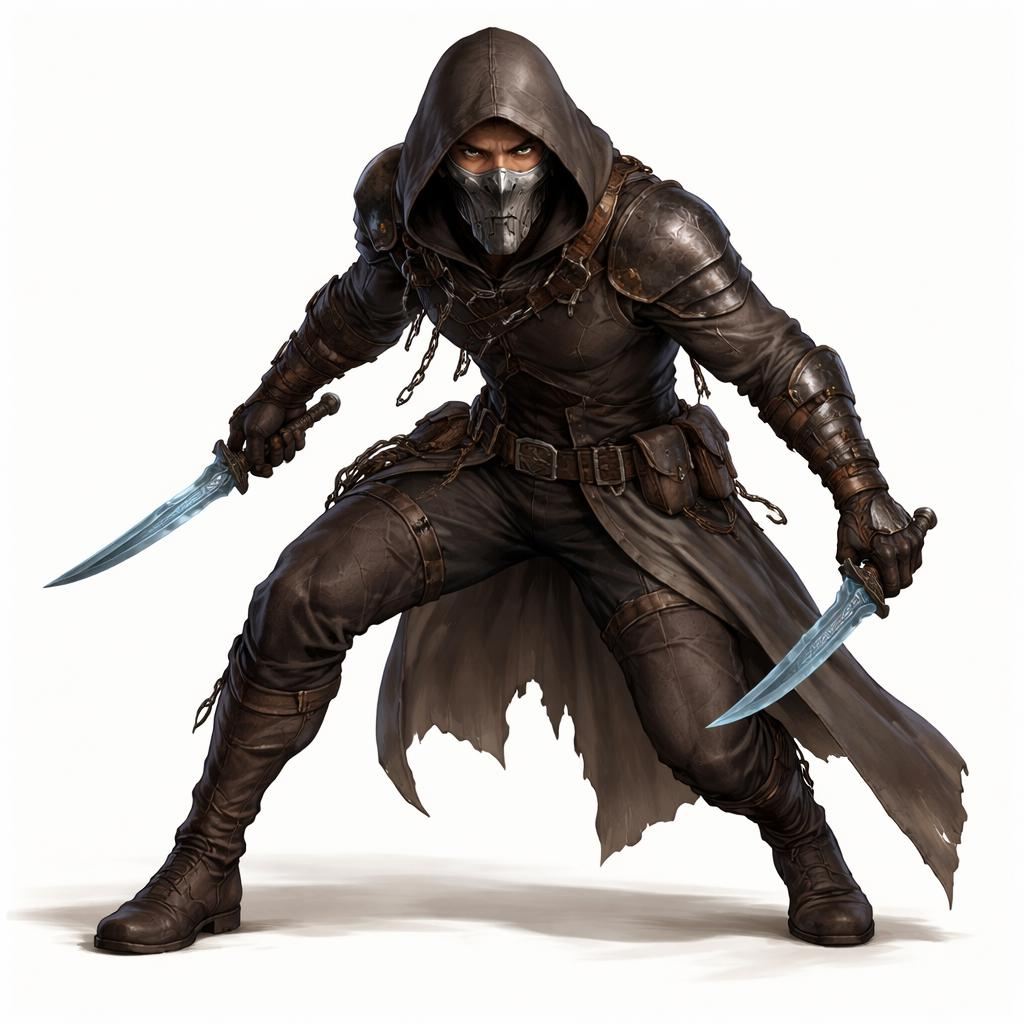

Mawbound Raider
Medium Humanoid (Treasure Hunter Bandit), Neutral
Armor Class: 12 (Leather)
Hit Points: 9 (2d8)
Speed: 30ft
Challenge Rating: 1/2 (100xp)
| STR | DEX | CON | INT | WIS | CHA |
|---|---|---|---|---|---|
| 11 | 14 | 11 | 10 | 9 | 8 |
Saving Throws: none
Skills: Stealth +4, Perception +1
Damage Vulnerabilities: none
Damage Resistances: none
Damage Immunities: none
Condition Immunities: none
Senses: Passive Perception 11
Languages: Common
Spellcasting
“”
Actions & Abilities
Dagger: Melee Weapon Attack: +4 to hit, reach 5 ft, one target. Hit: 1d4+2 piercing damage.
Disengage: The Mawbound Raider takes the Disengage action, giving it freedom to move without provoking opportunity attacks on its next turn.
Hide Behind Idol (Bonus Action): The Mawbound Raider can attempt to hide as a bonus action if it is adjacent to an idol statue and not currently seen by enemies. DC 12 Dexterity (Stealth) check to succeed. If successful, the raider becomes hidden.
Appearance
Against a stark white backdrop, a lean, medium humanoid moves with dancer-like precision. Stature sits between 5’6″ and 5’10″, a lithe frame built for rapid, exact motions rather than brute power. Bronze-tanned skin is sun-worn and scarred along the forearms, a map of trials and raids. The silhouette is compact and ready-for-action: knees slightly bent, weight on the balls of the feet, always slipping into the next angle or cover.
Clad in a hooded leather jacket the color of weathered ash, reinforced hide accents catch the light with every calculated step. The outer leather is supple and seasoned, creaking softly as the wearer moves; light chain or reinforced hide at the shoulders and forearms preserves mobility without rigidity. A heavy iron jaw mask sits over the lower face, dull gunmetal gray with rivets and seams showing where it’s strapped tight. The mask shapes a menacing, bite-like maw, muffling speech but sharpening the wearer’s wary, predatory expression. A thin, clinking chain binds the mask to the jacket, adding a percussive cadence to each motion. Hair stays short and mostly tucked under the hood, a few stray strands brushing the mask’s edge.
Eyes are the focal point above the mask: steel-gray to amber, bright with practiced calculation and a trace of mischief born from ruined ruins and hard-earned cunning. A few laugh-lines and scars near the eyes whisper of a life spent navigating shadows rather than relaxing in light.
Limbs emphasize agility: long, slender arms with nimble, deft fingers—perfect for quick dagger work and lockpicking. Legs mirror that lean strength, built for short, explosive bursts of speed across rubble and through arches. Boots are sturdy leather with reinforced toes, designed for silence and sure footing on uneven temple floors. The weapon pair are two slender, slightly curved daggers—each blade etched with faint, cool-blue sigils that glow faintly near relics or wards, hinting at a magical or thematic bond to the loot of the temple.
Signature gear includes a subtle armor accent: small iron plates at shoulders and forearms that catch torchlight without hindering agility. A relic-related aura lingers around the wearer, a metallic scent and a visual shimmer that intensifies when interacting with iron or relic motifs. Near the central dais, the sigil glow grows stronger, underscoring the gear’s synergy with the temple’s loot.
The movement communicates intent: compact, ready-for-action posture; steps here, sidesteps there, always seeking the next angle, the perfect knock, the safest line of escape. The overall impression is of a precise infiltrator—iron maw in silhouette, glow-kissed blades at the hips, and a wary, calculating gaze that cannot be deceived. On the bright white background, every texture—seasoned leather, the heavy mask, the chain’s clink, the daggers’ glow—reads clearly, making the entire creature vivid, coherent, and striking.
Tactical Information
Behavior in Day-to-Day Life
The Mawbound Raider lives for the next prize, and temple ruins are its workshop. It travels light and quiet, never far from the central relic’s pull or the seven idols’ whispered promises. In the day-to-day, it moves like a shadow that knows the building as well as its own skin—a lean, wiry figure weaving through arches, ducking behind rubble, pausing only to study a locked chest or a fresh set of footprints in dust. Its motivation is simple: secure, corral, and profit from the relics and wares those ruins contain. It treats the seven idols as both moral gatekeepers and practical tools—each one a reminder of a different fort’s loot and a potential lever to shape a fight in its favor.
Socially, the Mawbound Raider is a disciplined, solitary-to-small-group operator. It may work alone, or as part of a tiny scouting squad under the same Iron Bound Maw banner, rehearsing routes and ambush points. It trains newcomers to think in terms of terrain, lines of sight, and timing—not flashy displays, but a measured, almost ritual precision in how to use arches, columns, and idols for cover. It respects competent rivals and will trade information or guidance for efficient gains, but it has little patience for fools or for fights it can’t win through cunning and positioning. Loot is a story told in gleams—the better the relic’s aura and the richer the trinkets, the more the Raider’s eyes gleam.
Combat Behavior
When trouble arrives in the temple-gallery, the Mawbound Raider pivots from patrol to skirmish mode with surgical efficiency. It chooses weaker targets first, not out of cruelty but because soft targets are easiest to isolate and herd toward danger zones—the central dais, a narrow arch, or a choke point where a squad’s numbers can’t trickle in at once. It slides along the edges of the idols, using the statues as partial cover and as cover-blows to misdirect attention.
Initiation is often a quick, decisive strike from concealment. The Raider steps from behind a statue or rubble, delivering a pair of dagger blows to catch a target off guard, then re-enters the shadows to threaten from another angle. If space allows, it uses a second dagger in a tight, repeated rhythm—a simple multiattack designed to pressure rather than overpower. If it finds itself adjacent to an idol, it may use itsBONUS action to Hide Behind Idol, melting into the statue’s shadow and returning to a safer stance after a moment.
Archways and rubble are not mere scenery; they’re tools. The Raider prefers the long corridor’s lanes, where it can force one or two foes into a narrowing, the central relic’s glow or aura nudging opponents toward the dais or into a side passage. If a foe tries to press through a sightline, the Raider can retreat a few feet to reestablish cover behind a different idol or a new patch of rubble, preserving its line of sight and the illusion of mobility.
If outnumbered or the fight pivots toward a stalemate, the Raider retreats to a preferred idol, halting briefly behind its shield of stone and leather. It then darts to a new angle, attempting to split the party or draw them into a tighter corridor where it can take advantage of chokepoints. A ranged attack through an idol’s line of sight triggers its Relocation Retreat—as a quick, reactive repositioning to keep cover and avoid being pinned.
The center of gravity in combat is the relic’s aura. The Raider eyes the battlefield like a chessboard; the relic’s hum is a compass that guides its pressure. It will try to shepherd weaker opponents toward the dais, where the relic’s aura is accessible to its favoring, or use the aura to unsettle morale, making a party hesitate at key moments so it can slip away or rejoin the fight with a fresh angle.
In all, the Mawbound Raider is not a brash brawler. It is a terrain-oriented skirmisher who relies on cover, speed, and the temple’s architecture to tilt encounters toward its advantage. Its strengths lie in closing gaps, creating distractions, and keeping the pressure on weaker targets while denying stronger foes a clean, frontal assault.
Roleplay/Narrative Interactions
In noncombat moments, the Mawbound Raider behaves like a pragmatic professional with a luxury of cold efficiency. It speaks in clipped, matter-of-fact phrases about routes, loot, and threats. It does not boast; it inventories its words like it inventories its gear: short, precise, and useful. It is unfazed by threats that do not threaten its loot, and it will try to negotiate only when a benefit is clear.
Diplomacy and bribes are treated as practical gambits. The Raider’s loyalty to the Iron Bound Maw Legion can be leveraged to gain information or safe passage, but only if the deal makes sense within its worldview: a map fragment, a key fragment, or a chance to claim a portion of a vault’s spoils might tempt it. It values efficiency and will test an interlocutor’s worth quickly—if a bargain looks like a trap, it will pivot to deception or retreat, never exposing itself to needless risk.
If approached with questions about the seven idols, the Raider answers with tight, useful lines that hint at lore without giving away everything. Each idol’s aura corresponds to a fort’s wares—armory, supply, documents, fortifications, maps, weapons, ritual items—and the Raider can gesture toward the idol that best matches the party’s goals, offering directional guidance rather than moral defense. It may reveal a partial secret about the relic’s vault only if it believes the party will use that knowledge to advance the Raiders’ aims—otherwise it will keep its counsel, guarding the mystery as a means to maintain leverage.
Cornered or compelled to negotiate under pressure, the Mawbound Raider tends to test the party’s greed as much as their nerve. It will propose a bargain that preserves its own loot while granting a temporary advantage to the party—perhaps revealing a safer route through a side passage, or trading a minor loot item for safe passage to the relic’s vault. If the party proves themselves capable or if a stronger foe appears, the Raider may switch to deception or feigned surrender, attempting to lure the party into a trap or into overstepping a boundary that could unleash a well-timed ambush from the idols’ shadows.
The Idol Gallery can be a stage for personality: the Idol of Armory might be where it projects a calmer, almost reverent stance toward the weapons and gear it loves; the Idol of Maps signals a more sly, route-focused persona; and the Idol of Ritual Items suggests a colder, more calculating edge. In conversation, the Raider will let its curiosity surface through small questions about the party’s goals, always tying them back to loot, routes, or the relic’s vault.
If the party proves resourceful or worthy of respect, the Mawbound Raider can become a reluctant ally for a short time—sharing a path, guiding a covert approach toward the relic, or giving a tacit tip about a hidden mechanism behind an idol. But it remains a predator at heart: a hunter who can parley when there’s something to gain, and a schemer who will retreat, regroup, and return when the odds look favorable.
Summary for Use in Play
- Day-to-Day: A lean, terrain-savvy opportunist who treats ruins as both trophy and battlefield; uses idol-cover and central relic as leverage; trains others to think in terms of routes and ambush points.
- Combat: Aids weaker targets first, uses arches and rubble for flanking, hides behind idols as a routine tactic, repositioning to preserve cover; relies on the relic’s aura to influence the fight; retreats to maintain advantage when outmatched or cornered.
- Roleplay: Professional, concise, and opportunistic; open to bargaining and information, but always with a keen eye on loot and routes; uses idol lore to guide conversations and to test the party’s greed, nerve, and cleverness.
This interpretation keeps Mawbound Raider as a compact, thematically rich CR 1/2 threat—a master of terrain, a collector of relics, and a disciplined scout who can turn a temple gallery into a deadly, dynamic encounter.