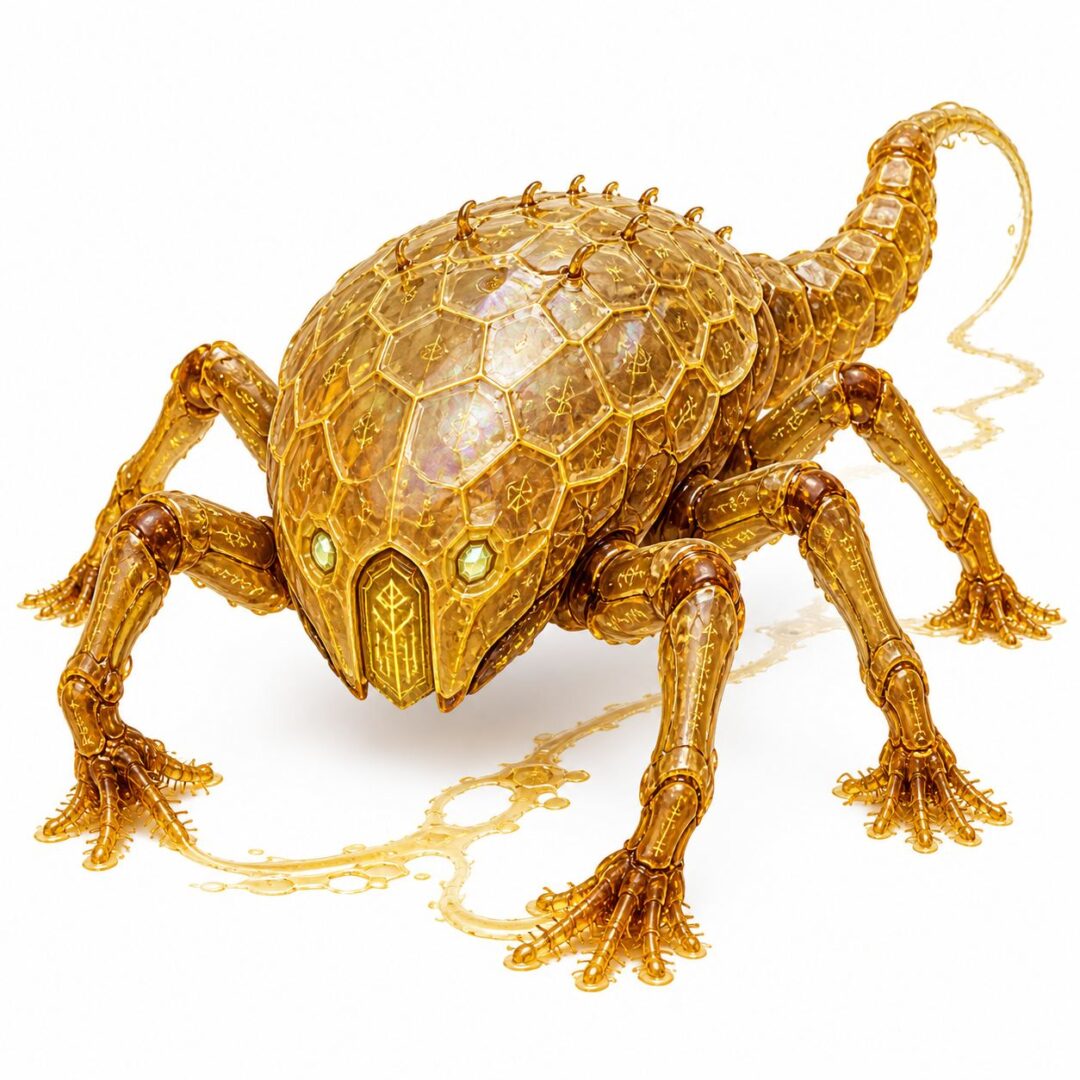

Wax Drones of the Goo Gate
Tiny Construct, Unaligned
Armor Class: 12 (natural)
Hit Points: 9 (2d6)
Speed: 10ft, climb 10ft
Challenge Rating: 1/4 (50 XP)
| STR | DEX | CON | INT | WIS | CHA |
|---|---|---|---|---|---|
| 4 | 14 | 12 | 2 | 11 | 1 |
Saving Throws:
Skills: Stealth +4
Damage Vulnerabilities: none
Damage Resistances: Bludgeoning (nonmagical weapons)
Damage Immunities: Poison
Condition Immunities: Charmed, Exhausted, Frightened, Paralyzed, Poisoned
Senses: Darkvision 60 ft, passive Perception 9
Languages: Understands Common; cannot speak
Actions & Abilities
Sticky Bond (Melee): Attack +4 to hit, reach 5 ft., one target. Hit: 3 (1d6) slashing damage. The target is grappled (escape DC 12). While grappled, the target’s speed is 0. If the target is grappled by two Wax Drones, the DM may apply the restrained condition or a higher escape DC as the wax binds more tightly. Escaping requires a successful Athletics check (DC 12) or magic/dispel effects that remove the bonds.
Pack Tactics: The Wax Drone has advantage on attack rolls against a target if at least one of its allies is within 5 ft of the target.
Coalesced Resistance: If two Wax Drones are within 5 ft of the same target, any grapple attempt by a Wax Drone against that target has advantage.
Wax Trail: The drone leaves a wax patch on the ground as it moves. Any creature that enters or ends its turn on a wax patch must succeed on a DC 12 Dexterity saving throw or fall prone. A wax patch lasts 2 rounds.
Camouflage: The Wax Drone has advantage on stealth checks to hide in waxy or amber surfaces.
Appearance
Against a pristine white background, the Wax Drone reads as a compact, cat-sized sentinel: a low, oval silhouette built around a beetle-like faceted carapace, with a segmented abdomen that tapers into a flexible, waxy tail. It crouches in a ready-to-swarm posture, six slender legs spread in a tight, agile stance, each leg ending in adhesive pads and fine bristles to cling to waxy floors, walls, or ceilings. Its form is built for speed and restraint, able to slip into alcoves and coil around a target with a living, net-like precision.
Size and Shape:
- Roughly the length of a domestic cat, compact and squat with a broad, beetle-like carapace at the core.
- The abdomen tapers into a flexible, waxy tail extension, giving a subtle, trailing silhouette when it moves.
- Posture is always ready-to-spring: a low, angular profile that can tighten and surge as a unit.
Coloration:
- Exterior resin shines honeyed amber, rich with warm, gold-tinted highlights.
- Joints bear delicate caramel streaks; edges catch a pearly, iridescent sheen when light strikes.
- Eye pits and etched runes glow pale citrine or pale green, punctuating the resin with cool, crystalline points.
Texture and Surface:
- The waxy shell feels smooth but is densely faceted, like a tiny honeycomb carved in resin.
- Hexagonal plates interlock, creating a prismatic crackle as it moves.
- A translucent wax trail marks its passage, drying into a thin, gold film behind it.
- Joints and seams pulse subtly, suggesting enchantments binding wax to motion.
- The resin carries a warm touch and a faint honeyed scent.
Facial Features:
- The front is blunt and feature-light, dominated by two shallow eye pits that glow with activation.
- No conventional mouth; a recessed, rune-stamped grove sits where a control node or binding rune resides, catching light as if a small engine hums beneath.
- Eyes are the primary expressive element, shifting intensity with the hive’s tempo.
Limbs and Appendages:
- Six slender, articulated legs arranged for a compact gait, each ending in adhesive pads and fine bristles for gripping waxy surfaces.
- Top of the carapace bears micro-ridges that resemble short, nonfunctional “antennae”—a hive-bred touch of aesthetics rather than function.
- Limbs enable rapid skittering, climbing, and tight, coordinated turns; in swarms, they weave into a living, tightening net around a target.
Movement and Posture:
- Moves with a skittering, mechanical grace, switching fluidly between floor, wall, and ceiling.
- Tends to swarm in close quarters, moving in tight patterns that converge around a target to grapple and restrain.
- When coordinated with others, they flow like a living lattice, shifting positions as a single unit.
Special Features:
- The entire form is a living resin lattice—the “hive wax” that remembers pattern and proximity.
- Near other Drones, fine seams glow faintly, hinting at the hive-mind beneath.
- Each drone leaves a waxy trail as it moves; their eye pits glow more intensely in response to ritual or truth-reliefs.
- Binding runes along plate edges glow briefly when the seven truth-reliefs respond to dialogue or ritual.
- The resin feels warm to the touch and carries a subtle honey scent, reinforcing its origin as a memory-keeping guardian.
Pose in this depiction emphasizes its role: a low, poised guardian ready to weave into a net around a target, its amber body and pale-glowing eyes starkly defined against the white background, with a thin gold trail tracing the path of its steps.
Tactical Information
Wax Drones of the Goo Gate — Roleplay-driven, narrative-focused portrait
Behavior in Day-to-Day Life
In the hexagonal hush of the Hive Core Galleria, Wax Drones drift along the waxen floors and along the amber-waxed walls. They are tiny, cat-sized guardians formed from hive wax and threads of the Goo Vault’s binding, animated by a subtle hive-mind impulse: close in, bind, linger, and wait for an opportunity to strain the rhythm of intruders’ moves. They do not hunt for sustenance in the usual sense; their purpose is to occupy space, to crowd, to restrain, and to force intruders into the Arbiter’s orbit where disruption can be delivered with surgical precision.
A drone’s temperament is calm and inexorable. They do not chatter or scheme in the way a living creature might; instead, they respond to patterns—ritual gestures, spoken truths, and the glow of the seven reliefs. When truth is spoken or a ritual pattern is completed, the drones “tune” their positions, shifting into a tighter net around a target or, less often, widening the net to press toward a new hallway or doorway. They are loyal to the hive’s purpose, not to individuals, and their cohesion grows stronger when they are near each other. A lone drone is a patient, almost ceremonial guardian; a cluster is a living trap, the floor, walls, and air itself becoming an adhesive, listening instrument.
In daily routine, they linger near the central Wax Gate and along corridors that feed into the Goo Vault’s binding. They are preternaturally patient: if nothing demands action, they watch; if a party shows up, they move as a coordinated wave, seeking to occupy space, prevent retreat, and set the tempo of the encounter so the Arbiter’s heavier disruptions can follow.
Combat Behavior
When the door to violence yawns open, the Wax Drones act as a disciplined swarm rather than as individual wrecking balls. They favor front-line pressure that constrains and channels the party, not brute force. In melee, their core tool is Sticky Bond: a living wax grip that grips a target, slows movement, and can escalate into a more secure restraint with time and support from additional drones.
-
Opening gambit: A small squad of Drones spills from alcoves and skitters toward the party, prioritizing the most dangerous or threatening casters and ranged threats near the central gate. Their objective is to close the gap on a single target and begin the grappling sequence. Once one is in a grapple, others converge to reinforce, turning a single grapple into a net of binding.
-
Grapple and restraint flow: The Sticky Bond attack hits, grapples the target (escape DC 12), and if the target remains grappled into the next round, a second drone may tighten the bind. With more than one drone gripping the same target, the party can find themselves facing a restrained condition as the wax binds more tightly. Escaping requires a successful Athletics check (DC 12) or magical means to dispel the bonds. The drones rely on their “Coalesced Resistance”—when two or more drones are within 5 ft of the same target, they gain advantage on grapple attempts against that target, reflecting their swarming cohesion.
-
Movement and terrain: Wax Trails leave behind a shallow, drying film that hardens into a golden line as drones pass. This trail can become slick (a Dex save DC 12 to avoid a slip) in fresh patches (lasts about 2 rounds). The goo pools around the center or along corridors slow movement and aid grappling, giving the drones a tactical edge in closing off space.
-
Reactions and defensive play: If a melee attacker disrupts a drone, Wax Weave allows the defending drone to adjust its grip, potentially imposing disadvantage on the triggering attack in narrative terms (DM fiat). This is less about precise mechanics and more about the mood of struggle; it signals the drone’s readiness to reassert control.
-
When outnumbered or the fight stalls: The Drones don’t fear overwhelming odds; they shift to a tighter formation around the front line, aiming to maintain their wall of binding to prevent quick disengagement. If the Arbiter’s influence grows or the reliefs glow with new intensity, a drone may split a portion of the swarm to guard the gate more strictly, or to create a fresh choke point by pinning a path between wax pillars and the central gate.
-
Endgame behavior: If the party shows spell or action that threatens the Goo Vault’s binding itself (via truth-reliefs or ritual actions), the Drones can momentarily loosen their hold to exploit a brief vulnerability window—the Arbiter can exploit this window better, and clever players who track the reliefs can lean into a risk-reward moment.
-
Strengths and weaknesses: Their strength lies in crowding and controlling the battlefield. They are not built to explode with damage; they are built to disrupt, restrain, and shape the fight. They are relatively fragile to single, precise, or highly mobile hits that break the net of binding. Environmental hazards—slick wax and goo pools—are their ally but also a potential liability if misread by the party.
Roleplay/Narrative Interactions
In noncombat, Wax Drones communicate primarily through presence, motion, and the faint glow of their “eye pits.” They do not speak, but they can be moved by ritual action and spoken truths, and their behavior shifts in response to the seven truth-reliefs that line the room.
-
Noncombat demeanor: The Drones project an aura of quiet inevitability. They tilt their bodies to listen when spoken to; their eye-pits glow slightly brighter when a truth resonates with the Goo Vault’s binding. They do not bargain or parley in the traditional sense; if pressed for information, they will provide only what their hive-mind deems publicly relevant: the safety of the gate and the integrity of the binding.
-
Diplomacy, bribes, and deception: The drone’s intelligence is limited, and it recognizes patterns rather than nuance. A cunning diplomat may try to trick a drone into shifting a guard position by invoking ritual gestures or speaking truths that align with ritual patterns. Yet the drones do not “owe” someone a deal; they respond to the reliefs and to the Hive Core’s will as expressed through the Arbiter and the Goo Vault. Bribes that rely on wealth or fear are unlikely to change their behavior unless they align with a ritual truth that strengthens the hive’s binding or opens a path near the central gate.
-
Reactions to threats: If threatened, the Drones remain calm and slow—an unhurried wave that moves to re-form their net around the gate or a preferred target. Cornered or grappled themselves, they coil, then release a short, controlled rush to shift their position, retaining the core tactic of closing space rather than breaking away.
-
Communication style: They do not articulate words; instead they communicate through the glow of their ocular pits and through the pace and direction of their movements. A perceptive party member who has paid attention to the reliefs might read their timing as a kind of “yes” or “no” in the room’s ritual language, especially when a truth aligns perfectly with the reliefs.
-
Personality flavor: They are patient, unyielding, and perfectly cooperative in the hive’s goal. They are not cruel; they exist to press without overreaching, to delay without slaughter, and to ensure the Arbiter’s actions can unfold as intended. They are calm under pressure but not indifferent to a party that somehow demonstrates insight or ritual competence—at such moments, their glow brightens briefly, signaling a receptive shift in the room’s rhythm.
Notes for the GM
- The Drones are designed to feel like a tactical, low-CR obstacle rather than a damage engine. Emphasize space control, environment, and the tempo shift between rounds as the reliefs glow and truths are spoken.
- Use the seven truth-reliefs as a dynamic metagame cue: whether players interpret them correctly alters the fight’s tempo, potentially opening a vulnerability window or tightening the gate’s defenses.
- When describing combat, lean into the scent of honey, the creak of amber, and the soft thrumming of the Goo Vault. Let players hear the waxy floor sigh with each step as the Drones tighten their hold around a chosen target.
In short, Wax Drones are not slayers; they are the Hive Core’s patient, adhesive guard dogs. They exist to crowd space, bind movement, and create openings for bigger forces to act, while their narrative behavior rewards players who engage with the room’s ritual language and the reliefs’ glow.