Prismatic Truthwalk — The Glass Onion
Complexity: Complex
Type: Environmental (magical/mechanical hybrid)
Severity: Dangerous
Trigger: Core Trigger: Truthfulness checks or any detected deception when stepping on or standing upon glass walkway tiles.
Effect: Primary Effect: A 10-foot-wide zone of the walkway becomes a hazardous tremor area. Dex save DC 15 to avoid the hazard. On a failed save, the target takes 3d10 piercing damage as glass shards scatter and the fall risk is heightened, and the target is knocked slightly off balance, entering the hazard zone. Secondary Effects: Failed saves or lingering tremors impose movement speed halved until end of the next turn and give the affected creature disadvantage on the next check to cross that zone. The zone remains hazardous for about 1 minute unless the Truth Prism is disabled.
Damage Output: 3d10 piercing damage (Piercing)
Detection DC: Perception DC 12; Investigation DC 14; Insight DC 16; Arcana DC 14+
Disarm DC: Investigation or Perception DC 15 to locate prism; Sleight of Hand or Thieves’ Tools DC 15 to disengage
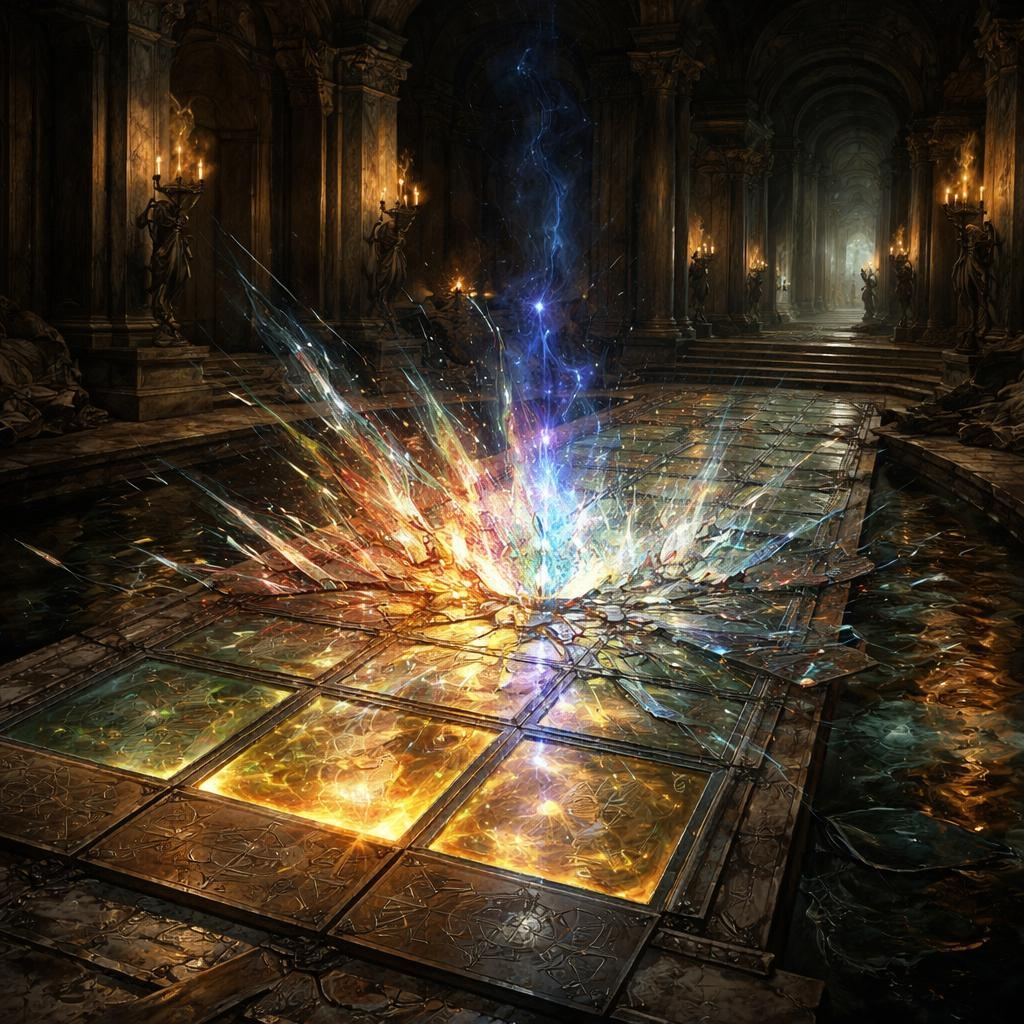
The Hall of Facets is a grand corridor carved from pale marble, its walls threaded with glass arches that catch and bend light into a symphony of refracted color. A central glass walkway crosses a shallow pool of infernal-spring water, each pane a square of crystal-clear surface etched with subtle questions and runes. When spoken aloud, a truth or a lie sets the room humming; prisms flare along the joints, and a soft lilac hum whispers from behind the glass. The truth-detection array beneath the surface hums with life, mapping every spoken word to a color—blue for honesty, amber for motive, green for intent—until a lie fractures the harmony. When deception is detected, one pane or a small strip of panes vibrates; the sound swells into a prismatic tremor, and a portion of the floor cracks into a dazzling, dangerous mosaic. Shards glitter, but they are mostly harmless unless the tremor claims a victim. The air smells faintly of ozone and wax, and the runic edges along the panes glow only when a truth is spoken.
Trap Gameplay Notes: The Glass Onion Mystery – Prismatic Truthwalk
Overview for the DM
- Type: Environmental (hybrid mechanical/magical)
- Complexity: Complex (multi-round, multi-check dynamics with detection, truth-testing, and tremors)
- Scale: Designed for a party around level 5; modulate DCs and damage up or down to fit your party
- Core idea: A truth-lensing corridor where honesty stabilizes the walkways and deception fractures them into a hazardous, prismatic tremor. Runs as a mini-encounter with detection, truth-testing, tremors, and possible disarm or bypass options.
- Trap Activation
- When it starts: The trap activates as soon as a PC steps onto the glass walkway and utters a statement that the truth-detection system evaluates as deception, or when a party member performs a truth/lie assessment about the current scene. The “Truth Prism” beneath the glass and the hidden rune-sphere begin evaluating truthfulness in real time.
- Environmental cue: The glass panes glow with shifting prism colors; a soft lilac hum rises from the wall behind the glass; faint glyphs along the pane seams brighten in cadence with spoken words.
- Scope of hazard: Only the 10-foot-wide strip of walkway currently affected by tremor becomes the hazard zone. The tremor can travel with or expand from that zone if deception recurs.
- Detection and Disarm Notes
- Detection checks (for the players)
- Perception DC 12: Noticing the prismatic sheen and subtle cracks forming in the glass even when seemingly intact.
- Investigation DC 14: Locating hidden runes beneath the glass and recognizing that truth/lie is being monitored.
- Insight DC 16: Sensing the room’s active judgment of truthfulness; a gut sense that honesty is required to keep the floor solid.
- Arcana DC 14+: Detect Magic (2nd-level or higher) reveals a concealed truth-detection aura tied to the floor and runes.
- Clues and flavor hints
- Faint prisms glow in alignment with a speaker’s truth or deception.
- A lilac-hummed resonance sounds when deception is detected.
- Some panes display inscriptions or questions about honesty and motive; a careful reader can glean when the truth will stabilize the surface.
- Disarm options (primary and alternatives)
- Primary disarm (Truth Prism disablement)
- Locate the Truth Prism behind the glass walkway housing.
- Checks: DC 15 Investigation or DC 15 Perception to pinpoint; DC 15 Sleight of Hand or DC 15 Thieves’ Tools to disengage or detach the prism assembly.
- Time: 1–2 minutes per action; multiple PCs can assist with a combined check (advantage).
- Consequences of success: The truth-detection system is disabled for 1 hour (or until a long rest). Walkways function normally; deception no longer triggers tremors.
- Consequences of failure: Tremor triggers immediately; players must succeed on a DC 15 Dexterity save to avoid hazard (or suffer the standard hazard effects). The mechanism remains in place and the hazard will reset in 1 hour unless disabled.
- Riddle-based bypass (roleplay emphasis)
- A party member can attempt to satisfy a truth-check requirement via a simple riddle on-site (e.g., answering a question about the room’s true purpose). A successful Charisma (Persuasion) or Wisdom (Insight) check at DC 14 that confirms truthfulness dampens the hazard for the next cross.
- Secondary methods (optional)
- Dispel Magic (3rd level or higher) can suppress the device for ~10 minutes; longer suppression at DM’s discretion.
- Cleric or other spellcasters with appropriate domain features can attempt to “reframe” the Truth Prism into a harmless state with similar spell-slot expenditure (DM’s discretion).
- Primary disarm (Truth Prism disablement)
- When to use which: Use primary disarm for a classic solving approach; offer the bypass for roleplay-heavy groups; allow Dispel Magic or a divine intervention for spell-focused parties.
- Complex Trap Tactics and Variations
- How to vary the challenge by party level or style
- Tighter timing (DCs raised by 1–2, damage increased by 1d6 per increment of difficulty) for higher-tension play.
- Multiple truth-detection cycles: if a deception occurs again within a minute, a second (or expanded) hazard zone activates nearby panes, creating a longer or wider tremor.
- Limited attempts: grant the party only a handful of truth/deception checks before tremors escalate or the Truth Prism resets (DM’s call).
- Social manipulation: NPCs in or near the Hall of Facets can influence or mislead a party member’s statements; use as dynamic roleplay pressure to encourage careful truth-telling.
- Quick-bypass emphasis: provide a simple riddle or clue-based bypass for groups who want puzzle-solving emphasis rather than social deception.
- Targeting and pacing considerations
- Focus on the most talkative party member during detection checks to create dramatic tension.
- If players attempt to cross with deception, the tremor should feel immediate and consequential; if they choose truth, optional hints or calm passages help them progress.
- You can stagger tremors to encourage coordination: the first tremor cracks the zone; a second deception check within the current hazard broadens the cracked area; a third detection expands the hazard further, up to an overall maximum width.
- Initiative and Round Actions (Trap as a Complex Hazard)
- Initiative setup
- Trap Initiative Bonus: +0
- The trap can operate on its own initiative as a separate hazard, or you can integrate it into the party’s initiative by treating tremors as occurring the moment deception is detected (no separate roll). If you run it with its own initiative, roll a d20 at the start of the encounter and assign the trap an initiative score; treat its turn each round as a hazard phase.
- Trap actions on its turn (each round)
- TremorPulse (primary action)
- Trigger: Occurs immediately after deception is detected on a pane or when a lie is spoken.
- Effects: Creates the hazard zone on the specified 10-foot strip; Dex save DC 15 to avoid the hazard. On a fail: 3d10 piercing damage; movement speed halved until end of the next turn; disadvantage on the next check to cross that zone.
- PrismMaintenance or Stabilize (secondary action)
- If the Truth Prism is still active, this action resolves to stabilize the current zone for one more round, potentially dampening the hazard slightly for the next crossing.
- WidenHazard (conditional action)
- If a deception check occurs again while the hazard zone is active, you may expand the hazard to a larger strip (e.g., add another 5 feet on the same axis or widen to 15 feet total) and impose an additional minor tremor for those crossing the newly affected panes.
- Cooldown/Reset (optional action)
- After a tremor, if the Truth Prism remains disabled, the hazard gradually reseals itself over 1–2 rounds (or after 1 minute in real time if you’re running the encounter without a strict round-by-round tempo).
- TremorPulse (primary action)
- Round-by-round breakdown (example)
- Phase 1 (Round 1): Activation and first tremor
- A PC’s deception is detected; the hazard zone is created (10 ft wide). Dex save DC 15; fail = 3d10 piercing; speed halved; disadvantage on next cross-zone check.
- The Truth Prism may “lock” or “begin” a cooldown; if disabled, this phase ends with no further tremor.
- Phase 2 (Rounds 2–3): Hazard persists; optional expansions
- If a new deception occurs within the hazard, roll to expand the hazard (add 5 ft or more). Players may attempt a bypass (truth-prompt or disarm) to reduce or stop hazards.
- Those crossing the zone again with previous deception face a new Dex save (DC 15) but with disadvantage on cross checks; damage is applied only if they fail again.
- Phase 3 (On-going): Maximum hazard or reset
- If the Truth Prism is still active and not disabled, the hazard can escalate to a broader area or a more intense tremor with a possible “Critical Tremor” (see variant) that deals 2d10 extra damage and imposes a longer slow.
- If the Prism is disabled, hazards end and the walkway stabilizes after a short cooldown (1–2 rounds).
- Phase 1 (Round 1): Activation and first tremor
- Environmental and dynamic hazards
- The prism colors intensify as truth is spoken; deception causes discordant color-shifting and a louder hum.
- The glass panes self-repair after tremors; a quick “reset” occurs if the Truth Prism is disabled or after a short cooldown.
- Round-by-Round Event Outline (concise)
- Phase 1: Round 1
- Trigger check occurs after a PC speaks.
- If deception detected: Tremor triggers; hazard zone (10 ft) appears; Dex save DC 15; fail = 3d10 piercing, speed halved, disadvantage on next cross.
- Truth Prism status recorded (active or being disengaged).
- Phase 2: Rounds 2–3
- Hazard zone remains active; any character crossing the damaged zone must succeed Dex save DC 15 (disadvantage on cross checks if re-entering the same damaged area).
- If deception occurs again within hazard: optional expansion to wider zone; potential second tremor.
- Phase 3: Round 4 onward
- If the Truth Prism is disabled: hazard begins to reseal; normal crossing resumes after 1–2 rounds of cooldown.
- If the Prism remains active and not disabled: escalate with a “Critical Tremor” (DM’s call) or widen the hazard; otherwise hold steady until disabled or until 1 minute passes without deception triggers.
- End-state
- Hazard ends once the Truth Prism is disabled, or after the 1-minute window, or after the party completes a bypass that dampens the hazard for crossing.
- Running the Trap Smoothly: tips
- Track deception: Keep a quick mental log of when deception checks were made and whether tremors occurred. Note which panes glow and align to the speaker to make it feel tactile.
- Use theater: Emphasize prism color shifts and the lilac hum when deception is spoken. Have a “color cue” card for players to associate with truth vs deception (cool colors for truth, shifting colors for deception).
- Manage multi-round timing: Use a round counter (Phase 1, Phase 2, Phase 3) and a timer (1 minute) for hazard window to prevent players from losing track.
- Balance for party style: If your party leans heavily into social/puzzle play, emphasize bypass options (truth prompts, riddle) and reduce raw damage. If combat-focused, offer stronger disarm options and provide a straightforward path to disable the trap.
- Clues and roleplay: Provide players with inscriptions and rune hints that point toward truthfulness and the “layers” concept. Encourage players to discuss what constitutes truth in this scenario rather than just bluffing.
- Tracking resources: If using Dispel Magic or a dedicated Truth Prism bypass, mark durations (e.g., 10 minutes for Dispel Magic; 1 hour for disabling the prism). Use common sense to handle long durations and resets.
- Quick Reference Summary (GM cheat sheet)
- Trap name: The Glass Onion Mystery – Prismatic Truthwalk
- Location: Hall of Facets, glass walkway
- Trigger: Truthfulness checks or deception detected on glass walkway
- Primary hazard: Prismatic tremor; 10-foot-wide hazard zone
- Dex save DC: 15
- Damage on fail: 3d10 piercing
- Secondary effects on fail: Speed halved until end of next turn; disadvantage on next cross-zone check
- Detection DCs: Perception 12; Investigation 14; Insight 16; Arcana 14+
- Disarm options:
- Primary: Find and disable Truth Prism (DC 15 Investigation/Perception to locate; DC 15 Sleight of Hand or Thieves’ Tools to disengage)
- Bypass: Truth-based riddle or truth-check DC 14 (Persuasion/Insight)
- Dispel Magic: 3rd-level or higher; duration ~10 minutes
- Hazard duration: Hazard zone persists for about 1 minute unless disabled
- Initiative: Trap initiative bonus +0; treat as a separate hazard with its own turn order if you prefer discrete rounds
- Complexity: Complex (multi-round encounter-like flow)
- Variants: Scale DCs and damage for higher-level play; Deadly version can add wider hazards, multiple zones, and a Critical Tremor (2d10 extra damage + longer slow)
Notes on adaptation
- If you want a gentler version, collapse the multi-round structure into a single-crossing hazard with a flat 2d10–4d10 damage range and a one-time truth/detection check; otherwise, keep the multi-round flow for the full experience described above.
- If you want a harder version, raise Dex save DC to 16–18, increase damage to 4d10–6d10, widen zones to 15 feet, and introduce chained tremors that trigger with successive deception checks within the hazard.
This set of gameplay notes should help you run The Glass Onion Mystery – Prismatic Truthwalk as a vivid, multi-round trap that rewards truthful interaction, puzzle-solving, and careful detection, while offering clear paths to disarm or bypass for varied play styles.