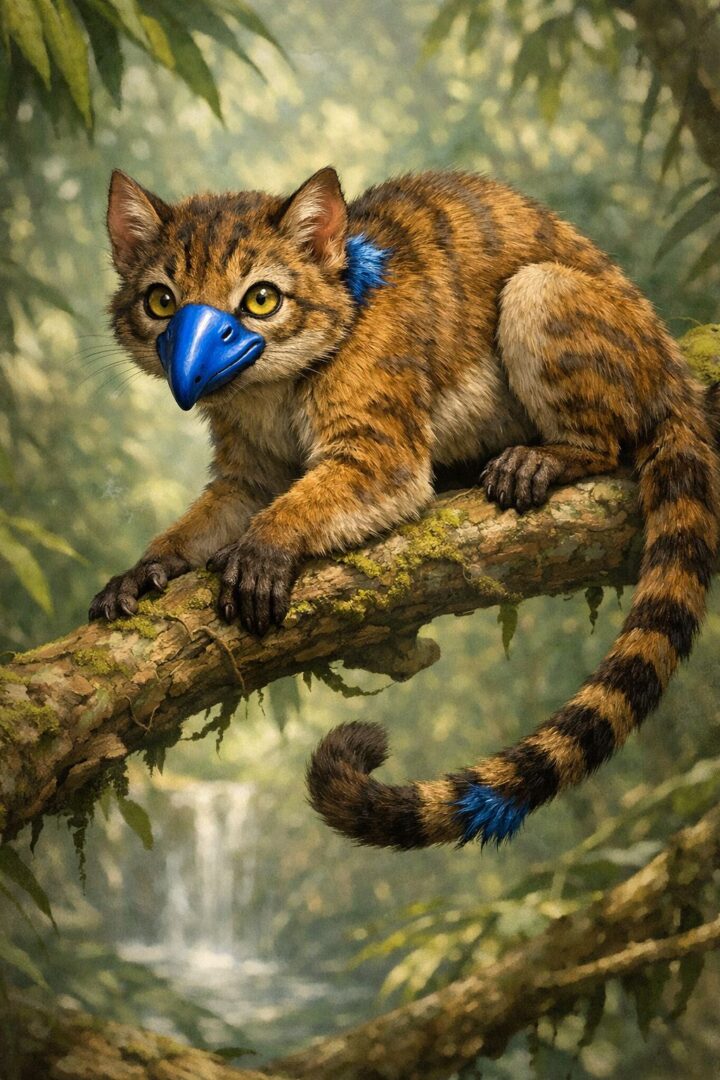

Blue-billed Cat Monkey
Tiny beast, neutral
Armor Class: 12 (natural armor)
Hit Points: 2 (1d4)
Speed: 30 ft., climb 30 ft.
Challenge Rating: 0 (10 XP)
| STR | DEX | CON | INT | WIS | CHA |
|---|---|---|---|---|---|
| 2 | 16 | 8 | 4 | 12 | 10 |
Saving Throws: None
Skills: Acrobatics +5, Perception +3, Stealth +5
Damage Vulnerabilities: None
Damage Resistances: None
Damage Immunities: None
Condition Immunities: None
Senses: Keen Hearing and Smell (advantage on Wisdom (Perception) checks that rely on hearing or smell), passive Perception 13
Languages: — (understands a few simple words and commands if tamed)
Spellcasting
“”
Actions & Abilities
Peck.: Melee Weapon Attack: +5 to hit, reach 5 ft., one target. Hit: 1 bludgeoning damage.
• The monkey uses its bill to prod, open shells, or peck at small creatures or unattended food. The attack is nonlethal by nature; a player may insist it be lethal damage but the monkey prefers to harry rather than kill.
Mischief (Snatch).: The monkey attempts to steal an unattended Tiny item (coins, keys, small gemstones, components up to 1 in. across or a weight of 1 lb. or less) within 5 feet. No attack roll is required. If the object is on a creature and not firmly held, the owner can prevent the theft with a successful Dexterity (Sleight of Hand) check contested by the monkey’s Dexterity (Sleight of Hand) or an Animal Handling check at the DM’s option.
• If the monkey succeeds, it immediately takes the item and hides it somewhere within its movement that round (up a tree, under leaves, in a pouch, etc.). Retrieving the item requires either: (a) the owner or another creature use an Action to make a DC 10 Dexterity (Sleight of Hand) check to reclaim it if they know the monkey’s approximate location, or (b) befriending the monkey (see DM roleplay options / Animal Handling DC 10).
Blue‑squawk (Recharge 5–6).: The monkey emits a loud, resonant call. Each creature of the monkey’s choice within 10 feet that is not hostile to the monkey must succeed on a DC 10 Wisdom saving throw or be distracted: the creature has disadvantage on the first attack roll it makes before the end of its next turn.
• The sound is primarily an alarm/distraction and is not intended as a direct offensive tool; it also serves as an alert to other nearby animals (useful for roleplay/stealth scenes). The monkey can choose to use this call even when not in combat.
Acrobatic Retreat.: The monkey uses the Disengage action and can move up to its speed as part of that action without provoking opportunity attacks. While using Acrobatic Retreat it can move across vertical surfaces and difficult arboreal terrain (vines, thin branches) without penalty.
• This action reflects the creature’s nimble climbing and tendency to flee rather than fight.
Fetch (Tamed Only).: The tamed monkey spends its Action to locate and retrieve a Tiny item (up to 1 lb.) it has previously seen within 60 feet. The DM may require an Animal Handling check (DC 10) for complicated fetches or to direct the monkey to a specific hiding place. The monkey will not fetch items it considers dangerous.
Appearance
A compact, lithe creature about the size of a domestic cat: a 1.5–2 ft body with an equally long, muscular prehensile tail and a weight of roughly 6–12 lbs. Its silhouette is narrow-shouldered and springy at the hips, built for long, precise leaps rather than brute force. Picture it low and coiled on a branch, tail curved like a balancing ribbon, ready to snap into a graceful bound.
Color warms the form: a tawny-to-russet coat with subtle tabby striping along shoulders and flanks and a pale cream throat and belly. The signature feature is a glossy cobalt-blue bill — smooth, slightly hooked and about 1–2 inches long — that catches light like polished ceramic. Dark brown or black rings band the tail toward the tip, and small flashes of bright blue feathers at the nape or tail base brighten the head-and-shoulder area when wet, giving a faint iridescent sheen.
Fur and feather texture is soft and fine; riverine individuals show slightly water-resistant slicking along the back. Downy feathers rim the bill and nape, shifting color as they catch light. Paw pads are leathery and callused for grip; the bill’s keratin surface bears faint growth lines and a subtle raised ridge at its base that helps project its resonant call.
The face blends feline and avian traits: large, forward-facing golden to green eyes with vertically narrow pupils, small tufted ears, a short muzzle largely replaced by the blue bill, and a compact, expressive brow. When the bill is lifted the animal’s posture reads as alert, mischievous, or intensely curious rather than threatening.
Limbs are long and dexterous: forelimbs with semi-retractile claws and a thumb-like pad for fine manipulation; hindlimbs are elongated and spring-loaded for explosive launches. The tail is a functional fifth limb — strong, tapered, with a sensitive underside able to wrap and steady on thin branches.
Movement is fluid and acrobatic: precise bounds, rapid pivots aided by the tail, ability to run along vines and hang inverted. In a striking pose for a white-background image, show the creature perched low with shoulders coiled, tail arced in a strong S, bill tipped upward and feathers at the nape flared — a vivid, well-defined profile that highlights its cobalt bill, ringed tail, and lithe, arboreal form.
No bioluminescence or overt magic; instead, iridescent feather flashes and the polished blue bill produce an almost jewel-like effect in bright light. Small, smooth pale-blue bill fragments are sometimes shed and treasured, a cultural detail to suggest rarity and value.
Tactical Information
Behavior in Day-to-Day Life
The Blue‑billed Cat Monkey is a small, acrobatic social creature whose day is shaped by three drives: curiosity, food, and social display. In the canopy a troop moves like a scattered braid of fur and blue flashes—individuals hunt insects and small amphibians, pry open snail shells and hard‑skinned fruits with that distinctive cobalt bill, and tussle over coveted shiny scraps. They forage in shifts: one or two animals will bounce along trunks and vines probing crevices with their bills, others will fidget through foliage searching for insects, and a sentry will periodically give a bright chitter or the resonant “blue‑squawk” to coordinate movement or warn of predators.
Social life is cooperative and noisy. Family groups groom, mock‑wrestle, and teach young how to grip with the tail and use the bill as a tool. Shiny objects are socially important; juveniles collect trinkets and present them to dominant animals during play or courting displays. Territorial disputes are resolved with loud displays—arched backs, flared bills, chittering—and occasional mobbing: several monkeys harry intruders by darting close, producing alarms, then slipping back into foliage.
Their temperament is boldly curious but cautious. Monkeys will approach stationary or quietly eating creatures to inspect and snatch unattended items, but they will rarely stand ground against sustained threats. Riverine populations are comfortable splashing and may forage along banks; temperate woodland variants are more reluctant about open water. They are opportunistic omnivores and efficient gleaners, spending much of the day leaping between branches, investigating scent trails, and caching small food or treasures in hollow branches.
Combat Behavior
Blue‑billed Cat Monkeys are not built for extended fights. In conflict they emphasize mobility, distraction, and escape rather than damage.
- Initial response: If a troop notices a potential threat, the sentry issues a rapid chitter and a blue‑squawk. This signal can startle nearby creatures, draw the rest of the troop, or drive off predators by imposing confusion and a flurry of movement. As the troop closes, members often attempt to intimidate by flashing their blue bills and making slashing gestures rather than immediately biting.
- Hit‑and‑run tactics: Individual monkeys use Nimble Climber and their Speed to dart along trunks and vines where larger foes can’t follow without climbing checks. They will close briefly to peck (the bill peck is meant to hurt or harass, not to kill) and then spring back beyond reach. In mechanical terms they exploit reach and vertical terrain—perching just out of reach, dropping to a lower branch to take another peck, and using Prehensile Tail to anchor while freeing a paw to snatch.
- Distraction and theft: If the group perceives an advantage, one or more monkeys will use Mischief to snatch unattended small objects—components, coins, keys—from open pouches or exposed belts as part of their movement. In combat this is a classic tactic: while five feet from a caster’s components they’ll snatch and retreat into the canopy, forcing the casters to pause or retrieve their gear.
- Alarm and confusion: The blue‑squawk is used tactically to break cohesion. In a skirmish a monkey emits this call to startle opponents (GM: treat as a minor distraction—disadvantage on the first attack roll the affected creature makes, or a brief hesitation). It’s as likely used to summon the troop as to interfere with an enemy’s actions.
- When outnumbered or pressed: They retreat fast. If injured or when a fight is going poorly, a monkey tries to flee upward or sideways through branches, using the canopy to gain separation. A troop being forced into the open will attempt coordinated harassment: several monkeys dart in to peck or snag an item, then vanish. Only if cornered and defending offspring will they escalate to bolder harassment—mobbing, throwing spoiled fruit or debris, and repeatedly pecking at vulnerable targets.
- Weaknesses to exploit: Low HP and strength make them fragile in straight fights. They rely on vertical terrain and surprises—remove access to trees and vines and they become far less effective. Loud noise, fire, or larger predators often break their morale. They are not tactically disciplined—once their path to safety is cut off, they panic and flee or become frantic thieves.
Roleplay / Narrative Interactions
The Blue‑billed Cat Monkey is primarily a social, curious creature rather than a scheming antagonist. Roleplaying them focuses on bribes, curiosity, and small bargains.
- Approach and social cues: A monkey will usually approach a calm, seated figure who is not making sudden movements or reaching for it. Food (fruit, insects, small pieces of meat) and small shiny objects will attract attention; offering either will often buy a few moments of trust. Loud, threatening gestures cause retreat and alarm calls; slow, gentle movements and chirping noises can soothe them.
- Bribery and bargaining: They respond well to trade—give a trinket and they may swap it for something even more interesting, or return an item later as a “gift.” The basic taming check is an Animal Handling DC 10: success gains a monkey’s trust and makes it more likely to stay, fetch small items, or obey a simple command. Repeated kindness reduces future DCs for tricks. A wild monkey that stole an item is most easily placated with trinkets or food; alternatively the owner can attempt to take it back by force (Sleight of Hand vs the monkey’s Stealth or Dexterity) or to track its cache.
- Communication: They use chirps, trills, the blue‑squawk, and mimicry. Some populations pick up snippets of human speech or rhythms and will repeat them, usually to solicit treats or attention. They cannot reason like humanoids, but their behavior conveys obvious motives—playful, wary, possessive, or alarmed.
- When threatened or cornered in narrative encounters: A lone monkey will try to flee; a troop will issue loud warnings and then either harass the intruder or attempt coordinated theft to create an opportunity to escape. If forced into a corner they may adopt bluffing displays—arched backs, exposed bright bills, and mock charges—hoping the larger opponent will give ground. If the PCs persist in aggressive behavior (trying to capture or hurt it), local villagers often react negatively, so PCs must weigh social costs.
- Using the monkey in story hooks: They are ideal as living plot devices—stealing a key component during a ritual; presenting a token that leads to a hidden cache; alerting a camp to an ambush. A tamed monkey can act as a scout: it will warn its handler of approaching animals with chitter and blue‑squawk, snatch small items for delivery, and fetch things from low, accessible places with a handler’s command.
- Training and domestication: A tamed monkey remains independent but affectionate. With time and food, it will perform simple tasks (fetch, deliver tiny messages, sound an alarm) and is more willing to hand over stolen goods. Advanced training (messenger duty, tricks) requires repeated care and rising DCs—treat these as downtime projects involving multiple successful Animal Handling checks and time investment.
GM tips for use in play
- Flavorful nuisance: Use monkeys to complicate scenes without escalating danger—missing spell components, a purse that no one can find, or a funny exchange of trinkets between NPCs.
- Tactical distraction: In tense encounters, allow a monkey to use Mischief to take a small component or produce a blue‑squawk that imposes a single round’s penalty or grants the party a chance to reposition.
- Social consequences: Killing or needlessly harming a Blue‑billed Cat Monkey is small in mechanical terms but can have outsized social fallout with riverfolk or herbalists who value them.
- Group encounters: A troop of 4–8 can create chaos without risking PCs: coordinated distractions, multiple snatches, and alarm calls that attract other forest fauna or villagers.
In short: the Blue‑billed Cat Monkey is best used as a living bit of color that complicates plans, rewards patience with amusing tradeoffs, and offers light tactical options—harassment, distraction, and theft—rather than brute force.